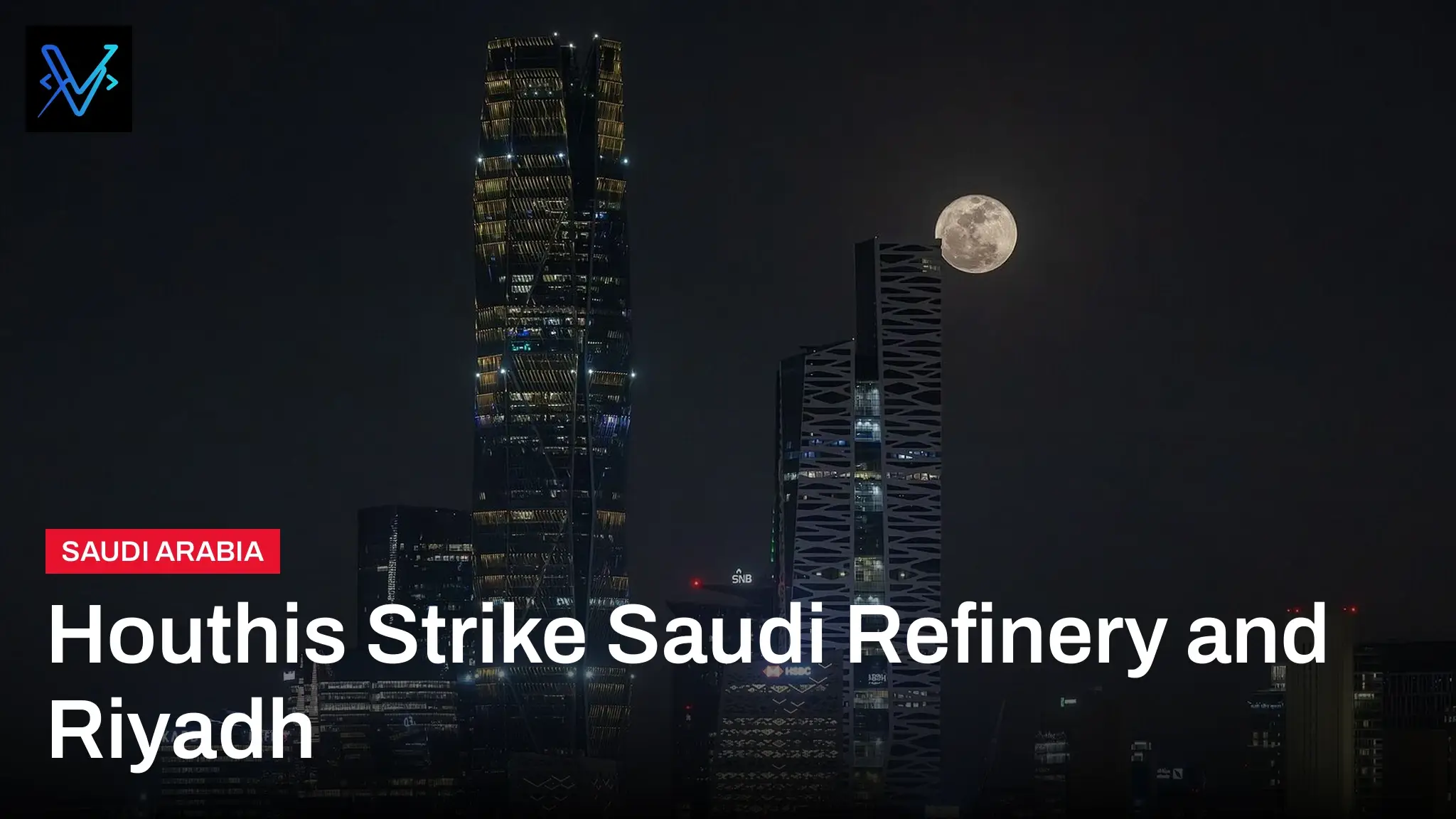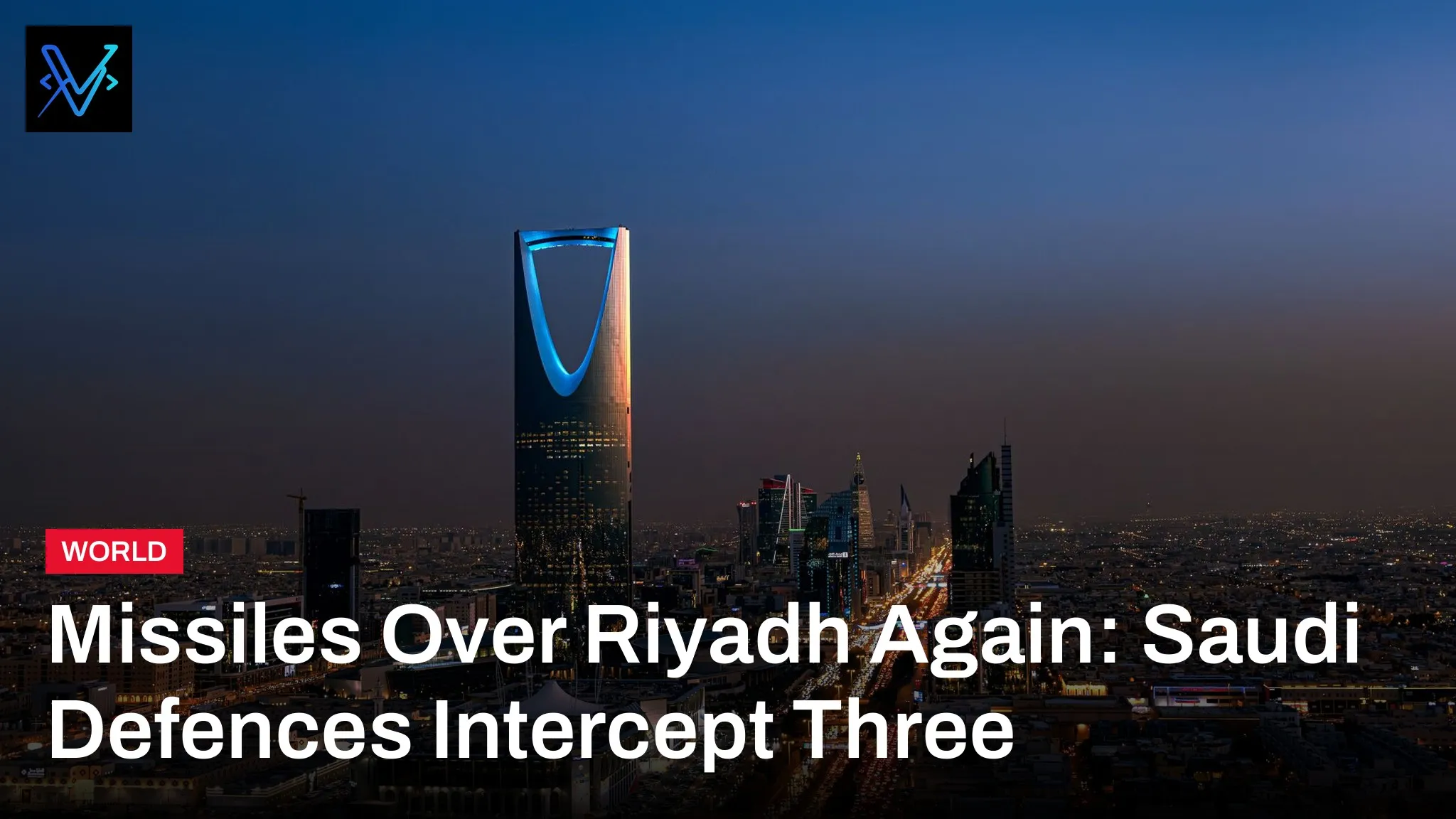
Riyadh was woken by sirens and explosions in the early hours of Saturday, as Saudi air defences intercepted and destroyed three Houthi ballistic missiles fired toward the capital. Nobody was hurt — but it was the third straight day of aerial threat alerts for the city, and the second attack on Riyadh in three days.
The salvo came two days after a suspected Houthi missile damaged the PIF Tower, the headquarters of Saudi Arabia's sovereign wealth fund and the tallest skyscraper in the city. Each day this week has answered the one before it, and the intervals between attack and counter-attack keep getting shorter.
KEY POINTS
- Saudi air defences intercepted and destroyed three Houthi ballistic missiles fired toward Riyadh early on Saturday 21 November, the Saudi-led coalition said. Civil Defence issued an alert at about 01:53 local time warning the city was "under a hostile aerial threat", then lifted it once the interceptions were complete. No casualties were reported.
- It was the third consecutive day of aerial threat alerts for the capital. Saudi Civil Defence had issued eight public emergency alerts in a 24-hour period starting at 07:30 Saudi time on Friday, and hours after Saturday's salvo the coalition said it had destroyed a Houthi drone headed toward the south of the country.
- Friday's coalition "special operation" struck the Red Sea port of Hodeidah and targets in Sanaa. The Houthis have threatened Jeddah and other Red Sea ports, warned airlines that Saudi airspace is "unsafe", and declared Riyadh's King Abdullah Financial District a "military target". The United Nations said it was following the escalation "with concern".
What happened over Riyadh
Coalition spokesman Maj. Gen. Turki al-Malki announced on X that "air defences intercepted and destroyed (3) ballistic missiles launched by the terrorist Houthi militia toward Riyadh". The announcement came after Saudi Civil Defence sent out its alert in the middle of the night and told residents the city was under a hostile aerial threat, then announced that "the danger has passed" once the engagement was over.
People on the ground heard it happen. An AFP journalist in Riyadh reported hearing two explosions after the alert went out, and a Reuters witness saw a projectile streak across the sky shortly before a loud bang, leaving a trail of smoke behind it. No source has confirmed whether the sounds were the interceptions detonating above the city or debris reaching the ground — only that nothing hit its target, and nobody was hurt.
The attack did not stop there. Hours later the coalition said it had destroyed another Houthi drone fired toward the kingdom's south. It did not say which province was targeted. Alerts were also issued on Saturday for Al-Sulayyil, Najran and Khamis Mushait, a spread of warnings that runs from the capital in the central Najd plateau down to the southern border regions — a measure of how far the Houthi missile and drone arsenal now reaches.
Three days, three escalations
The speed of the cycle is the story. Each day this week has produced a strike, a response, and then a bigger strike, all inside 48 hours:
| Day | What happened | Casualties |
|---|---|---|
| Thu 19 Nov | Suspected Houthi missile damages the PIF Tower in the King Abdullah Financial District, Riyadh's tallest skyscraper and home to the sovereign wealth fund's headquarters | None reported |
| Fri 20 Nov | Coalition "special operation" strikes Hodeidah port and targets in Sanaa; eight public emergency alerts issued across Saudi Arabia in 24 hours | None reported |
| Sat 21 Nov | Three ballistic missiles intercepted over Riyadh in the early hours; a Houthi drone headed south is destroyed hours later | None reported |
Thursday's strike was the one that changed the register. The PIF Tower is an 80-storey building at the heart of the financial district — not a border post or a military base, but the glass symbol of the kingdom's economic ambitions. The Houthis then declared the whole financial district a military target and told workers to stay away, ahead of Saturday's three-missile salvo.
Friday's strikes set it off
Saturday's missiles were, in the Houthis' own sequence, the answer to Friday. The coalition said its "special operation" hit operational capabilities at Hodeidah port that were used in smuggling operations and the transport of weapons and ballistic missiles, in al-Malki's words, along with military targets in Sanaa. Al Jazeera also reported strikes on positions in Saada and Taiz.
The Houthis responded with a volley of threats that went well beyond Riyadh. They threatened Jeddah and other Saudi Red Sea ports, warned airlines that Saudi airspace was "unsafe" — excepting the airspace over Mecca and Medina — and threatened a power station at Al-Shuqaiq and the port of Jizan. A Houthi military spokesman claimed strikes on the Al-Shuqaiq power station and Jizan port with "accurate and direct" hits causing "extensive damage"; the coalition said two ballistic missiles targeting the Jazan region were intercepted, with debris falling in Al-Shuqaiq, and whether the power station was damaged remains unconfirmed by any independent source.
Hodeidah matters for a reason that has nothing to do with missiles. It is the main way food, fuel and medicine get into Houthi-held territory, and the UN warned that continued operations around the port could jeopardise vital humanitarian supply routes. That is the other edge of this escalation: every strike on the port tightens the siege on a population already living through one of the world's worst humanitarian crises.
Why it matters
The target list tells you what the Houthis are trying to do. A sovereign wealth fund headquarters, a financial district, an international airport, Red Sea ports, the airspace above one of the world's busiest aviation corridors — these are not battlefield targets. They are the infrastructure of a country trying to present itself as open for business, and each alert chips away at that image a little further.
The tempo matters too. This is not a war that started this week. Saudi Arabia has been backing Yemen's internationally recognised government for more than a decade, in a war that was fought to a stalemate in 2022 and reignited in July. The Houthis have seized Yemen's Red Sea coast and forced the Saudi-backed forces aligned with the government to retreat to the southern port of Aden. But the campaign against Riyadh itself is new: it began in September, when smoke rose near King Khalid International Airport, and an October strike near the airport killed 13 people and wounded more than 300.
And it is the second missile crisis of the week to reach a capital city. Russian missiles landed in Poland on Friday, beside a live NATO exercise — while Trump, Xi and Putin met in Shenzhen on Thursday and signed a four-point peace declaration. Within 48 hours, missiles were falling over two capitals. The diplomacy and the fighting are no longer even pretending to be on the same track.
What to watch next
First, whether the tempo holds into Sunday. Three straight days of alerts, eight in a single 24-hour period, and a strike-and-response cycle now measured in hours rather than days — if a fourth day follows, Riyadh will be living under something close to a standing air-raid routine.
Second, what Riyadh does next. The coalition's answer to Thursday's PIF Tower strike was Friday's operation at Hodeidah; the answer to Saturday's salvo is not yet visible. The Saudi Foreign Ministry has condemned the attacks and said the kingdom reserves the right to take the measures necessary to defend itself. Whether that means more strikes on the ports, or a wider campaign, will set the shape of the coming week.
Third, the airspace question. The Houthis' warning to airlines is the threat with the widest reach: if carriers start rerouting around Saudi airspace, the disruption spreads far beyond the cities under alert. So far there is no sign of that happening. But the warning itself, repeated twice in two days, is designed to make airlines — and their insurers — do the maths.
For now, the capital is back to normal on the surface, and the alerts have been lifted. But a city that has spent three nights listening for sirens does not forget the sound quickly — and neither do the markets, the airlines, or the diplomats watching from the sidelines.
Looking to grow your business online? Explore Vertex Agency at vertexagency.in for professional website development, Meta Ads and social media growth.
Sources: Reuters — Saudi Arabia says it intercepts three Houthi missiles targeting Riyadh; Al Jazeera — Saudi-led coalition intercepts three Houthi missiles headed for Riyadh; House of Saud — Coalition Intercepts 3 Houthi Missiles Over Riyadh.