UPDATE — 8:56 PM IST, November 25, 2026: The PCE report this explainer was waiting for has landed — and it came in hot. US inflation rose to 3.8% in October, core PCE beat forecasts at 3.3%, and traders now price a December Fed rate hike at around 97%. Stocks tumbled, with the Nasdaq down 3.3% in early trading. Read the full breakdown here.
No — at least, nobody can honestly say that yet. What has happened is more specific, and more important: the market has stopped taking the artificial intelligence build-out on trust. For two years, every new spending announcement sent AI stocks higher. Now good earnings send them lower, borrowing costs are flashing red, and the question hanging over Wall Street is the one investors keep asking out loud — is this a bubble, and is it bursting? The numbers behind the doubt are very real. So is the case against panic. Here is the whole picture, in one place.
KEY POINTS
- The five biggest US hyperscalers — Alphabet, Amazon, Meta, Microsoft and Oracle — will spend more than $800 billion on AI infrastructure in 2026, up 94% on 2025, and the Brookings Institution projects US investment in AI will exceed $10 trillion between 2025 and 2032.
- The doubt has three parts: spending is outrunning cash, with Alphabet, Amazon and Meta all posting negative free cash flow in the third quarter; debt is piling up, with big tech borrowing $214 billion in 2026 against $83 billion in all of 2025; and circular deals — 176 of them, worth $3.6 trillion — blur how much of the demand is real.
- The market’s verdict this week is brutal but not final: Nasdaq futures fell 2% on Wednesday, Nvidia fell about 5% before the open and Anthropic dropped below its $83 IPO price — yet the S&P 500 still trades at 17.7 times forward earnings, its cheapest valuation in more than three years.
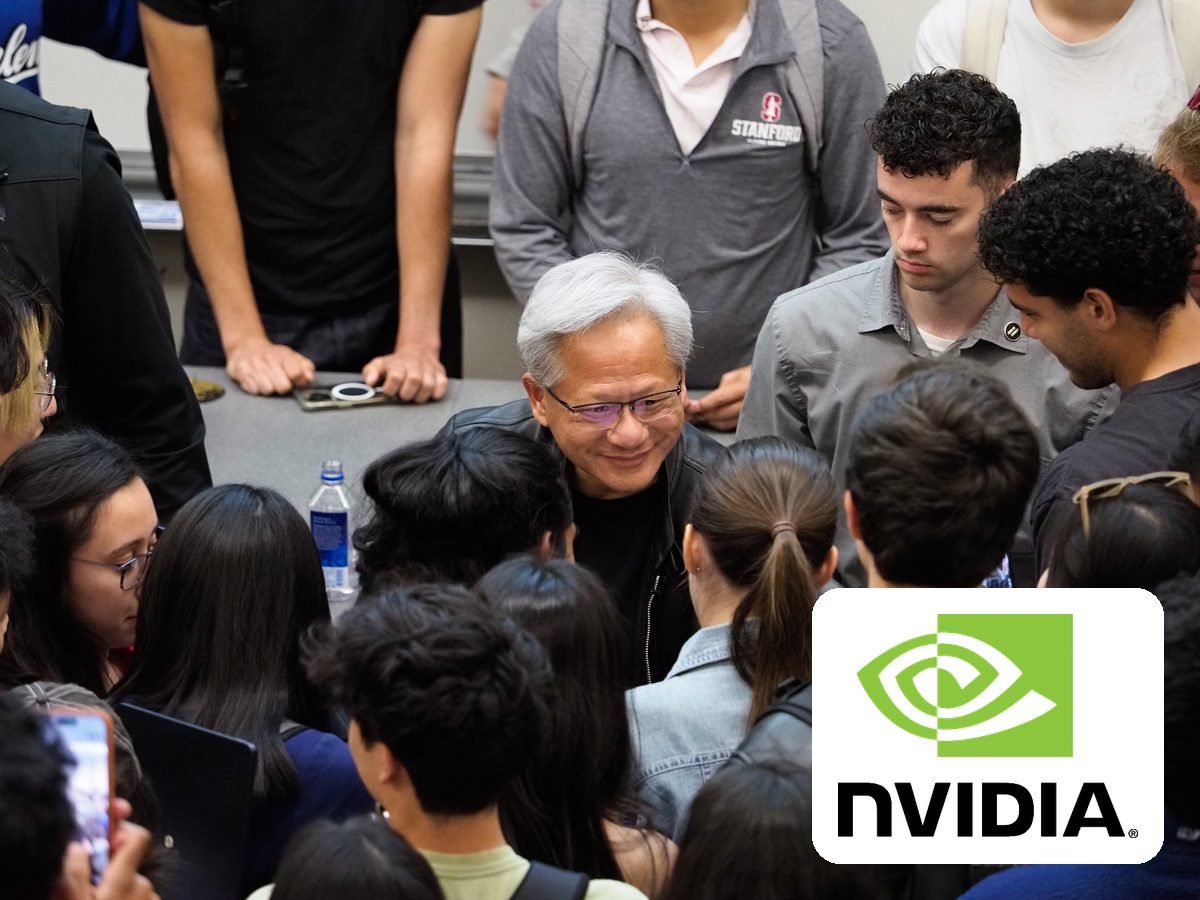
Nvidia chief executive Jensen Huang with students after a talk at Stanford University in April 2026. Nvidia sits at the centre of the AI trade — and of the bubble debate. (Photo: Anders Eidesvik / Wikimedia Commons, CC BY 4.0; Nvidia logo: Wikimedia Commons, CC0)
The week in 60 seconds
The sell-off did not start this week. It has been building since late October, when third-quarter earnings disappointed and the S&P 500 slumped, then dropped a further 4.4% after the Democrats’ big gains in the midterm elections. But the last three days have been the wildest of the year. On Monday, Nvidia surged more than 30% after its board reinstated Jensen Huang as chief executive, and the Nasdaq jumped 6.5% — Wall Street’s best day since April. By Tuesday, traders were taking profits: Nvidia gave back 5.9%, the Philadelphia semiconductor index fell 7.9%, and Anthropic dropped 6.5% to close below its $83 IPO price, five days after the biggest listing in history.
Wednesday was worse. SoftBank plunged 13.8% in Tokyo, leading a rout across Asian chip stocks, and Nasdaq futures fell 2% before the US open, with Nvidia down about 5% in premarket trading and Anthropic down a further 5.6%. The Dow, meanwhile, has been the odd one out: it rose 0.85% on Tuesday to close above 50,000 for the first time, as money rotated out of tech and into the rest of the market. As Kyle Rodda, senior market analyst at Capital.com, put it to Reuters: “Wall Street pared its Monday advance as sobriety returned to the market and a focus returned to fundamentals.”
| Stock / index | Move | What it signals |
|---|---|---|
| Nvidia | +30% Monday, −5.9% Tuesday, ~−5% premarket Wednesday | The Huang comeback rally has already faded |
| Philadelphia semiconductor index | −7.9% Tuesday | The whole chip supply chain is being repriced |
| Anthropic (ANT) | Closed $81.90 Tuesday, below its $83 IPO price; −5.6% premarket Wednesday | The last pricing anchor of the AI IPO market has failed |
| SoftBank | −13.8% in Tokyo on Wednesday | OpenAI’s biggest backer is now the trade’s weakest link |
| Dell | −7.2% Wednesday despite raising forecasts | Good earnings no longer lift AI stocks |
| HPE | −16.3% Tuesday despite raising its outlook | Same story: beat and raise, shares fall anyway |
| Dow Jones | +0.85% Tuesday, first close above 50,000 | This is a rotation out of AI, not a rush for the exits |
The bet: $800 billion and counting
Start with the scale, because it is what makes this different from every previous technology boom. The five largest US hyperscalers — Alphabet, Amazon, Meta, Microsoft and Oracle — estimate they will spend $800 billion or more on data centres, chips and other AI-related infrastructure this year, a 94% increase over 2025, according to the Council on Foreign Relations. A September 2026 report from the Brookings Institution projects that US investment in AI and related equipment will exceed $10 trillion between 2025 and 2032 — an average of 3.6% of GDP every year. The last time a new industry’s expansion made up such a large share of the American economy was during the railroad boom of the late nineteenth century. As Roger Ferguson, the Council’s distinguished fellow for international economics, put it: the AI boom “may be one-and-a-half to three times bigger, as a percentage of GDP, than was true in other technology booms. We haven’t ever seen anything quite like this.”
The spending is still rising. Company guidance tracked by Kurums puts the four calendar-year hyperscalers at roughly $700–735 billion of capital expenditure in 2026, nearly double the $416 billion-plus they spent in 2025 — and Amazon and Alphabet both say 2027 will be higher still.
| Company | 2026 spending guidance | Latest quarter | Cash-flow signal |
|---|---|---|---|
| Amazon | ~$220 billion; 2027 “meaningfully more” | $77.3 billion in Q3 2026 | Trailing free cash flow −$42.4 billion |
| Alphabet | $195–205 billion (raised twice in 2026) | $51.4 billion in Q3 2026 | Negative free cash flow in Q3; cloud revenue +103% |
| Microsoft | ~$175 billion (calendar 2026) | $39.4 billion in fiscal Q1 2027 | Quarterly free cash flow $18.6 billion |
| Meta | $135–145 billion | $34.91 billion in Q3 2026 | Q3 free cash flow −$2.12 billion |
| Oracle | ~$40 billion of financing planned for fiscal 2027 | $28.5 billion in the quarter to August 2026 | Free cash flow −$5.4 billion; negative for over a year |
That table is the whole argument in miniature. The spending is enormous, it is still growing, and — for the first time — it is running ahead of the cash that pays for it. In their third-quarter earnings reports, Alphabet, Amazon and Meta all posted negative free cash flow: the money left over after paying operating costs and capital expenditure. Amazon’s trailing twelve-month free cash flow is now an outflow of $42.4 billion, against an inflow of $14.8 billion a year earlier. Meta’s quarterly capital spending of $34.91 billion exceeded its operating cash flow of $32.79 billion. Oracle has been cash-negative for more than a year.
The debt problem
When cash flow turns negative, companies borrow — and they are borrowing at a pace the market has never seen from businesses this large. Alphabet, Amazon, Meta and Microsoft have borrowed a combined $214 billion so far in 2026, up from $83 billion for all of 2025, according to the Council on Foreign Relations. The bond market is starting to charge for the risk. The yield on CoreWeave’s bonds due 2031 has risen to almost 18% as prices fell to near record lows, Reuters reported on Wednesday, and the cost of insuring tech companies against default has jumped sharply, with five-year credit-default-swap spreads at Oracle, Alphabet, SpaceX and CoreWeave hitting record levels.
The pressure is worst at the edges of the trade, among the so-called neocloud providers — smaller companies that rent out specialised AI computing capacity, funded largely with debt. They have been under pressure since October over the borrowing behind their rapid expansion, and on Wednesday CoreWeave and Nebius Group each fell about 6%, while IREN, Applied Digital and Core Scientific lost more than 4%. The Democrats’ victory in the midterm elections has added to those worries, with investors weighing the prospect of a data-centre slowdown from tougher AI regulation and more hurdles to construction.
“The leading frontier AI labs have a ‘whatever it takes’ approach to spending to win the AI race,” Rebecca Patterson, a Council on Foreign Relations senior fellow, told the Council. “What we’ve seen recently, though, is that financial markets are growing more skeptical about ‘whatever it takes.’ The growing use of debt to finance the AI build-out, alongside questions about the timing and degree of revenue, is pushing up the cost of debt for many AI-related firms.”
The circular money
The second thing spooking investors is harder to see, and harder to dismiss: a large and growing share of the AI economy appears to be companies buying from each other. The practice is called circular financing — AI firms buying and selling infrastructure among themselves and lending each other vast sums in exchange for future purchase commitments. Sona, a London-based asset manager, identified 176 unique AI-related circular financing deals worth $3.6 trillion in the past three-and-a-half years, according to the Council on Foreign Relations. That interconnectedness inflates demand for AI products and can obscure financial vulnerabilities, in a way the Council compares to the housing market before the 2008 financial crisis.
Nvidia sits at the centre of many of these deals — as chip supplier, investor and lender to its own customers — which is one reason its stock has swung so violently. The company lost roughly $1.7 trillion in market value after the scandal that forced Huang out in early November, then gained back more than $900 billion in a single day when he was reinstated. The full story of those eleven days is here.
The bull case is that the demand is real and contracted: Amazon says its AWS capacity is sold out for 2026 and largely sold out for 2027, and the backlogs are staggering — $578 billion at AWS, $677 billion at Microsoft (up 73%) and $664 billion at Oracle, which signed a reported $300 billion agreement with OpenAI in September 2025 for about 4.5 gigawatts of capacity over five years. The bear case is that those backlogs are concentrated in a handful of AI labs, and that if one or two of them cannot pay, the whole chain wobbles. As Kurums puts it, the test is not headline spending but the quarterly change in guidance and backlog: raised guidance with rising backlogs signals durable demand; flat backlogs alongside rising spending signals risk.
Who is sounding the alarm
The warnings are coming from people with serious track records. Former SEC chair Gary Gensler recently warned that artificial intelligence had already formed a stock market bubble that could burst and trigger a recession before the 2028 presidential election, telling CNN he was concerned about the massive amount of money being invested in AI infrastructure, particularly the growing reliance on debt and complex financing deals. Michael Burry, the investor who predicted the collapse of the US housing market in 2008, has warned that technology companies are spending too much relative to the profits they are likely to earn: “It is just an asset bubble, plain and simple,” he wrote earlier this year. “This, all of it, is the scene of the bloody car crash, minutes before it happens.”
Jeremy Grantham, co-founder of investment firm GMO, wrote in a research paper earlier this year: “The rule from history is that great technological innovations lead to great bubbles.” Investment manager John Hussman believes the S&P 500 could eventually fall between 50% and 75% when the bubble bursts. One valuation metric the bears keep citing is the cyclically adjusted price-to-earnings ratio, which divides stock prices by average inflation-adjusted earnings over the past decade: it topped 40 in six consecutive months this year, a level last seen when the dot-com bubble burst in 2000.
The case for calm
None of that is wrong. But the other side of the argument has numbers too, and they are worth hearing before anyone concludes the crash is inevitable.
First, valuations are not what they were in 2000. The cyclically adjusted ratio the bears cite is backward-looking: it does not account for future earnings growth, which matters enormously for a transformative technology. The forward-looking measure tells a different story. The S&P 500’s forward price-to-earnings ratio topped 25 as the dot-com bubble built momentum in the late 1990s, and stayed above 22 until early 2001. Today it trades at 17.7 times forward earnings, according to FactSet — the cheapest valuation in more than three years, and a discount to the ten-year average of 18.9. That does not sound like a bubble, though it depends on companies meeting Wall Street’s earnings estimates.
Second, adoption is genuinely fast. The Federal Reserve Bank of St. Louis found that generative AI reached 55% of US adults aged 18 to 64 approximately three years after ChatGPT launched. At comparable stages, personal computers and the internet had adoption rates of just 20% and 30% respectively. And the economic benefits are already measurable: Klarna estimates its AI assistant does the work of 853 full-time agents, delivering $58 million in annual cost savings, and Federal Reserve researchers estimate generative AI may have increased aggregate labour productivity by as much as 1.3% since ChatGPT’s introduction.
Third, the revenue is real, even if it is smaller than the spending. Google Cloud revenue more than doubled in the third quarter, up 103% to $30.7 billion. Azure grew 48%. AWS grew 39%. Nvidia itself reported quarterly revenue of $115.84 billion and forecast $130 billion for the current quarter. The question is not whether anyone is making money from AI — it is whether they are making enough, fast enough, to justify $800 billion a year of spending.
The dot-com comparison
Every bubble debate ends up at the same place: 2000. Is this the dot-com crash again? The honest answer is that it rhymes, but it is not the same poem.
The similarities are real. A transformative technology, a winner-take-all race that encourages overinvestment, valuations built on orders that have not yet turned into profits, and a financial system finding creative ways to fund it all. Ferguson, at the Council on Foreign Relations, is blunt about the risk: “It’s too early to declare this as inevitably a boom that’s going to burst. On the other hand, one can’t deny that it’s moved very quickly, and there are, to be blunt, some companies that will probably go under because their financial models prove to be unsustainable.”
The differences matter too. The companies investing in AI are much larger and more profitable than the start-ups that fuelled the internet bubble — Amazon, Alphabet and Microsoft are among the most profitable businesses on earth. The inputs are multipurpose: the chips, data centres and power infrastructure being built for AI can be used for a variety of technologies beyond it. And AI has been adopted more quickly than the personal computer or the internet. “Even if the AI boom faces financial setbacks, it’s a fundamentally revolutionary technology, and it’s just not going to go away,” Ferguson said. The dot-com crash destroyed companies; it did not destroy the internet. The same is likely to be true here: the question is not whether AI survives, but which companies and investors pay for the excess.
What it means if you own the market
For most people, this is not an abstract debate about chip stocks. The AI boom has become the American economy’s growth engine, and its wobble reaches into pension funds and retirement accounts. US stock portfolios have roughly doubled in value since 2022, according to the Council on Foreign Relations, and in 2026 the ten largest AI stocks in the S&P 500 accounted for about 50% of the index’s gains. Bloomberg estimates that excluding the import discount on AI equipment, US growth in 2025 would have been 3.1%, higher than the 2.3% officially reported. The build-out has also created around one million US jobs, mostly in data-centre construction.
But the benefits have not been evenly distributed. Many lower-income households have not benefited from the stock market rally and continue to struggle with high inflation and energy prices, as well as slow wage growth. And the productivity gains that are supposed to justify the spending could come at the expense of employment: a September 2026 McKinsey study found AI could displace between six million and sixteen million American workers over the next decade, particularly in entry-level and clerical roles. The market’s rotation this week — the Dow above 50,000 while the Nasdaq slides — is, in part, investors pricing in exactly that unevenness: money moving from long-duration AI bets toward businesses whose cash flows are certain today.
What to watch next
The next 48 hours will say a lot. The US personal consumption expenditures report — the Federal Reserve’s preferred inflation gauge — is due at 8:30 a.m. ET on Wednesday, with economists expecting core prices to have risen 3.2% in October, up from 3.1% in September. A hot number would strengthen the case for a December rate rise, and higher rates are poison for long-duration AI bets. US markets are closed on Thursday for Thanksgiving, with a shortened session on Friday, so traders have a compressed window to reassess before the weekend.
Beyond this week, five things will settle the argument. First, the next round of earnings and, more importantly, the next round of spending guidance: if the hyperscalers keep raising their budgets while backlogs keep growing, the bull case holds; if guidance flattens while spending stays high, the bears gain ground. Second, the credit markets: watch CoreWeave’s bond yields and the credit-default-swap spreads at Oracle, Alphabet and the neoclouds. Third, politics: with Democrats about to take control of Congress, the data-centre build-out is expected to become “much more limited and much more constrained,” in the words of the Council’s AI fellow Vinh Nguyen, and the administration’s new tariff findings against 16 trading partners could raise the cost of the imported equipment the build-out depends on — about 90% of AI inputs originated in East Asia in 2025. Fourth, the physical constraints: backlogs of two to ten years for memory chips and power-grid equipment, and a shortage of the electricians and skilled workers needed to build data centres. And fifth, Nvidia itself: Huang faces transcribed interviews with three House committees on December 1, and the questions about the chips, the money and the company’s accounting are still unanswered.
The Council’s verdict, for now, is the one worth keeping: experts agree it is too early to tell whether the AI boom will go bust, and much will depend on whether demand for AI keeps up with the massive amounts of money companies are investing in it. Patterson put the optimistic version this way: “My question is more around how quickly and why it slows. If it’s gradual and happens alongside growing revenues, that will be easier for financial markets and the economy to absorb.” A gradual slowdown alongside growing revenue is a correction. A sudden stop is a crash. The market spent this week trying to work out which one it is looking at — and it has not decided yet.
Looking to grow your business online? Explore Vertex Agency at vertexagency.in for professional website development, Meta Ads and social media growth.
Sources
- Council on Foreign Relations — Boom or Bubble? Understanding AI and the U.S. Economy (Nov 23, 2026)
- Reuters — AI stocks slide on fears over infrastructure buildout costs (Nov 25, 2026)
- Dow Jones via Morningstar — Nasdaq Futures Slide as AI Growth Fears Return to Center Stage (Nov 25, 2026)
- Kurums — AI Capex Supercycle: Big Tech Data Center Spending
- Motley Fool — Is the Stock Market Really in an AI Bubble? Wall Street's Doomsayers Are Ignoring Crucial Facts (Nov 18, 2026)