Wall Street’s biggest celebration in years lasted exactly one day. AI stocks fell sharply on Tuesday as the rally sparked by Jensen Huang’s return to Nvidia reversed: Nvidia dropped about 8% after surging 31.5% on Monday, the Philadelphia Semiconductor index fell 9.2%, and the Nasdaq Composite lost 2.47% by late morning — because putting Huang back in charge does not settle the hawkish Federal Reserve, sticky inflation, or the governance questions now hanging over the world’s most important AI company. Losses eased into the afternoon, and the Dow Jones Industrial Average actually rose, underlining that this was a narrow tech unwind rather than a market-wide panic.
KEY POINTS
- Nvidia fell 8.4% on Tuesday after surging 31.5% on Monday and adding nearly $1 trillion in market value; the Philadelphia Semiconductor index dropped 9.2% after jumping more than 14% a day earlier.
- The sell-off stayed inside tech: defensive sectors rose, advancing stocks outnumbered decliners, and the Dow held roughly flat — a rotation out of AI names, not a broad flight from risk.
- The next tests come within hours: Dell reports earnings after Tuesday’s closing bell, and Wednesday’s PCE inflation report is the last major data release before the Fed’s December meeting, where traders are fully pricing in a 25-basis-point rate hike.
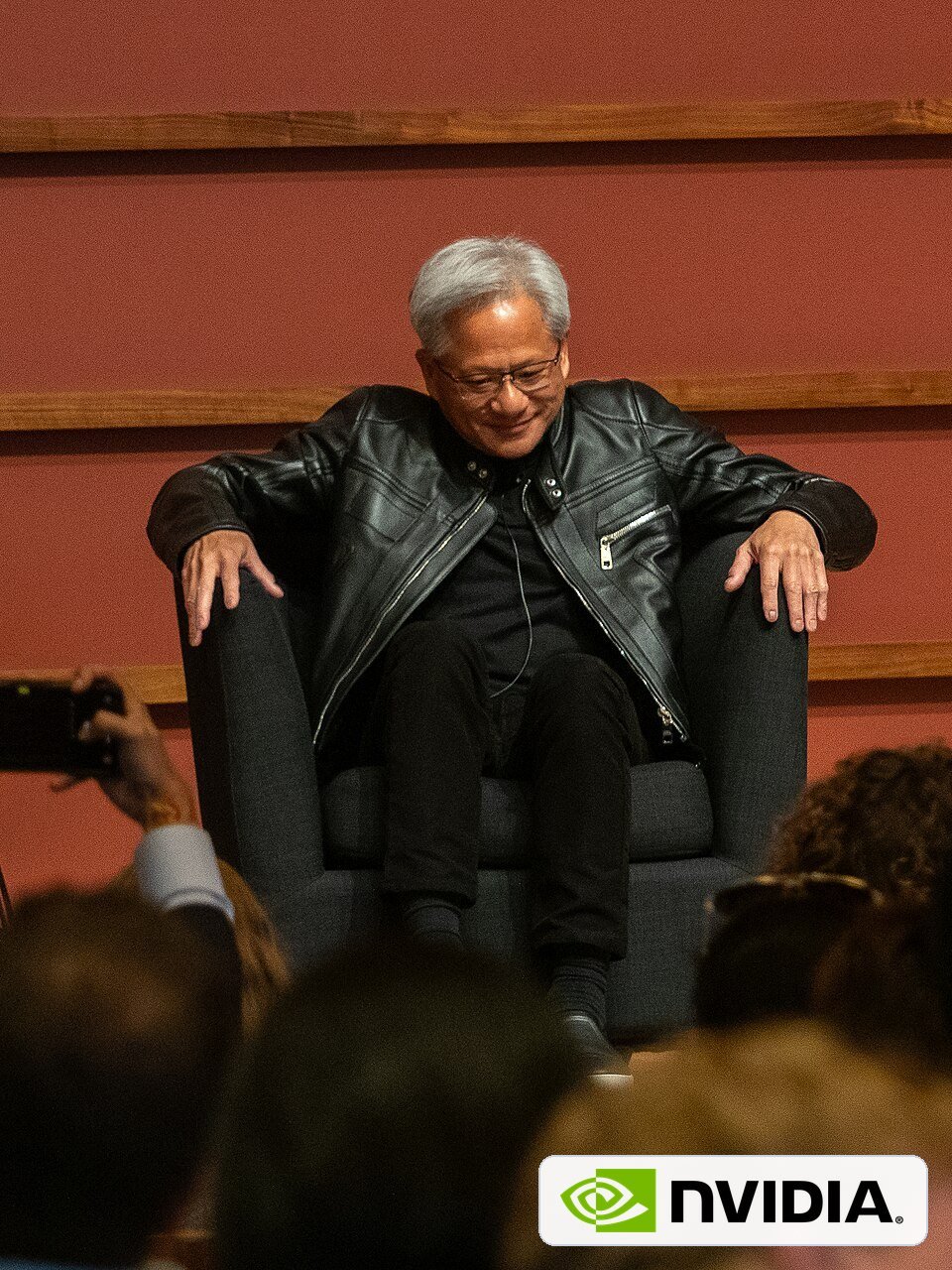
Jensen Huang, co-founder and chief executive of Nvidia. Photo: Anders Eidesvik / Wikimedia Commons (CC BY 4.0); Nvidia logo via Wikimedia Commons
What happened on Wall Street today?
Monday’s session was historic: the S&P 500 jumped nearly 5% and the Nasdaq more than 6% — the indexes’ biggest one-day gains since April 2025 — after Nvidia’s board reinstated Huang as chief executive, capping an 11-day saga that had knocked almost a third off the stock. Tuesday gave a large slice of it back. By 11:36 a.m. ET, the Nasdaq Composite was down 594 points at 23,493.83, the S&P 500 was down 1.20% at 7,150.51, and the Dow was fractionally higher at 49,635.67. The S&P 500 information technology index fell 3.4%, the worst of any sector, while healthcare and consumer staples rose as investors looked for shelter.
Why did the rally unravel so fast?
Because the problem was never only who runs Nvidia. “Oil prices, the hawkish Federal Reserve, inflation — just bringing Jensen Huang back doesn’t solve any of that,” Robert Pavlik, senior portfolio manager at Dakota Wealth, told Reuters. Three pressures collided. First, governance: Huang’s reinstatement followed input from senior US government officials, drawing criticism from Senator Elizabeth Warren and fresh questions about board independence and the company’s compliance with export controls on chip sales to China — the full background is in our explainer on the Nvidia scandal and Huang’s 11-day comeback. Second, monetary policy: New York Fed President John Williams struck a hawkish tone on Monday, and traders are now fully pricing a 25-basis-point rate hike in December, with even a slim chance of 50 basis points, according to CME’s FedWatch tool. Third, the old doubt never went away: before Monday’s rebound, AI stocks had slid for weeks as investors questioned the sector’s debt-fuelled spending and what it will earn.
Which stocks were hit hardest?
The falls were steepest where Monday’s gains had been wildest. Neocloud firms CoreWeave and Nebius each gave back about 13%, Hewlett Packard Enterprise plunged 15.7% as investors focused on margin pressure despite a sharply raised fiscal 2027 outlook, and Dell fell 11.9% hours before its own earnings report. Anthropic — whose debut was supposed to rekindle the AI trade — tumbled 13.4% to $76, further below its $83 IPO price, dragging its big backers Amazon and Alphabet down about 2% each. Not everything fell: discount retailer Dollar Tree gained 11.3% after raising its annual profit forecast, and US consumer confidence hit its highest level in nearly two years in November, according to the Conference Board.
| Stock / index | Tuesday move | The context |
|---|---|---|
| Nvidia (NVDA) | −8.4% | +31.5% on Monday, adding nearly $1 trillion in value |
| Philadelphia Semiconductor Index | −9.2% | Jumped more than 14% on Monday |
| CoreWeave / Nebius | about −13% each | Neocloud names that surged on Monday |
| Hewlett Packard Enterprise | −15.7% | Margin worries despite a sharply raised FY2027 outlook |
| Dell Technologies | −11.9% | Reports earnings after Tuesday’s close |
| Anthropic (ANT) | −13.4% to $76 | Further below its $83 IPO price |
| Dollar Tree | +11.3% | Raised its annual profit forecast |
Index levels as of 11:36 a.m. ET, Tuesday November 24 (Reuters). Afternoon trading later pared some losses: the Nasdaq was down 1.7% and the Dow up 0.7% in recent trading.
What happens next?
The next 48 hours are crowded. Dell’s earnings land after Tuesday’s closing bell and will be read as a health check on AI server demand; Wednesday brings the PCE price index, the Fed’s preferred inflation gauge and the final major release before the December 8–9 policy meeting. US markets then close on Thursday for Thanksgiving, with a shortened session on Friday. Beyond the data, Huang is expected to face congressional questions over export-control compliance in the coming days, keeping the governance story — and the volatility — alive. Bitcoin, often a rough gauge of risk appetite, told the same story as the chip stocks: it slipped to about $59,700 after bouncing above $64,000 overnight.
For investors, Tuesday’s lesson is that a leadership headline can move a trillion dollars in a day, in both directions — but it cannot repeal interest rates, inflation prints, or an unfinished investigation. Looking to grow your business online? Explore Vertex Agency at vertexagency.in for professional website development, Meta Ads and social media growth.