Two Russian missiles and a drone came down in south-eastern Poland in the early hours of Friday, landing within a few dozen kilometres of a major NATO-allied military exercise. Nobody was hurt and nothing was damaged — but Warsaw is calling it a deliberate provocation, not an accident.
Polish Prime Minister Donald Tusk said the timing left little room for doubt. "We are dealing with an intentional provocation," he told reporters, adding that it "does not seem to be a coincidence" that the weapons landed near the training ground where troops from 11 countries are rehearsing a possible postwar mission in Ukraine.
KEY POINTS
- Two Russian missiles and a likely jet-powered drone crashed in south-eastern Poland early on Friday 20 November, during one of Russia's heaviest overnight barrages on Ukraine since the full-scale invasion began.
- A Kh-101 cruise missile came down near Nowy Lipowiec, about 50 kilometres (31 miles) from the Ukrainian border, around 06:30 local time; the other objects fell near Rudnik nad Sanem and Mołodycz. No one was hurt and no damage was reported.
- Prime Minister Donald Tusk called the incident "an intentional provocation", and NATO Secretary General Mark Rutte called it a "grave violation" of Polish airspace. Rutte is due in Warsaw on Saturday 21 November, and Poland is asking NATO for more air-defence forces on its eastern flank.
What fell, and where
The first weapon down was the one Polish officials can describe with the most confidence: a Kh-101, Russia's long-range air-launched cruise missile, which crashed in open farmland near the village of Nowy Lipowiec in the Biłgoraj district, about 50 kilometres (31 miles) from the Ukrainian border, at around 06:30 local time. A local resident told the BBC she heard "a whistle and a dull impact" as she got her children ready for school. Firefighters said the wreckage burned itself out, 200 to 300 metres from the nearest homes.
Two more objects followed. A second missile — Polish officials believe it was also a cruise missile — came down near Rudnik nad Sanem, to the west. Fragments of a third object, described by Defence Minister Władysław Kosiniak-Kamysz as most likely a jet-powered drone, were recovered near Mołodycz, about 30 kilometres from the border.
| Object | Where it came down | Distance from Ukraine border |
|---|---|---|
| Kh-101 cruise missile | Nowy Lipowiec, Biłgoraj district | About 50 km (31 miles) |
| Second missile | Near Rudnik nad Sanem | Not specified; roughly 35 km (22 miles) from the Nowa Dęba exercise area |
| Likely jet-powered drone | Near Mołodycz | About 30 km (19 miles) |
Jets were already in the air
Poland was not caught unawares. Its armed forces had been on heightened readiness since Thursday evening as Russia's bombardment of Ukraine built up, and at about 03:30 on Friday it scrambled jets and activated air defences — roughly three hours before the Kh-101 hit Nowy Lipowiec.
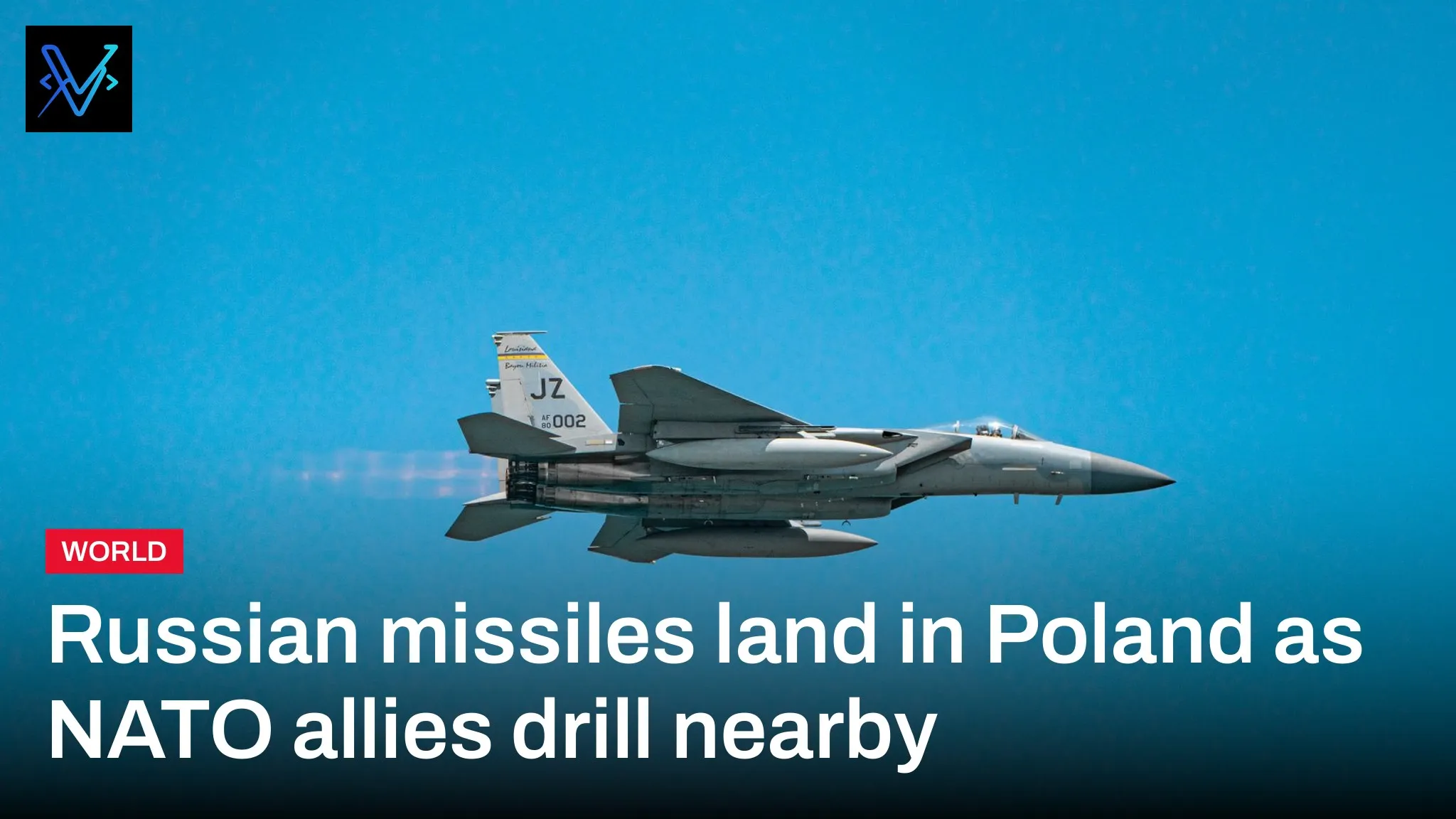
Polish F-16s and Swedish JAS 39 Gripens patrolled through the night, joined by a Dutch A330 tanker and other allied aircraft, while Patriot batteries near Rzeszów and Świdnik were switched on. Even so, all three weapons crossed the border. Warsaw says that failure is exactly why it needs more allied air-defence assets, and Kosiniak-Kamysz said he would ask Rutte for reinforcements under Operation Eastern Sentry, the NATO mission launched in 2025 to guard the alliance's eastern flank against drones.
The exercise next door
What makes the timing so charged is what was happening a short drive away. Thousands of European troops are in the middle of Koalicja 2026, a two-week, UK- and France-led exercise that began on 9 November at the Nowa Dęba training ground in south-eastern Poland. Soldiers from 11 countries in the Coalition of the Willing are rehearsing a possible postwar stabilisation mission in Ukraine — the force that might one day help secure the country and rebuild its military once the war ends.
One of the missiles came down roughly 35 kilometres (22 miles) from the drills, according to officials cited by the Associated Press. Five defence ministers — from the UK, France, Estonia, Lithuania and Poland — toured the training ground hours after the strike. The exercise is continuing.
Kosiniak-Kamysz wrote that the overlap in time and place was "hard to regard" as a coincidence. Tusk went further, saying NATO partners agreed with him that it did not look like an accident. President Vladimir Putin has said Russia would treat any European troops deployed to Ukraine after a peace deal as legitimate targets.
A night of heavy bombardment
The incursion came during one of the largest Russian air attacks of the war. More than 400 drones and over 110 missiles, 27 of them ballistic and some carrying cluster warheads, were fired at Ukraine overnight, according to President Volodymyr Zelenskyy. At least eight civilians were killed and more than two dozen wounded, including six dead in Kyiv, where apartment blocks, medical facilities, warehouses and three bridges were hit.
Russia also struck power plants, substations and transmission networks, forcing Ukraine's three operational nuclear power plants to cut generation and bringing emergency outages in 11 regions, according to Deputy Energy Minister Artem Nekrasov. Moscow said the sites it hit were linked to Ukraine's military, including a missile-assembly facility, a rocket-fuel components plant and a drone-assembly plant.
The barrage followed Ukraine's strikes this week on the Kerch Bridge, the link between occupied Crimea and the Russian mainland. Putin had warned on 19 November, after meeting Donald Trump and Xi Jinping in Shenzhen, that Russia's response would be "far more painful". Zelenskyy said on Friday that Russia launched the attack "following weak meetings in China and the actual failure of (Putin's) attempt to somehow 'redraw' the world."
Why it matters
This is not the first time Russian weapons have landed on Polish soil. A cruise missile left a 10-metre crater in Poland in July 2026 during an attack on Lviv, and Poland requested NATO consultations under Article 4 of the alliance treaty after Russian drones crossed its airspace in September 2025. But Friday's incident is the most pointed yet: three weapons, not one, landing beside a live allied exercise, a day after a summit that was supposed to be about ending the war.
It also lands at an awkward moment for the diplomacy. Trump discussed the war with Putin and Xi at the trilateral summit in Shenzhen on Thursday, and his envoy Jared Kushner told European leaders the US believes Russia is "comfortable" with NATO-like security guarantees for postwar Ukraine. Hours later, Russian missiles were falling on NATO territory. The US-led talks are expected to continue, but no date has been set for a next meeting, and both sides are still bombing each other in the meantime.
For NATO, the test is practical as much as political. Article 5 — an attack on one member is an attack on all — is not automatic; it requires a political decision by the allies. What Poland is asking for right now is narrower and more immediate: more jets, more air defences, more surveillance on its eastern border. Rutte's visit on Saturday will show how quickly the alliance answers.
And for the markets, it is one more source of strain in a brutal week. The Nasdaq erased its entire 2026 gain on Friday as the AI selloff deepened — a reminder that geopolitics and markets are no longer moving on separate tracks.
What to watch next
First, Rutte's visit to Warsaw on Saturday and what Poland actually gets: the specific assets — AWACS-type aircraft, F-35s, more Patriot batteries — will tell the world how seriously NATO is taking the incursion.
Second, Moscow's response. Russia had made no public comment on the incident as of Friday evening. Whether it acknowledges the strikes, denies them, or says nothing at all will shape how European capitals read the message behind them.
Third, the investigation. Polish investigators are still examining the wreckage, and prosecutors have confirmed the Kh-101 was Russian ordnance. Any further detail — flight paths, launch points, whether the weapons were deliberately steered — will determine whether this stays a "provocation" in Warsaw's telling or becomes something the whole alliance has to answer together.
Looking to grow your business online? Explore Vertex Agency at vertexagency.in for professional website development, Meta Ads and social media growth.
Sources: Associated Press (via EuropeSays) — Warsaw says a Russian missile crash in Poland is a provocation as Ukraine allies hold drills; SOFX — Russian Missiles and Drone Crash in Poland During Overnight Barrage on Ukraine.