Iran fired missiles and drones at American military positions in Bahrain late on Saturday night, setting fire to a civilian industrial facility, while two oil tankers were struck near the Strait of Hormuz. Nobody was reported hurt in any of the incidents — but the night marked a sharp widening of a Gulf war that is now in its ninth month.
KEY POINTS
- Iran's Revolutionary Guards said they launched a combined missile-and-drone attack on US positions at the al-Riffa and Awali bases in Bahrain, claiming they destroyed two US Patriot air defence radars. The US military has not confirmed the claim.
- Bahrain said an Iranian attack hit a civilian industrial facility, starting a fire. Civil Defence teams worked through the night to contain it; there were no injuries, and the facility was not named.
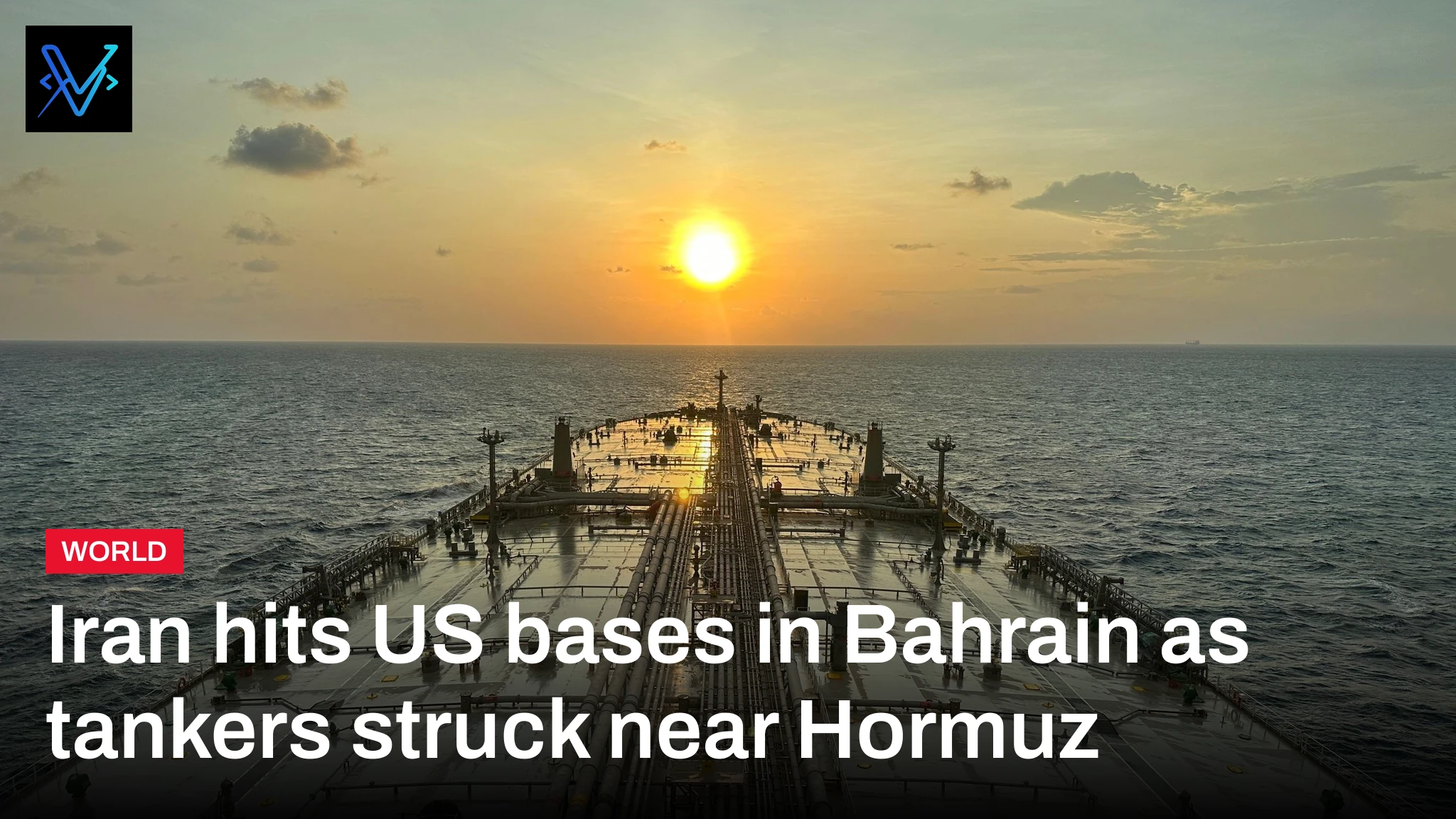
- Two tankers were hit in or near the Strait of Hormuz, the waterway that carried about a fifth of the world's oil before the war. No casualties were reported on either vessel.
| Saturday night, at a glance | What is known |
|---|---|
| Target in Bahrain, per Iran | US positions at al-Riffa and Awali bases; two Patriot radars claimed destroyed (unconfirmed) |
| Damage in Bahrain, per Manama | Civilian industrial facility hit and on fire; material damage, no injuries; smoke seen over Sitra Island |
| Tankers near Hormuz | Two vessels struck, one by an unknown projectile and one in its engine room; no casualties. A third ship reported on fire after Iran said it hit a mine |
| Bahrain's defences | Air defences intercepted a number of incoming attacks; falling shrapnel caused material damage |
| War's start | US and Israeli strikes on Iran began on February 28, 2026 |
Source: Reuters, Bangkok Post / AFP, Al Jazeera, November 21–22, 2026.
What happened in Bahrain
The evening began with sirens. Bahrain's Interior Ministry issued an alert telling residents to move to the nearest safe place because of a potential threat, without saying what it was. It then issued an all-clear — and then a second alert.
Soon after, the ministry said an Iranian attack had hit a civilian industrial facility. "As a result of the heinous Iranian aggression, a civilian industrial facility was targeted, causing a fire at the site. Civil Defence is working to bring the fire under control," it posted on X. It did not name the site or say where it was, though residents told AFP they saw smoke rising over Sitra Island, on Bahrain's east coast, home to several industrial sites including a refinery run by the state oil company Bapco.
Bahrain's Defence Force said its air defences had intercepted a number of Iranian aerial attacks, and that shrapnel from the interceptions caused material damage but no casualties. It accused Tehran of continuing its "systematic hostile approach" towards the kingdom.
Bahrain is no bystander in this war. It hosts the US Navy's Fifth Fleet, and it has been attacked repeatedly since the fighting began — including three drone attacks in recent days after a lull of several weeks.
Two very different accounts
What makes Saturday night hard to read is that the two sides described different attacks.
Iran's Revolutionary Guards said their aerospace force had carried out a combined missile-and-drone operation against US military positions at the al-Riffa and Awali bases. "Two radars belonging to the US Army's Patriot air defense systems… were struck," the statement said, adding that any violation of Iranian airspace would be met with a "harsh and decisive response". The Guards presented the attack as retaliation for what they called repeated violations of Iranian airspace, saying two US MQ-1 and MQ-9 drones had entered it.
But Iran's own semi-official Fars news agency named different targets — Sheikh Isa and Juffair, the bases used by US forces — and Iranian state news agency IRNA offered yet another version, reporting that an interceptor missile launched from the US Fifth Fleet base had crashed on Sitra Island and started a large fire, blaming a recurring malfunction in the Patriot system.
US Central Command did not immediately respond to a Reuters request for comment on the Guards' account, and the claim about the Patriot radars has not been independently confirmed. For now, the only damage either side's account agrees on is the burning industrial facility.
The tankers in the Strait of Hormuz
While Bahrain was under attack, the war's other front flared in the waterway that matters most to the world economy. The British maritime agency UKMTO said on Saturday that one tanker was struck by an "unknown projectile" while transiting the Strait of Hormuz, and that another tanker was hit in its engine room. "There are no reported casualties at this time," it said.
Iran's army later reported that a ship was on fire after entering a "restricted zone" and hitting a mine in the strait. The tanker had switched off its identification and navigation systems "in defiance of issued warnings and maritime transit regulations", it said in a statement carried by state TV. Tehran has repeatedly reported ships catching fire in the strait in recent weeks, often claiming they struck mines — though the US military recently said it had cleared all mines from the main routes through the waterway.
The strait carried about a fifth of the world's oil before the war. The US military has been escorting ships through it, while maintaining its own counter-blockade of Iranian ports — and US Central Command said last month that it had helped Gulf countries export 1.5 billion barrels of oil via Hormuz since the summer. Every tanker hit there is a reminder of how thin the margin is between a regional war and a global energy shock.
Why it matters
Saturday's attacks hit both halves of the Gulf's security equation in a single night: American forces stationed in the region, and the shipping lane the world's oil depends on. That combination is what makes this different from the weeks of lower-level exchanges that came before it.
The pattern around the Gulf is widening, not narrowing. Saudi defences have spent the week shooting down Houthi ballistic missiles over Riyadh, and Bahrain has now been hit three times in a matter of days. The Gulf Arab states, drawn into a conflict that began with US and Israeli strikes on Iran on February 28, are absorbing attacks on their own soil.
For readers in the US, UK and Europe, the most immediate consequence lands on Monday, when oil traders return to their desks. Friday's market rout already erased the Nasdaq's gains for the whole of 2026; a fresh escalation around Hormuz is the last thing jittery markets need. Iran also said on Saturday that it shot down a US drone over Qeshm Island in the strait, and American fighter jets struck an Iranian missile site on Qeshm last Tuesday, according to a US military official — a tit-for-tat that is running in parallel with the strikes on Bahrain.
The diplomacy running alongside
None of this is happening in a diplomatic vacuum. A Qatari delegation visited Tehran on Friday evening and held two hours of talks, according to Iranian deputy foreign minister Kazem Gharibabadi. Foreign Minister Abbas Araghchi said on Saturday that "the ongoing talks in the region must be given a chance, and the blockade must be lifted rationally" — while adding that "as long as Iran's demands are not met, the discussion on the Strait of Hormuz and its opening is pointless".
Iran's demands, as Araghchi has stated them, are sweeping: ending the war on all fronts, unfreezing Iranian assets, lifting oil sanctions and ending the US counter-blockade of Iranian ports. Gharibabadi said on Saturday that Tehran considers the economic blockade an act of war, and Washington's "economic asphyxiation" campaign, announced in August, is aimed at curbing Iran's trade and financial flows.
Meanwhile the war's costs are showing up at home in Iran. President Masoud Pezeshkian said US and Israeli strikes on Iran's energy infrastructure had worsened energy problems, "and we should therefore expect difficulties this winter". The head of the national electricity company said the country would impose rolling power cuts from Sunday, citing fuel supply conditions. Araghchi also reiterated that Tehran would not allow its stockpiles of enriched uranium to leave the country — "we have clear red lines", he said — the nuclear question that sits underneath all of it. The contrast with the first Trump-Xi-Putin trilateral summit could hardly be sharper: great-power diplomacy in one room, a widening war in another.
What to watch next
Three things will tell us where this goes. First, whether US Central Command responds to the radar claim — silence so far leaves the most dramatic part of Iran's account unverified. Second, what happens to oil when markets open on Monday, and whether shipping through Hormuz slows or reroutes. And third, whether the Qatari mediation produces anything concrete, or whether Saturday night was the start of a new, harder phase of the war.
The one certainty from Saturday is that the lull is over. Bahrain's residents went to sleep twice in one night to air raid alerts, a civilian facility burned, and two more tankers were hit in the world's most important oil waterway. The war that began in February has not stayed where it started — and after Saturday, it is closer to everyone's doorstep than it was on Friday.
Looking to grow your business online? Explore Vertex Agency at vertexagency.in for professional website development, Meta Ads and social media growth.
Sources: Reuters — Bahrain says Iranian attack hits industrial facility as air defences intercept attacks; Bangkok Post (AFP) — Bahrain says Iran struck industrial site as tankers hit in Hormuz; Al Jazeera — Bahrain says Iranian attack causes fire at industrial facility. Photo: Punit Singh / Pexels.