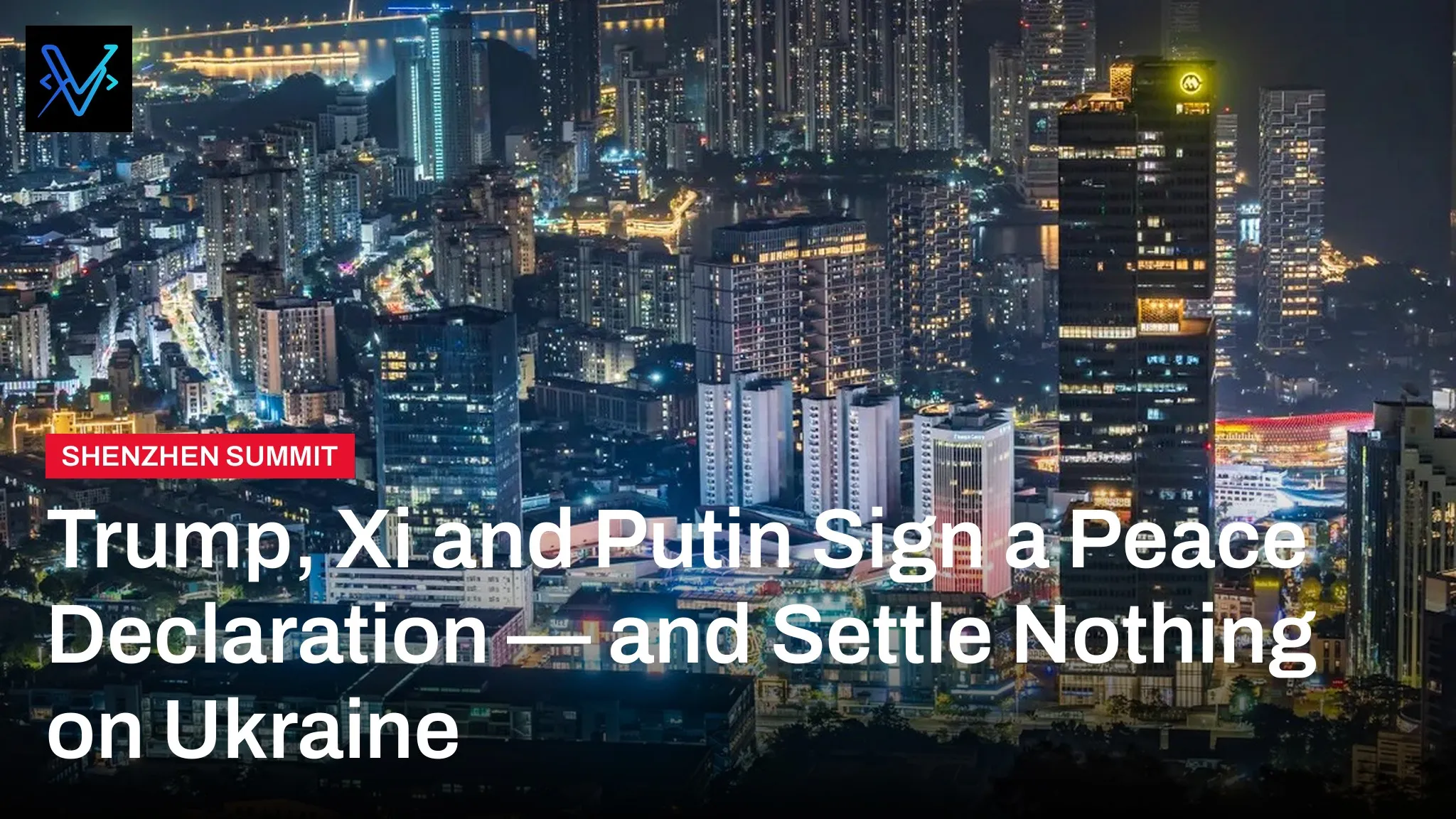
Donald Trump, Xi Jinping and Vladimir Putin ended the first-ever trilateral summit of the leaders of the United States, China and Russia on Thursday with a four-point joint "peace declaration" — and no agreement on Ukraine, Iran or nuclear arms limits. The three leaders met for about 1 hour and 45 minutes at Kylin Villa in Shenzhen, on the sidelines of the APEC summit, after the session began nearly two hours late.
KEY POINTS
- Donald Trump, Xi Jinping and Vladimir Putin held the first-ever trilateral summit of the three countries' leaders on Thursday in Shenzhen, meeting for about 1 hour and 45 minutes at Kylin Villa on the sidelines of APEC after starting nearly two hours late.
- The talks ended with a four-point joint declaration — UN reform, more refined oil supply, limits on the International Criminal Court's reach and a dialogue on reducing nuclear risks — published by China's state news agency Xinhua at 6:55 p.m. local time.
- The declaration settles nothing on the wars: it names neither Ukraine nor Iran, sets no nuclear arms cap, and no date was fixed for the nuclear-risk dialogue or a next meeting. Trump flew back to Washington without speaking to reporters.
| Point | What the declaration says |
|---|---|
| United Nations reform | The three permanent Security Council members commit to reforming the UN so it can respond more effectively to global challenges. |
| Energy supply | Increase the production and supply of refined petroleum products for all countries, reaffirming the importance of stable energy flows. |
| Courts and immunity | State consent and respect for the immunities of state officials are paramount, and the ICC and similar bodies "must not abuse their jurisdiction". |
| Nuclear risk | Reaffirmed that "a nuclear war cannot be won and must never be fought", and the three countries will hold a dialogue on reducing nuclear risks and preventing proliferation. |
Source: the joint declaration as published by Xinhua and released by the Kremlin, via Reuters and Yonhap.
What happened in Shenzhen
The meeting was the first of its kind, as set out in our preview of the summit's agenda: never before have the leaders of the United States, China and Russia sat down together in a three-way format. The session had been due to start at 2:30 p.m. local time. It began at 4:16 p.m., nearly two hours late, and ended at 6:01 p.m., with the three men seated around a large round table in a grand hall at Kylin Villa, a government retreat beside a lake outside Shenzhen, the flags of all three countries standing around them.
Trump spent the day in one-to-one meetings first. He sat with Putin for about 40 minutes — the war in Ukraine dominated that conversation, according to Russian state news agency TASS and Kremlin foreign policy aide Yuri Ushakov — and then with Xi for more than an hour. Xi had greeted Trump at Shenzhen airport on his arrival, the first time he has done so for a visiting leader since becoming president, and the two briefly hugged.
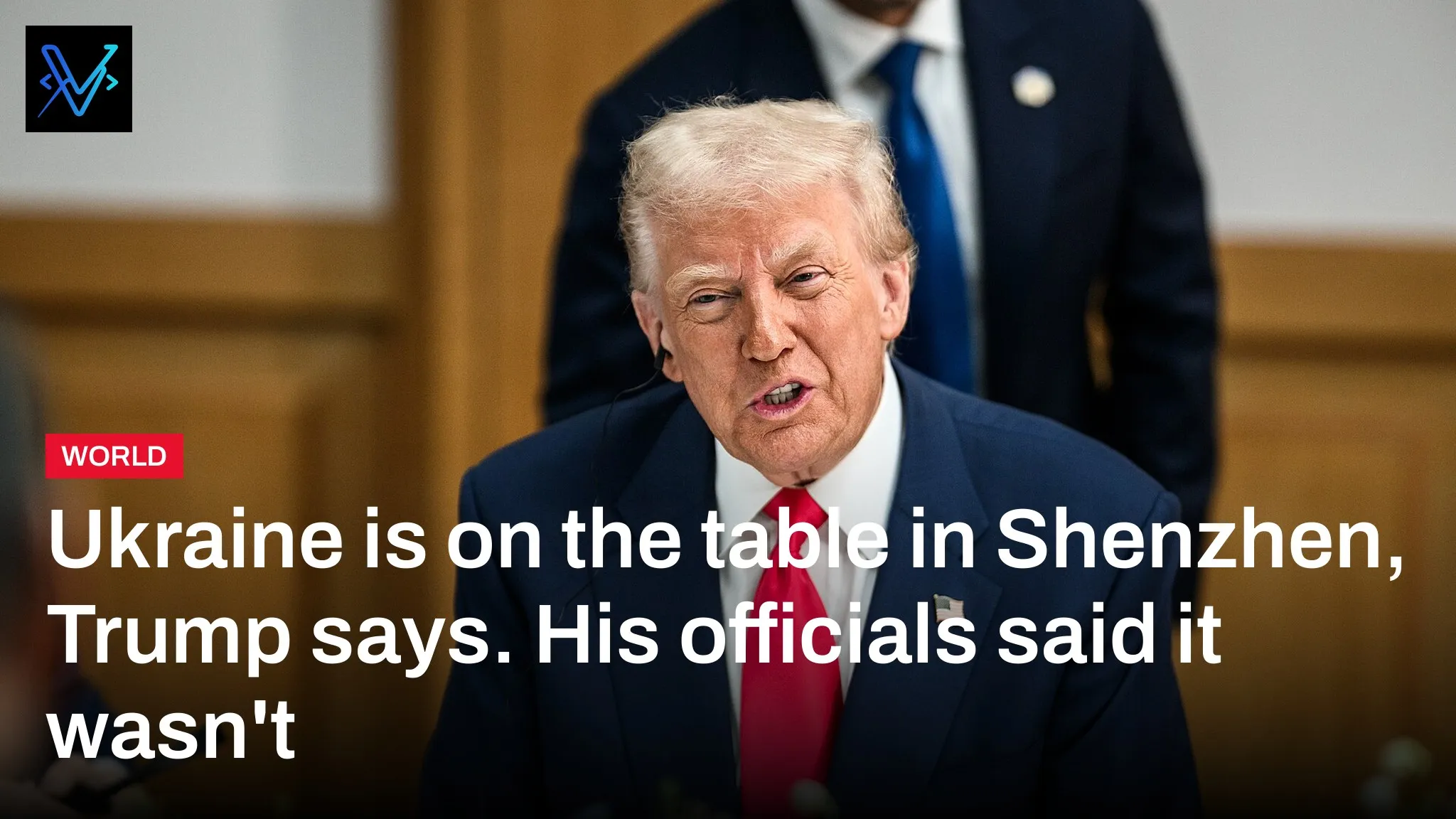
Once the three were together, Xi opened by saying that good relations between major powers were "not a matter of choice, but a mandatory requirement". Trump said the United States would not let Iran have a nuclear weapon, and that the three countries were "uniquely positioned to discuss how to reduce the number of nuclear weapons and to lessen the risk" — while warning that "it's not an easy thing to give up nuclear weapons". Putin said all three countries shared an interest in ending the war in Ukraine. Trump later said of the gathering: "We are really making history."
What each leader said on nuclear weapons
Nuclear weapons were the subject Trump had insisted on putting at the centre of the meeting, and the opening remarks showed how far apart the three sides remain. Xi went further than either of the other two, calling for nuclear weapons to be "comprehensively banned and thoroughly destroyed", describing them as a "sword of Damocles" hanging over humanity and saying "every effort must be made to prevent nuclear war".
Trump, speaking before the session, said the three countries were "uniquely positioned to discuss how to reduce the number of nuclear weapons and to lessen the risk", while warning it was "not an easy thing to give up nuclear weapons". Putin proposed discussing global and regional economic ties and food and energy security, and said the three countries had "numerous shared interests in the settlement of regional conflicts, including obviously the conflict in Ukraine".
The declaration's fourth point is the closest the three came to common ground on the subject: a reaffirmation that "a nuclear war cannot be won and must never be fought", and a promise to hold a dialogue on reducing nuclear risks and preventing proliferation. It names no cap, sets no timetable and creates no working group. New START, the last treaty capping the US and Russian strategic arsenals, lapsed in February, leaving the two largest arsenals without a limit for the first time in more than half a century.
What was not agreed
For all the history made by the photograph, the declaration settles none of the conflicts that filled the agenda. It names neither Ukraine nor Iran, and it makes no mention of North Korea's nuclear weapons programme or the denuclearisation of the Korean Peninsula, despite its language on proliferation. No trade agreement came out of the trilateral session, and no nuclear arms treaty was signed.
The court point is the declaration's most pointed passage. The three leaders said the consent of states and respect for the immunities of state officials are of paramount importance, and agreed the International Criminal Court and similar bodies "must not abuse their jurisdiction". The court has an arrest warrant out for Putin over Russia's full-scale invasion of Ukraine in 2022. The energy point — a joint promise of more refined fuel supply — is aimed at steady prices and stable flows from three of the world's largest producers and consumers.
Nothing was said about when — or whether — the three leaders will meet again, and no date was set for the nuclear-risk dialogue the declaration promises. The leaders made no statements to the media after the meeting, and Trump left Shenzhen for Washington soon after the talks ended. The speculated meeting between Trump and North Korean leader Kim Jong-un did not materialise during the president's visit to China.
The one concrete result came before the trilateral
The day's clearest outcome was agreed in the Trump–Xi meeting held before the three-way session. The Globe and Mail, CNBC and Bloomberg reported that the two leaders agreed to extend the trade truce between their countries. Neither side said how long the new extension runs, or on what terms — and China's own readout of the Xi–Trump meeting mentioned no extension details.
The truce agreed in Busan in October 2025 had been due to run until 10 January 2027, after tariffs between the two countries peaked at 145 percent on the American side and 125 percent on the Chinese side. In the bilateral, Trump also said the United States and China shared an interest in energy flowing through the Strait of Hormuz and in Iran not having a nuclear weapon, while Xi raised Taiwan and told Trump the US must "do the right thing" to avoid major setbacks in the relationship.
Why it matters
The declaration is the first thing the three leaders have ever signed together, and its most substantial point is the last one: a promise to talk about reducing nuclear risks. It is a dialogue, not a deal. No caps were agreed, no treaty was signed, and the arsenals of the United States and Russia remain uncapped while China, with more than 600 warheads against more than 5,000 in each of the American and Russian stockpiles, has shown little appetite for joining talks that would limit its own build-up.
The unease beyond the room was real, and it has not gone away. Ukraine's president, Volodymyr Zelenskyy, warned in October that he did not want the meeting to become a new Yalta, the 1945 conference where Roosevelt, Churchill and Stalin carved up the post-war world. "We really don't want this to turn into 'Yalta 2, 3, 4,' with a redistribution of influence," he said. Allies in Europe and Asia worried that Trump might present proposals on Ukraine or Taiwan as wins, without Ukraine or Europe in the room. The summit was always more about the photograph than the outcome: the White House, the Kremlin and Beijing all said in advance that no agreement was likely, and analysts described the meeting as a first conversation rather than a place where deals get signed.
What to watch next
Three things now matter more than the declaration's wording. First, whether the promised nuclear-risk dialogue gets a date, a format and a working group — without those, the fourth point is only a sentence. Second, the terms of the US–China trade truce extension, which neither side has disclosed, and whether the broader trade talks meant to follow it get a date. Third, the separate readouts: with no joint press appearance, the White House, the Kremlin and Beijing will each put their own gloss on the day, and the gaps between those accounts will show where the real disagreements sit. The wars in Ukraine and Iran go on, and the declaration the three leaders signed says nothing about either of them.
Looking to grow your business online? Explore Vertex Agency at vertexagency.in for professional website development, Meta Ads and social media growth.
Sources: Reuters (via Business Day); Yonhap (via K-Vibe); World Pulse Wire; joint declaration as published by Xinhua and released by the Kremlin.