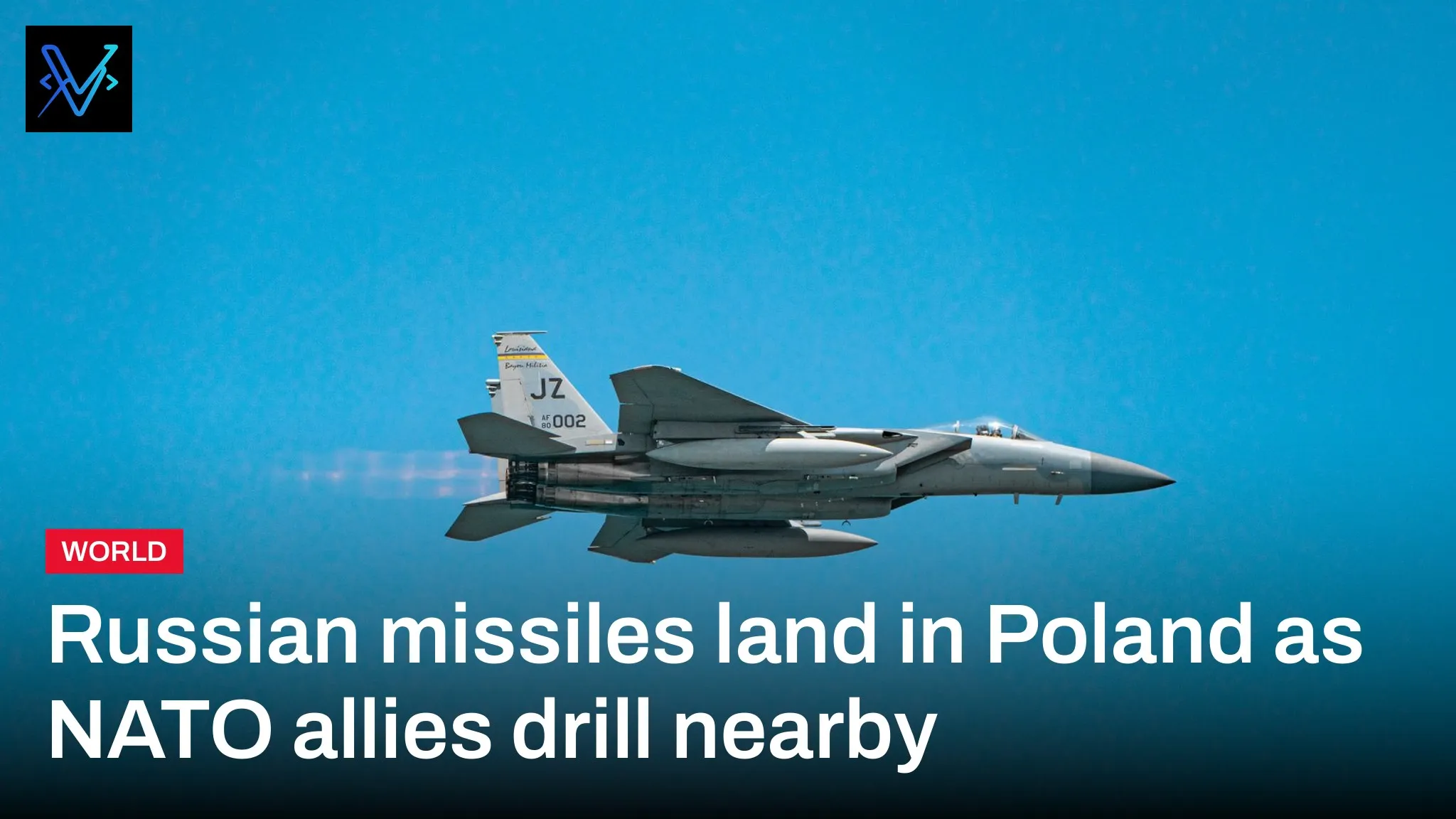
Two suspected Russian missiles and a jet-powered drone came down in south-eastern Poland on Friday, landing within a few dozen kilometres of a military exercise involving troops from 11 allied countries. Nobody was hurt — but NATO's chief flew to Warsaw the next day and promised the alliance would defend "every inch" of Polish territory.
KEY POINTS
- Two suspected Russian missiles and a jet-powered drone landed in south-eastern Poland on Friday — a Kh-101 cruise missile near Nowy Lipowiec, a second suspected missile near Rudnik nad Sanem, and the drone near Molodycz. No injuries or structural damage were reported.
- Poland's prime minister, Donald Tusk, called the incursion an apparent intentional provocation timed to coincide with a Coalition of the Willing exercise at Nowa Deba, involving about 2,800 troops from 11 countries. Russia has not commented.
- NATO Secretary General Mark Rutte visited Warsaw on Saturday and promised the alliance would defend "every inch" of Polish territory. The NATO Council meets in Brussels on Monday; Poland has asked for more air-defence assets but has not invoked Article 4.
| Friday in Poland, at a glance | What is known |
|---|---|
| What crossed into Poland | Two suspected Russian missiles and a jet-powered drone |
| Where they landed | Nowy Lipowiec (Kh-101 cruise missile), Rudnik nad Sanem and Molodycz — all in the south-east |
| How close to the exercise | One missile came down about 35 km from the Nowa Deba training ground; the Kh-101 landed about 50 km from the Ukrainian border |
| The attack on Ukraine | More than 400 drones and over 110 missiles fired overnight, according to President Volodymyr Zelenskyy |
| Casualties in Poland | None reported; no structural damage, Polish officials said |
| NATO's next step | The North Atlantic Council meets in Brussels on Monday |
Source: Associated Press, Polish Press Agency / AFP, Al Jazeera, November 21–22, 2026.
What happened in Poland
The objects came down in the early hours of Friday, while Russia was carrying out one of its largest overnight attacks on Ukraine of the war — more than 400 drones and over 110 missiles, according to President Volodymyr Zelenskyy. Polish air defences tracked the raid through the night, with Polish F-16 jets and Swedish Gripen aircraft patrolling as the attack unfolded.
Three of the objects crossed into Polish airspace and landed in the country's south-east. Defence Minister Wladyslaw Kosiniak-Kamysz confirmed that one was a Kh-101 cruise missile, which exploded in a rural area near the village of Nowy Lipowiec, about 50 kilometres from the Ukrainian border. A second object believed to be a missile fell near Rudnik nad Sanem, and what officials believe was a jet-powered drone crashed near Molodycz, around 30 kilometres from the border.
Nobody was hurt and no buildings were damaged, Polish officials said. Investigators were working at all three sites by Friday morning. Closed-circuit and mobile phone footage collected by Poland's PAP news agency showed a large, loud explosion and a bright flash, apparently in a wooded area, at one of the crash sites.
A provocation — or a mistake?
What makes Friday different from earlier airspace violations is where the missiles landed — and when. The Nowa Deba training ground, a few dozen kilometres from the impact sites, was hosting a two-week exercise by the Coalition of the Willing, the group of countries preparing a multinational force for a possible postwar mission in Ukraine. Around 2,800 personnel from Belgium, Estonia, France, Germany, Lithuania, the Netherlands, Spain, Sweden and the United Kingdom were taking part, with Poland providing the logistical backup. France alone had deployed 1,100 troops, President Emmanuel Macron said. Defence ministers from France, Britain and the Baltic states were in attendance on Friday.
Prime Minister Donald Tusk said it appeared that "we are dealing with an intentional provocation" by Russia, timed to coincide with the drill. Defence Minister Kosiniak-Kamysz went further: "This was not an accidental event. It was closely coordinated with our show of force today." The assessment was echoed by the British and French defence ministers attending the exercise. The Institute for the Study of War assessed that Russia intentionally fired the missiles and drone into Polish airspace.
Not everyone in the West agrees. President Donald Trump had told Fox News shortly before the incident that President Vladimir Putin had sent drones and missiles into Poland "by mistake". Moscow has made no public comment on the incident at all.
Britain's defence secretary, Wes Streeting, put it bluntly in Nowa Deba: "The fundamental point that's been proven overnight is that you have to judge Putin on what he does not on what he says. This is a man who said he wouldn't invade Ukraine only days before he invaded Ukraine."
Why it matters
This is the second time Russian weapons have landed on NATO soil — and the first time it has happened in the middle of a live allied exercise, with defence ministers watching. The message, as Warsaw reads it, was aimed squarely at the Coalition of the Willing: the European force that would deploy into Ukraine once a ceasefire is in place, to help regenerate its military, reopen its skies and clear mines in the Black Sea. Last year, Putin said any foreign troops inside Ukraine would be considered "legitimate targets".
The timing is also impossible to ignore. The incursion came a day after President Trump's trilateral talks in Shenzhen with Putin and Xi Jinping, and while US envoys Jared Kushner and Steve Witkoff were in Berlin reassuring European leaders about the negotiations. Kushner said on Thursday that he believed Russia was "comfortable" with NATO-like security guarantees for postwar Ukraine. Friday morning's missiles were Moscow's answer to that idea — or, at minimum, a reminder that it gets a vote on it.
For readers in the US and Europe, the stakes are straightforward: this is the closest a Russian strike has come to a NATO exercise, and the alliance's answer will set the tone for every future test. Analysts quoted by Al Jazeera expect Russia to keep probing just below the threshold of direct confrontation — the grey zone of airspace violations, cyberattacks and disinformation. The same week has already seen Iran strike US positions in Bahrain and tankers near the Strait of Hormuz, so the Poland incident lands in a world that is already on edge.
What NATO does next
NATO's response so far has been fast and public. Secretary General Mark Rutte flew to Warsaw on Saturday, a day after the landings, and stood beside Tusk to deliver the line every ally will be quoting this week: "I can guarantee that NATO will defend every inch of Polish territory." He had already called the incident a "grave violation" of Polish airspace that was "clearly dangerous".
Poland is not waiting for Monday's meeting to ask for help. Kosiniak-Kamysz said Warsaw had formally asked NATO for more forces under Operation Eastern Sentry, the alliance's air-defence mission on its eastern flank, including early-warning aircraft and F-35 jets. "In the near future, we will receive strong support from our NATO allies to bolster the protection of our eastern border," he wrote on X on Saturday. Rutte said General Alexus Grynkewich, NATO's top commander in Europe, would examine any weaknesses in the alliance's defences and make changes where needed.
What Poland has not done is invoke Article 4 of the North Atlantic Treaty, which lets a member demand consultations when its security is threatened. Warsaw instead requested extra NATO assets and allied consultations, and its foreign minister has signalled the incident will be raised at the United Nations Security Council. Article 5 — collective defence, an attack on one treated as an attack on all — is not on the table: it requires consensus among all 32 members, and analysts say a handful of crashed missiles does not meet the threshold. As one expert put it, Article 5 is for "a sustained Russian attack on Poland", not an airspace violation. The question on Monday is whether the allies agree on what, short of that, a credible answer looks like.
What to watch next
Three things will tell us where this goes. First, what the North Atlantic Council actually decides on Monday — more jets and early-warning aircraft over Poland, or just words. Second, whether Moscow breaks its silence, and whether it claims the missiles were stray or says nothing at all. And third, whether Russia does it again: analysts expect the testing to continue, and the next violation may not land in an empty field.
Friday's missiles did no damage and hurt no one. That is the luck of the draw, not a policy. They landed 35 kilometres from thousands of allied troops rehearsing for a postwar Ukraine — and the alliance now has until Monday to show it has an answer.
Looking to grow your business online? Explore Vertex Agency at vertexagency.in for professional website development, Meta Ads and social media growth.
Sources: Associated Press — Russian Missiles Land in Poland As Europe Held Military Drills Nearby; AsiaToday (Polish Press Agency / AFP) — NATO defends Poland, Rutte vows after missile landings; TBS News (Al Jazeera) — Russian missiles hit Poland: What happened, and could Nato respond?. Photo: U.S. Department of War photo by Staff Sgt. Madelyn Keech / Wikimedia Commons (public domain).