The stock market made Anthropic a $1.18 trillion company in the space of two days. The bond market is not buying it. Bond fund managers expect the AI lab’s debt to be rated junk — speculative grade — because of the nearly $900 billion it has committed to spend on computing power, according to a Wall Street Journal report published on Monday.
KEY POINTS
- Bond fund managers expect Moody’s, S&P and Fitch to place Anthropic’s debt in the BB range — one or two notches below investment grade — after the company disclosed $895.4 billion to $900.9 billion in spending commitments in its amended stock-market filing, according to a Wall Street Journal report published on Monday, November 23.
- Almost all of the money is earmarked for computing power and data centres: $320 billion in contractual obligations, $451.2 billion in leases that have not yet started, and $100.2 billion committed after September 30. About $447.5 billion falls due by the end of 2030, and $70 billion is payable within 12 months — against $95.6 billion of cash held at September 30.
- Kroll Bond Rating Agency already rates Anthropic BB+, one notch below investment grade, and junior debt in the company’s recent financings yields above 10%. An investment-grade rating would open up the $8.6 trillion US investment-grade bond market; without one, every dollar Anthropic borrows costs more, just as its bills start coming due.
| Anthropic’s $900 billion bill, broken down | Amount |
|---|---|
| Contractual obligations | $320.0 billion |
| Leases not yet started | $451.2 billion |
| Commitments after September 30 | $100.2 billion |
| Other | About $24 billion |
| Total | About $895.4 billion |
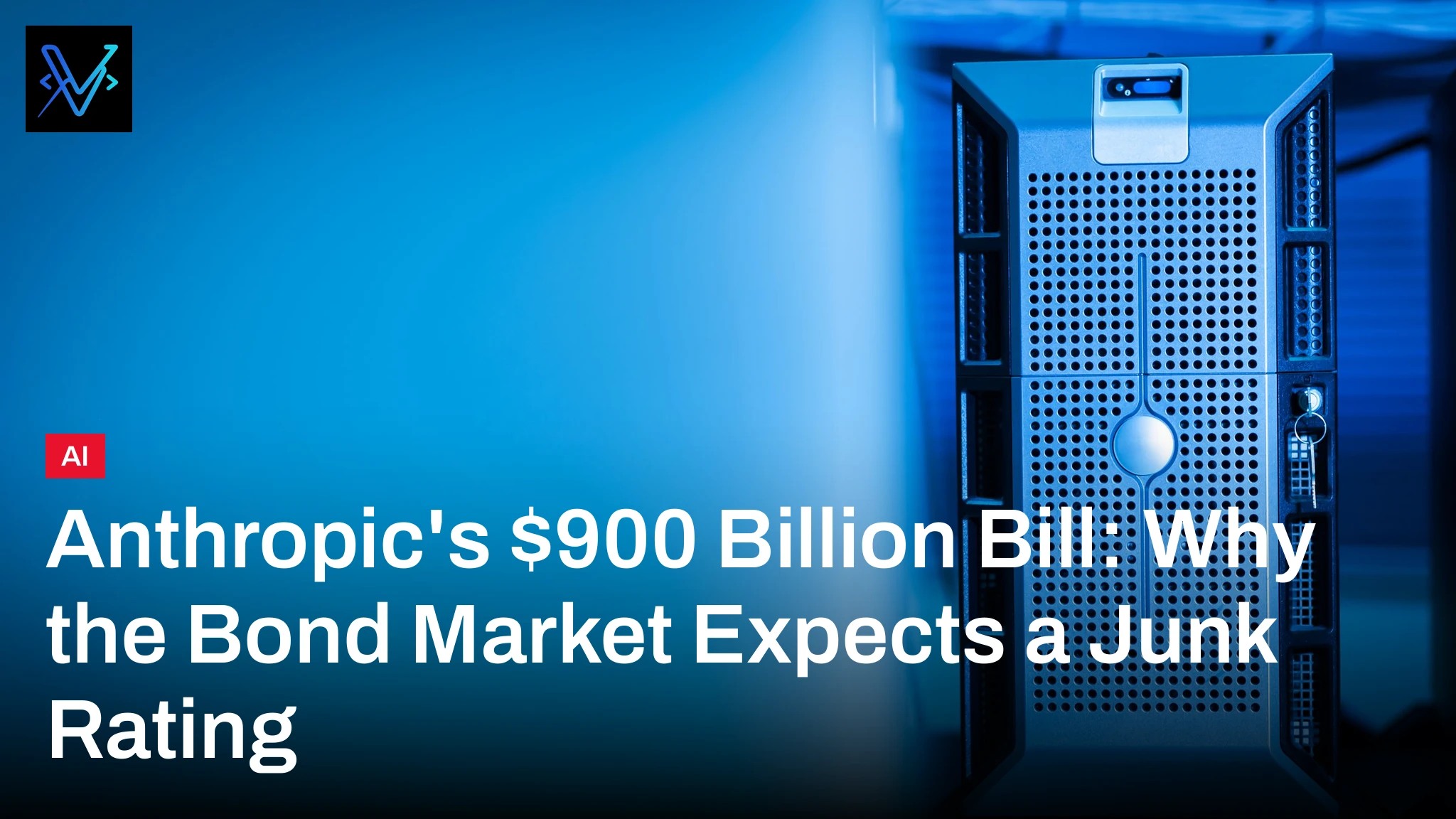
Server hardware in a data centre. Anthropic’s commitments are almost entirely for computing power and data centres. (Photo: panumas nikhomkhai / Pexels)
The stock market said yes. The bond market said not so fast
Anthropic’s first week as a public company had everything a record listing is supposed to have. The maker of the Claude chatbot priced its shares at $83 on November 18, above the $70–$78 range it had marketed, and raised $81.3 billion — the largest IPO in history. The shares opened at $111.50 on the Nasdaq the next morning, briefly topped $115, and closed the first day at $97.17, up 17%. Alongside a $26 billion private placement from the likes of Google, Microsoft and Nvidia, the company raised more than $100 billion in a single week and ended it worth around $1.18 trillion — more than Walmart or JPMorgan Chase.
Then came Friday. The shares fell 8.5% to $88.91, briefly touching $83.05 — five cents above the IPO price — as the Nasdaq plunged 5.3% and Friday’s selloff wiped about $3 trillion off US stocks. On Monday the shares steadied, rising about 3% in premarket trading to around $91.60, but they remain far below the $111.50 opening trade and the $115.10 debut peak. Investors who bought at the open are still deep underwater; only those allocated shares in the offering are ahead.
It is against that backdrop that the bond market’s verdict arrived. The Wall Street Journal reported on Monday that several large bond-fund managers expect the big three rating agencies — Moody’s, S&P and Fitch — to grade Anthropic’s debt as junk when it comes to market. No formal rating has been published yet, and spokespeople for Fitch and S&P declined to comment. But the expectation alone changes the maths of the AI boom’s biggest bet.
Where the $900 billion sits
The number comes from Anthropic’s own paperwork. Its amended prospectus, filed with the US Securities and Exchange Commission in early November, lists aggregate purchase and lease commitments of about $895.4 billion to $900.9 billion as of November 2026, almost all tied to computing power and data centres.
The breakdown shows what kind of bill it is. The largest slice, $451.2 billion, is leases that have not yet started — data centres that are planned and contracted but not yet built or switched on. A further $320 billion is contractual obligations, and $100.2 billion was committed after September 30. About $447.5 billion falls due by the end of 2030, and roughly $70 billion is payable within the next 12 months. Anthropic buys computing capacity 12 to 18 months ahead, so it has to judge demand well before the revenue arrives.
The commitments run through the companies building the AI economy alongside it — Amazon, Google, Nvidia and Broadcom among them — and the risk is shared in unusual ways. Broadcom has agreed to absorb losses under a $63 billion equipment-financing deal if Anthropic defaults. The scale of the spending is also what moved expectations: earlier forecasts had Anthropic reaching investment grade by the end of 2026, but information from Blackstone pointed the other way, and the amended filing settled the argument.
What a junk rating actually means
Credit ratings work like a report card, and the pass mark is BBB-. Anything below that is speculative grade — Wall Street’s polite term for junk. Double-B is the top of that lower bracket, one or two notches below investment grade. It is not a prediction that a company will fail. It is a judgement that lending to it carries materially more risk than lending to a blue-chip borrower, and that the lender should be paid more for taking it.
That judgement has practical consequences. Many pension funds, insurers and other large allocators operate under mandates that favour or require investment-grade holdings. A BB rating shrinks the pool of natural buyers for Anthropic’s bonds just as it prepares to tap public debt markets — and the market has already started pricing in the risk. Junior debt in Anthropic’s recent financings yields above 10%, and Kroll Bond Rating Agency assigned the company a BB+ rating back in June 2026, one notch below investment grade.
Craig Manchuck, a bond-fund manager at Osterweis Capital Management, put the pricing problem bluntly: “How do you gauge what the right price is for a company that has committed to spend $900 billion in the next couple of years?” An investment-grade rating would open the $8.6 trillion high-grade corporate bond market. Without it, Anthropic faces higher funding costs on every dollar it borrows, and less room to borrow at all.
Why it matters — and why Anthropic is not in trouble yet
None of this means the business is struggling to sell its product. Anthropic reported nearly $17 billion in revenue for the third quarter of 2026, up 47% on the previous quarter. Computing and infrastructure costs took 58% of that revenue — the price of delivering AI at scale — but the growth is real, and the company held $95.6 billion of cash at September 30. With the listing proceeds on top, it can fund its commitments for a year or more without touching the bond market.
The squeeze comes later, and that is what the rating agencies are looking at. Roughly half of the commitments do not start until 2030, and without an investment-grade rating by then, Anthropic could struggle to pay its bills as they fall due. The company has about three years to turn its revenue growth into steady profit and a stronger credit standing. Chief executive Dario Amodei told CNBC on Thursday that the company hopes to be investment grade “at some point in the future.” For now, that is an aspiration, not a rating.
The stakes reach beyond one company. The latest selloff, Commerzbank Research analysts said, “reflects growing concerns over stretched technology valuations, the scale and financing of AI-related capital expenditure, and uncertainty over the returns on these investments.” Anthropic’s $900 billion bill is the largest single example of that financing question — and the bond market has just given its first answer.
What to watch next
The first test is the formal ratings themselves: whether Moody’s, S&P and Fitch land where the bond managers expect, and whether they agree with each other. The second is the next time Anthropic taps the bond market, when the price it pays will show what a BB expectation costs in practice. The third is the revenue line: whether quarterly growth keeps pace with a spending schedule that does not wait for anyone.
The week’s calendar adds two more checkpoints. Nvidia reports quarterly results on Tuesday — now with Jensen Huang back as chief executive — and US inflation data lands on Wednesday. Markets are closed on Thursday for Thanksgiving. By the time trading resumes, the AI trade will have had a full week to decide whether the bond market’s warning is a footnote to the biggest IPO in history, or the start of a harder conversation about how the AI boom gets paid for.
Anthropic’s listing answered one question — how much the stock market thinks an AI lab is worth — and opened a harder one: how it pays for the machines. The bond market’s early answer is a warning, not a verdict. The next three years will decide which one it becomes.
Looking to grow your business online? Explore Vertex Agency at vertexagency.in for professional website development, Meta Ads and social media growth.
Sources
- Morningstar / Dow Jones Newswires — EMEA Morning Briefing: Wall Street Expects Anthropic's Debt to Be Junk (Nov 23, 2026)
- The Apex Wire — Anthropic's $900 Billion Bill Faces Junk Debt Rating: What Happens Next (Nov 23, 2026)
- Crypto Briefing — Wall Street expects Anthropic's debt to land in junk territory (Nov 23, 2026)
- TradingView News — ANT: Anthropic Stock Rebounds 3% After First Full Day Ends in Broad Multi-Trillion Wipeout (Nov 23, 2026)