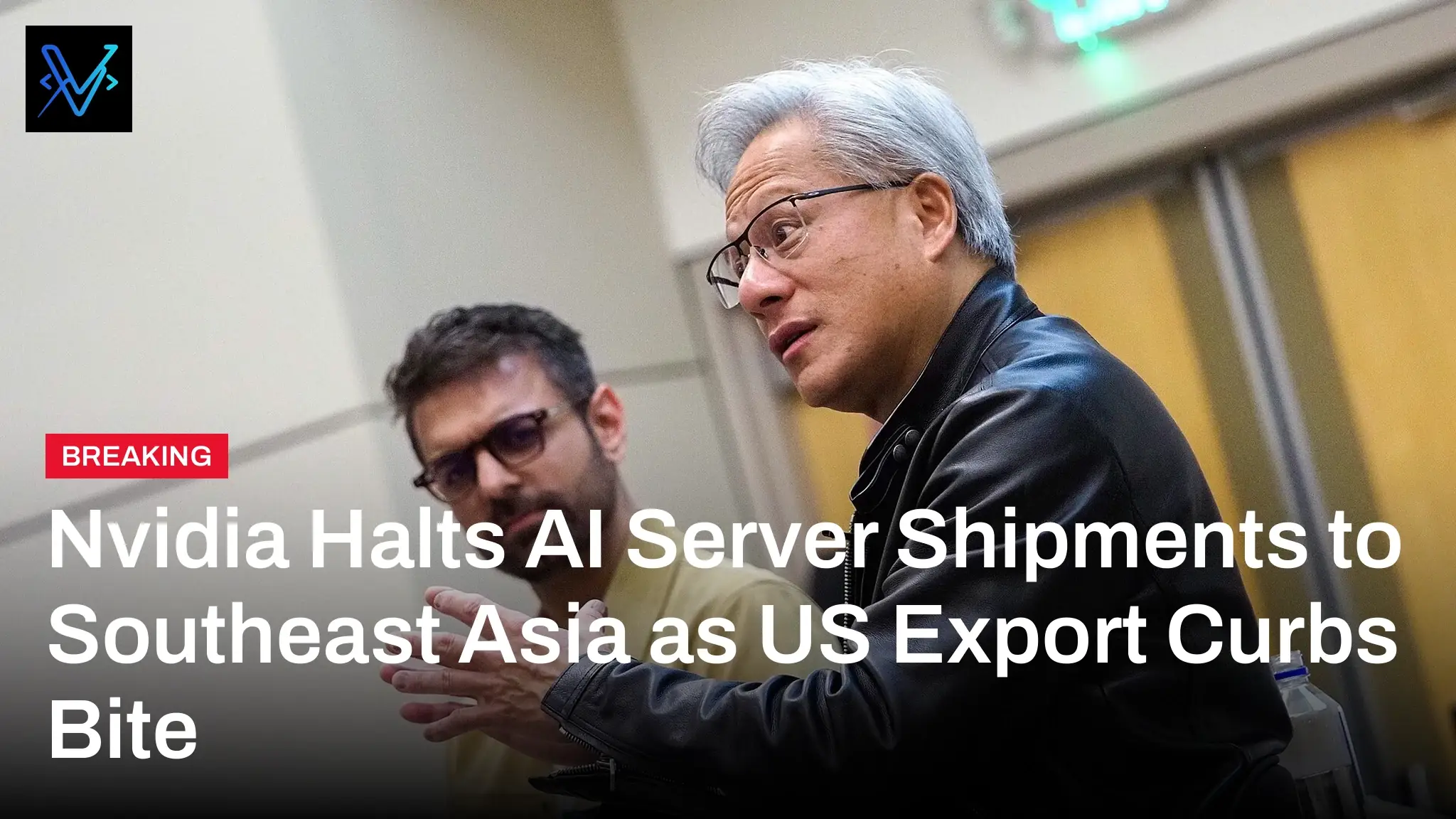
Nvidia has told its manufacturing partners to stop shipping AI servers to four Southeast Asian countries, the Financial Times reported on Thursday, in the sharpest escalation yet of Washington's campaign to keep its most advanced chips out of Chinese hands. Dell and Supermicro have already told buyers in Malaysia, Singapore, Thailand and Indonesia that their orders will not ship — and nobody, not even Nvidia's own partners, yet knows whether the freeze is temporary or the new normal.
KEY POINTS
- The Financial Times, citing three people with knowledge of the matter, reported on Thursday that Nvidia instructed its manufacturing partners to halt shipments of servers containing its chips to Malaysia, Singapore, Thailand and Indonesia. Dell and Supermicro, which package Nvidia's chips into servers, have told buyers in the four countries that Nvidia will not allow their orders to ship. Reuters said it could not immediately verify the report, and Nvidia declined to comment.
- The halt follows new US Commerce Department rules introduced last week requiring export licences for advanced chips shipped to the four countries, aimed at Chinese AI developers who get around US chip bans by renting computing power from data centres in Southeast Asia. Cloud providers have 90 days to obtain a licence by proving their end users do not include restricted entities.
- The stakes are enormous: Nvidia booked $104 billion of revenue through its Singapore subsidiary in 2025, up 72% in a year, and bankers have already stopped about $500 million of credit for a Singapore cloud project meant to supply computing power to ByteDance. Nvidia's shares ended Wednesday down 3.9% at $149.30 — $2.3 trillion below the October peak — and S&P has put the company's credit rating on watch for a possible downgrade.
| Figure | What it means |
|---|---|
| $104 billion | Nvidia revenue booked through its Singapore subsidiary in 2025, up 72% in 12 months |
| ~$500 million | Bank credit frozen for Aolani's project to supply advanced computing power to ByteDance |
| 90 days | Deadline for cloud providers to win licences proving their end users are not restricted entities |
| $149.30 | Nvidia's closing share price on Wednesday, down 3.9% |
| $2.3 trillion | Value Nvidia has shed since its October peak of $243.37 a share |
What the Financial Times reported
According to the FT, Nvidia told the partners that assemble and sell servers using its chips to stop shipping them to the four countries. Dell and Supermicro passed the message on to customers: the orders they placed will not be fulfilled, at least for now. It is unclear whether the halt is a temporary pause while Nvidia and its partners work out how to comply with the new US rules, or a longer freeze.
That uncertainty is the story. The FT's sources said many in the region had hoped Jensen Huang's return as chief executive this week would open a path to less strict enforcement of the new rules. There is, the report said, little indication the company will hold back from executing them.
Nvidia declined to comment on the report. Dell, Supermicro, ByteDance and Aolani did not respond to requests for comment, according to Channel News Asia, which republished the FT's reporting. Reuters, which also carried the story, said it could not immediately verify the FT's report.

Jensen Huang at Computex Taipei in 2016. (Photo: NVIDIA Taiwan via Wikimedia Commons, CC BY 2.0; Nvidia logo: Wikimedia Commons)
Why Washington moved now
The four countries at the centre of this — Malaysia, Singapore, Thailand and Indonesia — have become the favoured destinations for Chinese AI developers seeking access to Nvidia's most advanced chips, whose direct export to China is restricted by Washington. The workaround is simple: instead of buying the chips, Chinese groups rent computing power from cloud providers that buy servers full of Nvidia processors and run them in data centres outside China.
The US Commerce Department's new rules, introduced last week, are designed to close that loophole. They require export licences for shipments of advanced chips to the four countries, and they set a 90-day deadline for cloud providers to obtain a licence by proving that their end users do not include restricted entities. The problem, as one cloud provider executive told the FT, is that the rule arrived without instructions: "There's this new rule but no guidance on execution. No one knows how to apply for this licence while the 90-day clock is ticking. It's causing sheer chaos in the region."
The timing is tangled up with Nvidia's own extraordinary fortnight. Huang was briefly ousted as chief executive and then reinstated after reports involving a woman tied to a cloud provider that leased access to Chinese companies and is being investigated for alleged involvement in smuggling. The revelations complicated Huang's long-held argument that the US should keep selling Nvidia chips to Chinese companies to increase their dependence on American technology. S&P has since put Nvidia's credit rating on watch for a possible downgrade, citing weaknesses in the chipmaker's management and board.
Why Singapore sits at the centre of this
The region is not a sideshow for Nvidia — it is one of its biggest markets. The chipmaker booked $104 billion of revenue through its Singapore subsidiary in 2025, a 72% increase in 12 months, according to company accounts cited by CNA. Nvidia also records some of its Taiwan and China revenue through the Singapore unit, which makes the city-state the financial heart of its Asian business.
Demand from Chinese tech companies has fuelled Southeast Asia's data-centre boom, particularly in Malaysia and Indonesia, where billions of dollars have poured into building AI infrastructure. The new US restrictions have put much of that investment in jeopardy overnight — data centres that were built to serve Chinese customers suddenly cannot get the servers they were designed around, and the banks financing them are already pulling back.
The deal caught in the middle
Among those affected is Aolani, a Singapore-based cloud company that planned to provide advanced computing power to ByteDance, the Chinese owner of TikTok, through leasing agreements. According to the FT's reporting, the disruption has led some bankers who previously agreed to finance the project to stop issuing credit worth about $500 million — and ByteDance is now potentially dropping the deal altogether.
It is the clearest early casualty of the new rules, and it shows how the damage spreads beyond Nvidia itself. The halt hits server makers, data-centre builders, lenders and the Chinese AI labs that were counting on rented compute — all at once, and all before anyone has a licence application form to fill in.
What it means for Nvidia and the AI trade
For Nvidia, the halt lands in the middle of the worst month of its recent history. The shares ended Wednesday down 3.9% at $149.30, a staggering $2.3 trillion below the October peak of $243.37, as the AI trade that carried markets for two years came under sustained pressure. Markets steadied on Thursday as the latest US tariff proposals proved less damaging than feared, but Nvidia remained a source of unease — and this report is unlikely to calm it.
The bigger question is whether the export-control regime now becomes a permanent drag on Nvidia's growth. The company's pitch to investors has always been that AI demand is effectively limitless; the new rules say that a large and fast-growing slice of that demand — Chinese labs, routed through Southeast Asia — is now off-limits unless Washington grants a licence. If the halt lasts, it does not just cost Nvidia sales in four countries. It tells every data-centre operator in the region that building for Chinese customers is a stranded bet.
For the AI industry, the message is just as stark. The US government has moved from controlling which chips can be sold to China to controlling where the computing power itself can be rented. That is a much wider net — and, as the cloud executive's quote makes clear, one that the industry is still scrambling to understand.
What to watch next
First, whether Nvidia or its partners confirm the halt — and whether it is temporary. A short compliance pause would be a very different story from a months-long freeze, and Dell and Supermicro's next statements will be the first signal. Second, the licence process itself: if the Commerce Department publishes guidance quickly, the chaos eases; if the 90-day clock keeps ticking with no way to apply, more deals like Aolani's will unravel.
Third, watch whether the controls widen. The current rule targets four countries; the logic behind it — that compute can be rented anywhere — applies everywhere. And watch Beijing: China's leading AI labs remain heavily reliant on Nvidia's processors for training their flagship models, and how they respond — whether by accelerating domestic chip efforts or by finding new routes — will shape the next phase of the US-China tech war.
Looking to grow your business online? Explore Vertex Agency at vertexagency.in for professional website development, Meta Ads and social media growth.
Sources
- Reuters — Nvidia halts chip shipments to Southeast Asia, FT reports (Nov 26, 2026)
- Channel News Asia — Nvidia halts chip shipments to Southeast Asia: Report (Nov 26, 2026)
- Reuters — Stocks climb as traders shrug off latest US tariff salvo (Nov 26, 2026)
Photo: Anders Eidesvik via Wikimedia Commons, CC BY 4.0 (cover); NVIDIA Taiwan via Wikimedia Commons, CC BY 2.0 (Jensen Huang photo)