Eleven days. That is how long Jensen Huang spent out of the chief executive’s chair at Nvidia — eleven days between resigning over a scandal involving a suspected Chinese spy and being voted back in unanimously by the same board that had just ruled out his return. In between, the world’s most valuable chipmaker lost roughly $2.8 trillion in market value, then gained back more than $900 billion in a single day. This is the whole story, from the first report to the comeback, and what is still unresolved.
KEY POINTS
- Jensen Huang resigned as Nvidia chief executive on November 12 after reports of an affair with Alice Huang, a Singapore-based executive US intelligence officials suspected of working for China. On November 23, Nvidia’s board unanimously reinstated him after what it described as input from senior levels of the US government.
- The scandal centres on Megaspeed, a Singapore cloud firm investigators believe diverted at least $7.5 billion worth of Nvidia AI chips to Chinese companies. Washington added Megaspeed to its trade blacklist on the same day Huang returned.
- Huang is not out of the woods: he faces transcribed interviews with three House committees on December 1, a Senate hearing is being arranged, the SEC is examining Nvidia’s accounting, and the Justice Department is leading a criminal probe of Megaspeed. Nvidia shares fell more than 5% in premarket trading on Tuesday as the rally cooled.
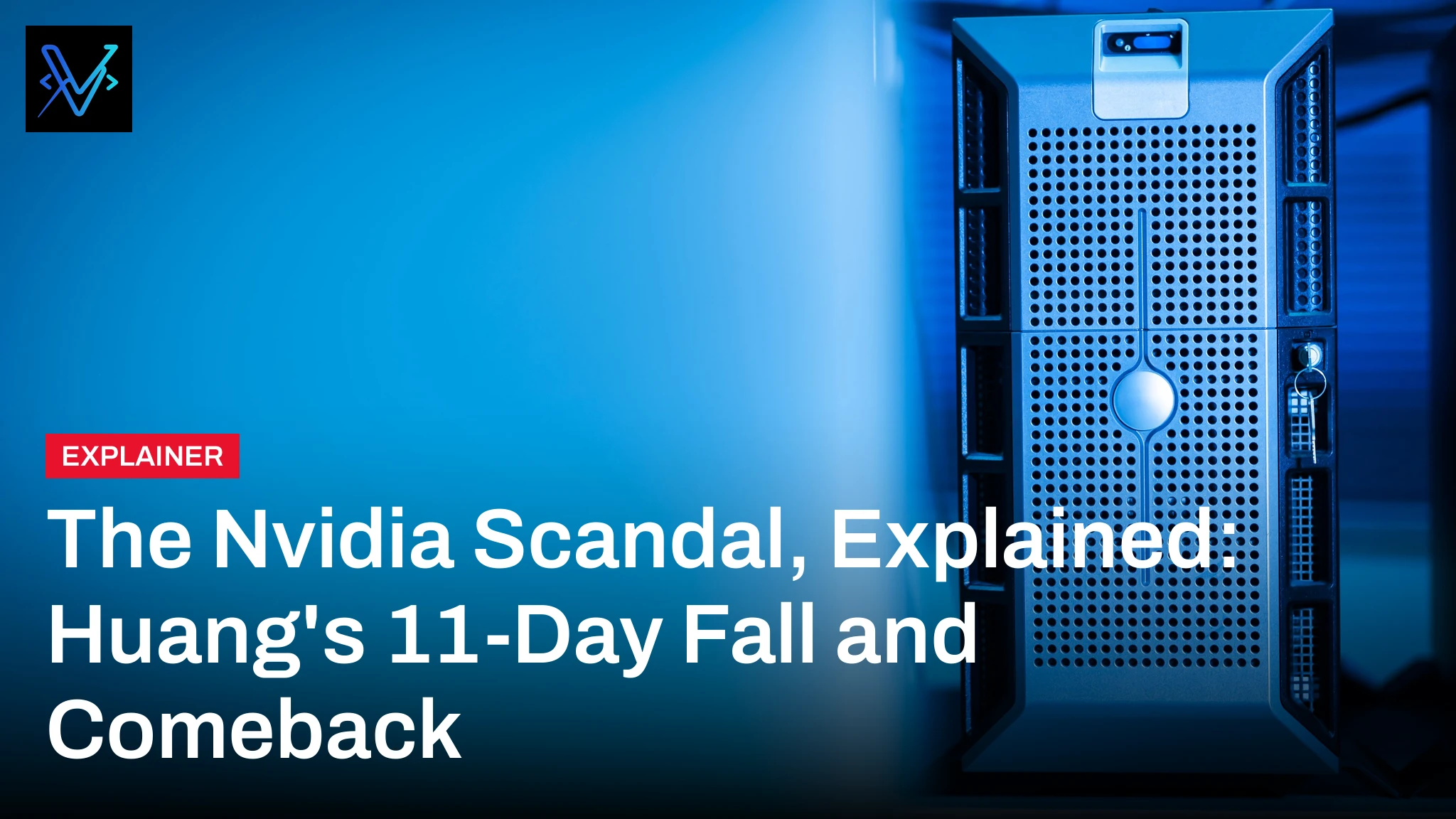
Server racks in a data centre. Nvidia’s chips are the raw material of the AI boom — and the centre of the biggest corporate scandal of the year. (Photo: panumas nikhomkhai / Pexels)
The story in 60 seconds
Nvidia makes the chips that power almost all serious artificial intelligence. Its processors train the models behind ChatGPT, Claude and Gemini, and its customers include every major cloud company on the planet. At its peak on October 6, the company was worth about $5.8 trillion — the most valuable company in history — and its co-founder Jensen Huang, who has run it since 1993, was widely described as the godfather of the AI revolution.
Then, in late October, The New York Times reported that US intelligence officials were concerned that Alice Huang, a business executive linked to Singapore-based cloud firm Megaspeed, was acting on behalf of Chinese intelligence and had a close relationship with Jensen Huang. Days later Huang admitted to employees that he had been unfaithful to his wife. The board opened an independent investigation into whether he had been targeted by a foreign intelligence effort. Within two weeks he had resigned, the stock had lost nearly half its value, and the president of the United States was personally lobbying for his return.
On Monday, November 23, the board reversed itself. Huang was reinstated, the shares jumped more than 30%, and Wall Street had its best day since April. But the questions that forced him out — about the chips, the money and who knew what — have not gone away. They have moved to Congress, the courts and the regulators.
The full timeline
| Date | What happened |
|---|---|
| June 2024 | Jensen Huang and Alice Huang are photographed together at the Computex conference in Taiwan. |
| Oct 2025 | The New York Times reports Alice Huang and Jensen Huang are seen socialising, and that federal investigators are examining Megaspeed’s activities and possible chip exports to China. |
| Oct 29, 2025 | The Times reports US intelligence officials were concerned Alice Huang was acting for Chinese intelligence. Nvidia says the relationship is “not unusual.” |
| Nov 8 | Huang tells Nvidia employees he has been unfaithful to his wife. The board launches an independent investigation. |
| Nov 9 | Nvidia and Huang are sued in a proposed shareholder class action accusing them of concealing his ties to a suspected Chinese spy. |
| Nov 10 | The Information reports the affair helped move at least $7.5 billion worth of Nvidia chips to Chinese firms. The board hires Wachtell Lipton’s Joon Kim to lead its probe. Senator Kevin Cramer calls for Huang’s resignation. |
| Nov 11 | The Times reports Huang also had an affair with Kimberly Powell, Nvidia’s vice president of health care, who reported to him. The board meets to decide whether to oust him. |
| Nov 12 | Huang resigns as chief executive and leaves the board. CFO Colette Kress becomes interim CEO. Reuters reports a second intimate relationship with another employee. Attorney General Todd Blanche says the Justice Department has not concluded whether Alice Huang is a spy, but the FBI is investigating. |
| Nov 16 | Commerce and Justice release details of the Megaspeed probe, open since 2024. The administration issues a new rule tightening chip exports. Trump says he “would certainly not mind” Huang returning. A reinstatement petition passes 177,000 signatures, including Elon Musk. |
| Nov 17 | Nvidia creates a board-level National Security and Export Control Oversight Committee. Huang says he would be “honoured” to return. Nvidia reports third-quarter revenue of $115.84 billion, beating expectations, and forecasts $130 billion for the current quarter. Board chair Harvey Jones says the company “will not rehire Huang.” |
| Nov 19 | California’s attorney general serves Nvidia with an investigative subpoena. The House Foreign Affairs Committee says the administration approved shipments of nearly 900,000 advanced Nvidia and AMD AI chips to Chinese companies between December 2025 and May. |
| Nov 20 | Reuters reports the SEC is examining Nvidia’s accounting practices. Huang agrees to testify at a public Senate hearing. The Times reports Alice Huang has extensive ties through family and associates to China’s defence industry. |
| Nov 21–22 | Vice President JD Vance and other administration officials work through the weekend to persuade Nvidia’s board to reconsider. The Times reports Alice Huang was in contact with an officer from China’s Ministry of State Security from spring 2025 until autumn 2026. |
| Nov 23 | The board votes unanimously to reinstate Huang, saying it is satisfied with his candour and leadership and sees no national security risk. Shares jump more than 30%. The US adds Megaspeed to its trade blacklist. |
| Nov 24 | Nvidia shares fall more than 5% in premarket trading as the rally cools, with chip stocks and the wider tech trade pulling back. |
The key players
Jensen Huang co-founded Nvidia in 1993 and built it from a graphics-card maker into the company at the centre of the AI economy. He is the face of the AI boom — leather jacket, keynote stages, a direct line to the White House — and, as this month proved, the person the market believes the company cannot do without. He has admitted to the affairs, apologised, and said he accepts the job again “with the utmost humility and a renewed commitment.”
Alice Huang is the business executive at the centre of the allegations. She was linked to Megaspeed, the Singapore cloud company now on the US trade blacklist, and, according to The New York Times, was in contact with an officer from China’s Ministry of State Security from spring 2025 until autumn 2026. Megaspeed says she officially left the company on August 30, 2025, and has no current role. Singapore says she left the country in February and was barred from re-entering after an investigation that, it says, did not concern espionage. The Justice Department has not concluded whether she is a spy. China has called the accusations groundless.
Harvey Jones, Nvidia’s board chair and a former Synopsys chief executive, is the man who said “no” and then said “yes.” On November 17, on an investor call after blockbuster quarterly results, he said Nvidia would not rehire Huang and would not take questions about his departure. Six days later he announced the unanimous vote to bring him back, saying the board believed Huang was the right person to lead the company and that his reinstatement was in the best interests of shareholders, employees, partners and customers.
Colette Kress, Nvidia’s chief financial officer, ran the company as interim chief executive for the eleven days Huang was gone, and continues as CFO now that he is back.
Donald Trump is the most unusual player in the story. The president pushed publicly and privately for Huang’s return, called him a “legend” and a “national treasure,” and said on CNBC that he had personally advocated for him. He also holds Nvidia shares himself — valued by CNBC at between $4.5 million and $57 million as of August — a fact Democrats have seized on. Trump and Huang have grown close during the president’s second term: Huang attended a $1 million-a-seat dinner at Mar-a-Lago in April 2025, Nvidia gave $25 million toward the construction of Trump’s new White House ballroom, and in October it pledged $1 billion to the White House’s AI initiative, the Genesis Mission Consortium.
Howard Lutnick, the commerce secretary, is under fire from both parties. Treasury Secretary Scott Bessent said publicly that his department, the Pentagon, the State Department and the trade representative had favoured blacklisting Megaspeed for months, but that “Commerce has the pen.” Senator Tom Cotton, chair of the Senate Intelligence Committee, has accused Lutnick of turning a blind eye to the smuggling routes. House Democrats have opened a probe into whether Lutnick used his office to help Cantor Fitzgerald, the firm controlled by his sons, avoid losses tied to scrutiny of Nvidia. Commerce says he has divested all financial interests in the firm; Cantor Fitzgerald denies the claims.
How the chips allegedly reached China
The United States bans the direct sale of its most advanced AI chips to China. The question at the heart of this scandal is whether that ban was, in practice, a detour sign.
According to The Information’s reporting, at least $7.5 billion worth of Nvidia chips — about 240,000 H100, H200 and A100 processors — reached Chinese firms through a web of companies across Singapore, Malaysia and China. The route, as investigators describe it, worked in two ways: chips were installed in data centres in Southeast Asia and their computing power was rented remotely to Chinese customers, or the hardware was physically shipped onward into China. Some of the computing power reportedly served Alibaba and Tencent, as well as smaller Chinese AI labs.
At the centre of the network was Shanghai Century Litong, a company linked to Alice Huang’s sister that Nvidia granted preferred cloud partner status four months after it was founded. Megaspeed itself began as 7Road International, renamed itself in March 2023 as it expanded into AI cloud computing, and built its business as an Nvidia cloud partner, leasing data-centre capacity in Singapore, Malaysia and Indonesia.
US authorities have been looking at Megaspeed since 2024. Commerce requested Nvidia’s records in May 2025, Nvidia put Megaspeed on its internal “no sell” list in June 2025, and US and Singaporean agents carried out an on-site check and interviewed Alice Huang, then the chief executive, the same month. The Justice Department then took the lead on a criminal investigation. On Monday, Washington finally added Megaspeed to its Entity List, cutting it off from American technology — along with six other companies in Singapore, Malaysia and Thailand linked to it.
The picture is complicated by what the administration itself allowed. The House Foreign Affairs Committee said on November 19 that the Trump administration approved shipments of nearly 900,000 advanced Nvidia and AMD AI chips to Chinese companies between December 2025 and May, under the December 2025 decision to allow H200 shipments to China. And on November 16 the administration issued a new rule tightening the regime: shipments to Singapore, Thailand, Malaysia, Indonesia and Brazil now need a US export licence, and overseas data centres serving China-based AI firms have 90 days to get one. The rule also formally rescinded the Biden-era global AI chip rule.
The numbers: what the saga cost — and made
| Figure | What it is |
|---|---|
| ~$5.8 trillion | Nvidia’s market value at its October 6 peak, at about $240 a share |
| ~$2.8 trillion | Market value wiped out in 45 days as the scandal unfolded; shares closed at $126 on November 20, down 48% from the peak |
| More than $900 billion | Market value added in a single day on Monday, November 23, as shares jumped more than 30% to about $165 — a record one-day gain for any company |
| $115.84 billion | Nvidia’s third-quarter revenue, above the $109.11 billion analysts expected |
| $130 billion | Nvidia’s forecast for fourth-quarter revenue, assuming no data-centre chip sales to China |
| At least $7.5 billion | Value of Nvidia chips The Information reported reached Chinese firms through the Megaspeed network |
| 177,000+ | Signatures on the petition calling for Huang’s reinstatement, including Elon Musk and Epic Games chief Tim Sweeney |
| More than 5% | How far Nvidia shares fell in premarket trading on Tuesday, November 24, as the rally cooled |
Monday’s rally was not just a Nvidia story. The S&P 500 jumped 4.73% and the Nasdaq 6.51%, adding about $2 trillion in market value — Wall Street’s best day since April. It was, as one fund manager put it, a demonstration of how central Nvidia has become: not only because of its chips, but because it funds so many of its own customers and suppliers through investments across the AI sector. The comeback restored confidence in a sector that had spent weeks questioning whether the debt-fuelled AI buildout would ever pay off.
Why the board said no — then yes
The reversal is the strangest part of the story, and the most revealing. On November 17, six days before the reinstatement, Harvey Jones told investors flatly that the board would not rehire Huang, that it had hired the search firm Heidrick & Struggles to find a permanent chief executive, and that it would not take questions about the departure. On November 23 the same board voted unanimously to bring him back, effective immediately, and said it was satisfied with his “candour and ability to lead.”
Three forces converged on the board over the weekend of November 21 and 22. The first was the president: Trump had been calling for Huang’s return for days, and Vice President JD Vance and other senior administration officials spent the weekend working to persuade the directors. Nvidia’s own statement understated it, saying only that it had “received input from senior levels of the United States government.” Trump was blunt on CNBC on Monday: “I wouldn’t do this if I thought that he did something wrong. I wouldn’t be recommending to his board to hire him.” A president personally intervening in the leadership of a publicly traded company is, as Le Monde put it, highly unusual.
The second was the market. Nvidia’s shares had fallen 48% from their peak, wiping out about $2.8 trillion in value in 45 days, and the wider AI trade was sliding with it. Directors who had spent a week watching the company’s value halve had a powerful incentive to change their minds — and on Monday the market told them they were right, handing the company the largest one-day gain in its history.
The third was Silicon Valley itself. An open letter signed by thousands of Nvidia employees circulated for days, and some of the industry’s biggest names — Elon Musk, Epic’s Tim Sweeney, Replit’s Amjad Masad, Shopify’s Tobi Lütke, investor Garry Tan — publicly backed Huang’s return. A petition passed 177,000 signatures. When the board finally moved, it moved all at once — unanimously, and with immediate effect.
Whether the board’s own investigation actually cleared Huang is something we do not yet know. The company says it is satisfied with his candour and sees no national security risk. But the board’s independent inquiry is still running, and the statement said nothing about what, if anything, it found about the chip shipments.
Why it matters
This is not a story about one man’s private life. It is a story about the fault lines running through the most important industry in the world economy.
First, it is a test of whether America’s export controls work at all. Washington can ban the direct sale of advanced chips to China, but the controls only matter if the chips cannot simply be routed through a friendly third country and rented back across the border. The alleged $7.5 billion that flowed through Megaspeed’s network suggests the detour was wide open for years — and the government’s own approval of nearly 900,000 chips for Chinese buyers in the same period shows the policy itself has been pulling in two directions.
Second, it exposes how much of the AI economy now rests on one person. Nvidia provides the raw material for the AI revolution and the capital to fund it, through investments in the very companies that buy its chips. When Huang resigned, the stock lost nearly half its value and the whole market slid. When he returned, the market added $2 trillion in a day. As Le Monde observed, the health of AI — and, by extension, much of the American economy — seems to rest on the shoulders of a single man. That is a strange position for a $5 trillion company, and a fragile one for an economy.
Third, it has become a political fight that will outlast the scandal itself. Democrats take control of Congress in January, and the incoming House speaker, Hakeem Jeffries, has promised a “swift, thorough and wide-ranging investigation into business malfeasance by Nvidia and corrupt abuse of power by Howard Lutnick and the Department of Commerce.” The president’s personal intervention — and his own Nvidia shareholding — is now part of that inquiry. And a November 20 investigation by The New York Times, based on testimony from Nvidia employees, described a management culture built on humiliation and degrading remarks, which suggests the questions about Huang’s leadership go beyond the affair.
What to watch next
The calendar is crowded. On December 1, Huang has agreed to transcribed interviews with three House committees — Foreign Affairs, the Select Committee on the Chinese Communist Party, and Intelligence — and Nvidia’s general counsel, Tim Teter, appears before the same committees on December 2. Senate Banking chair Tim Scott has asked Huang to testify at a public hearing and suggested December 3, though no date has been set. Those sessions are where lawmakers will press him on what he knew about Megaspeed and its customers, and on who was in charge of compliance — the question Treasury Secretary Scott Bessent has been asking publicly.
The regulators are moving too. The SEC is examining Nvidia’s accounting practices, according to Reuters, and California’s attorney general has served the company with an investigative subpoena. The Justice Department is leading a criminal investigation of Megaspeed, and the Commerce Department has launched its own probe. Any charges would turn a trade sanction into a courtroom case, with names, dates and evidence on the public record.
And the market will keep score. Tuesday’s pullback — Nvidia down more than 5% before the open, chip stocks and memory names falling with it — is a reminder that Monday’s surge was a vote of confidence in Huang’s return, not a verdict on the investigation. The stock is still down about 22% over the past month. The scandal that cost Huang his job for eleven days is not over. It has moved from the boardroom to Congress, the courts and the blacklist — and the answers that matter most have not been given yet.
Looking to grow your business online? Explore Vertex Agency at vertexagency.in for professional website development, Meta Ads and social media growth.