Nvidia did everything the market asked of it on Tuesday night. Revenue of $115.8 billion, up 103% from a year earlier, beat the company's own guidance and Wall Street's forecasts. The outlook for the current quarter, $130 billion, came in above expectations too. Then the stock went up 4.7% after hours, opened higher on Wednesday — and closed down 2.9% anyway, because the numbers were never really the story. The story is who runs Nvidia now, and on the same earnings call, the board made its answer final.
KEY POINTS
- Nvidia's third-quarter revenue hit $115.8 billion, up 103% year on year, with data-centre revenue of $107.6 billion and adjusted earnings of $2.68 a share against about $2.47 expected.
- Guidance for the current quarter is $130 billion, plus or minus 3% — above the roughly $125 billion consensus — assuming zero data-centre compute revenue from China.
- Shares rose 4.7% after hours, then reversed on Wednesday to close down 2.9% at $150.96 — a fifth straight fall — after the board used the call to rule out Jensen Huang's return and name Heidrick & Struggles to lead the CEO search.
| Q3 FY2027 | Reported | Expected / guided |
|---|---|---|
| Revenue | $115.8 billion (+103% year on year) | Guidance $108 billion ±2%; consensus about $109 billion |
| Data Center revenue | $107.6 billion (+110%) | — |
| Net income | $65.3 billion (+105%) | — |
| Earnings per share | $2.68 non-GAAP ($2.70 GAAP) | About $2.47 expected |
| Gross margin | 74.8% GAAP / 74.9% non-GAAP | — |
| Q4 guidance | Revenue $130.0 billion ±3% | Consensus about $125 billion; margin guided to 71–72% |
Source: Nvidia's third-quarter fiscal 2027 results release, 17 November 2026.
The numbers were not the problem
Start with the quarter itself, because it was emphatic. Revenue of $115.8 billion for the three months ended 25 October rose 20% from the previous quarter and 103% from a year earlier, ahead of the $108 billion the company had guided and the roughly $109 billion analysts expected. Data-centre revenue — the AI business — reached $107.6 billion, up 110% year on year. Net income was $65.3 billion. Adjusted earnings came to $2.68 a share, against a consensus near $2.47; on a GAAP basis, earnings were $2.70 a share.
Profitability held up as well. Gross margin was 74.8% on a GAAP basis and 74.9% adjusted — at the top of what the company had signalled. By any normal standard, this was the quarter of a company whose central problem is building product fast enough, not selling it.
A $130 billion outlook, with a margin warning inside it
The forecast mattered more than the results, and it did not disappoint on size. Nvidia guided fourth-quarter revenue to $130 billion, plus or minus 3%, against a consensus of roughly $125 billion compiled by LSEG. The outlook again assumes no data-centre compute revenue from China — the market at the centre of the export-control fight now hanging over the company.
Two caveats sit inside the headline. The fourth quarter is a 14-week quarter, one week longer than the third, which flatters the comparison. And gross margin is guided down to between 71% and 72%, from 74.9%, as the ramp of the Vera Rubin platform raises costs. Interim CEO Colette Kress also raised the company's fiscal 2028 revenue growth outlook to about 75%, arguing demand still exceeds supply — a striking claim from a company that has just lost its founder.
"We've got this" — and a door closed on the same call
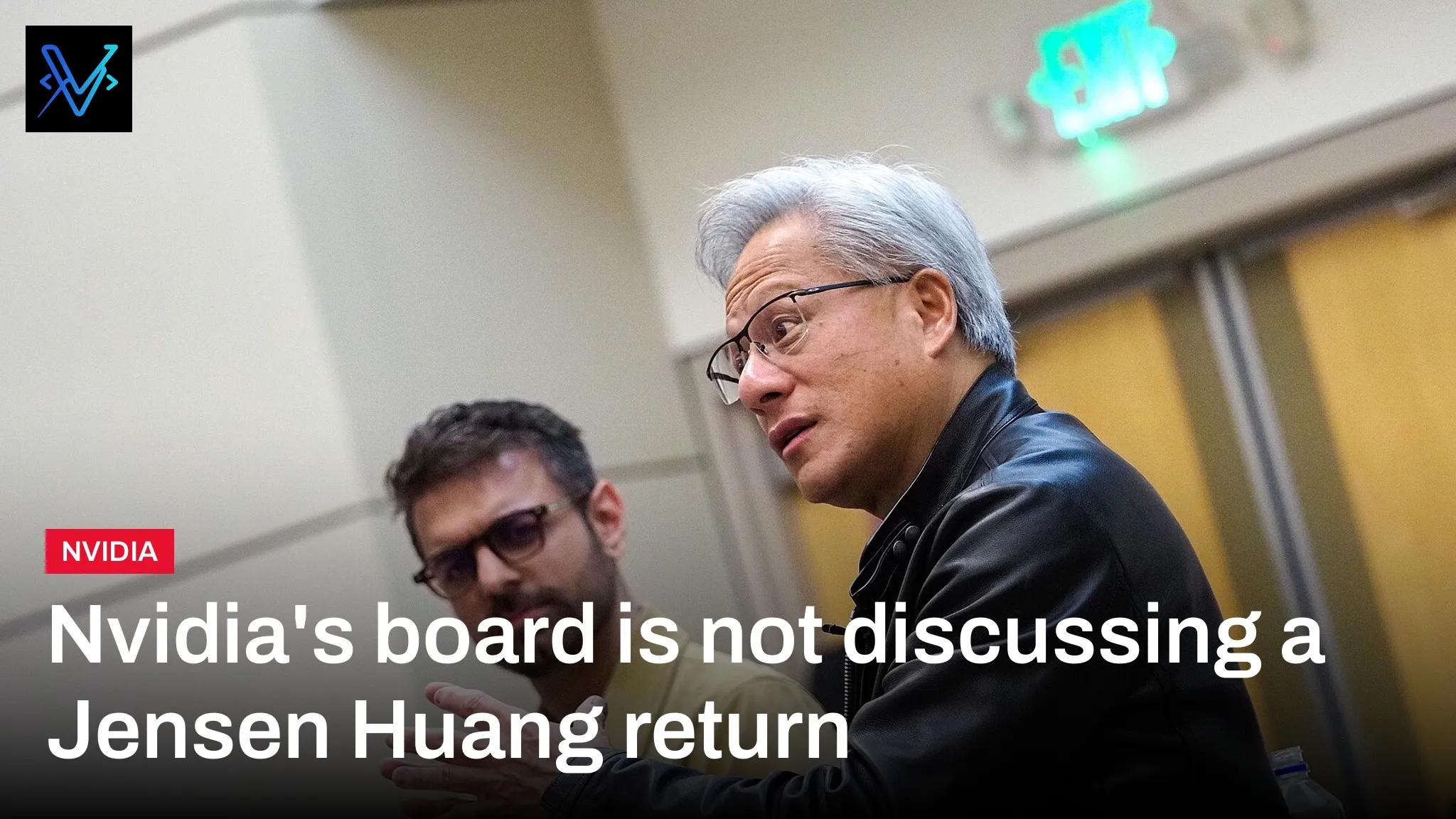
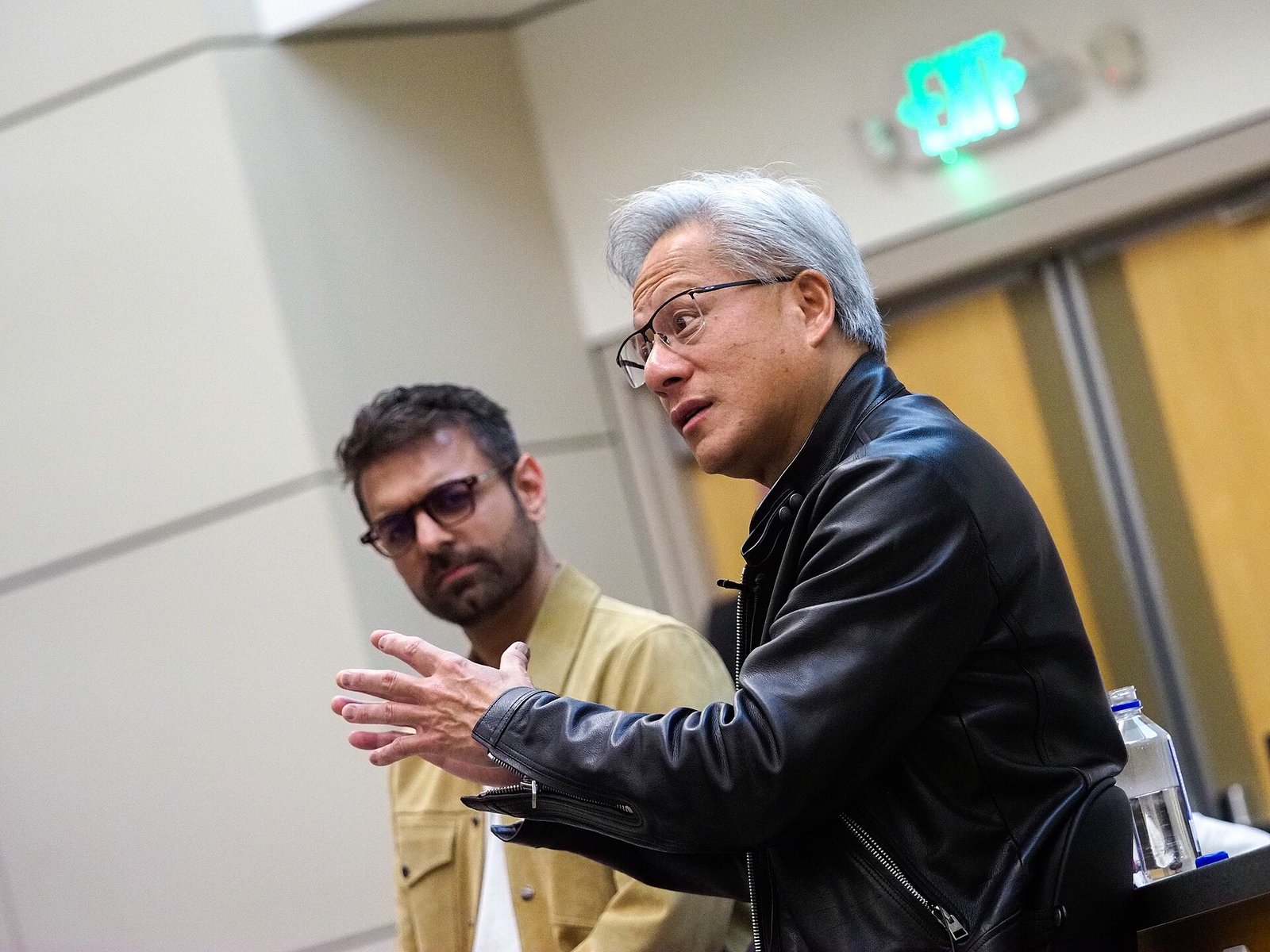
The earnings call opened with board chair Harvey Jones, and he used it to end the week's biggest speculation. Huang, who resigned on 12 November, had said earlier on Tuesday that he would be "honored" to return as CEO if the board allowed it. Jones said the board does not intend to reinstate him, that it has every confidence in Kress, and that it has hired the search firm Heidrick & Struggles to lead the hunt for a permanent chief executive, considering internal and external candidates with no fixed timetable.
Jones also announced a new board committee on national security and export controls — the board's first major governance move since Huang's departure, and a direct response to the scrutiny over whether advanced Nvidia chips reached China. He declined to take further questions on the resignation or the board's investigation.
Kress, Nvidia's finance chief of 13 years and now its interim CEO, kept her message to continuity. "Our ambition will not change, our passion to innovate will not change, and our commitment to customers, partners, and shareholders will not change," she told investors, closing with: "We've got this." The underlying allegation in the board's investigation — involving a former executive of a Singapore chip buyer and claimed links to Chinese intelligence — remains unverified; Reuters has said it could not independently confirm it, Beijing has denied it, and no US authority has announced a conclusion.
The reversal: up 4.7% after hours, down 2.9% by the close
The market's verdict arrived in two acts. On Tuesday evening, the results and guidance did their job: the stock rose 4.7% in after-hours trading, and Asian chip stocks followed it higher on Wednesday. Nvidia opened Wednesday at $159.19, up 2.4%.
Then it reversed. By Wednesday's close the shares were at $150.96, down 2.9% on the day — a fifth consecutive decline that leaves the stock 36% below its record closing high of 6 October, according to Reuters. The Nasdaq Composite rose 0.4% the same day, so this was not the market; it was Nvidia. Moody's Ratings revised its outlook on Nvidia's credit to stable from positive on Wednesday, citing governance uncertainty after Huang's departure and the absence of a formal succession plan.
Analysts captured the split precisely. After the report, LSEG data showed the average estimate for Nvidia's adjusted net income next fiscal year rising to $393 billion from $380 billion — the business, in their models, got stronger. The average price target fell anyway, to $251.74 from $265.70 on Monday. The numbers went up; the multiple investors will pay for them went down.
Why this matters
Nvidia has now reported two realities at once. Operationally, the AI build-out it supplies is still accelerating — $115.8 billion in a quarter, a $130 billion guide, demand above supply into fiscal 2028. Institutionally, the company is being repriced as a governance risk: a founder ruled out by his own board, a permanent CEO not yet chosen, a Treasury Secretary's deadline on China answers falling due around 25 November, and a ratings agency formally marking the uncertainty. Until the second story resolves, the first one may not be enough to lift the stock.
What to watch next
Three dates now matter more than any product launch. Around 25 November, Treasury Secretary Scott Bessent's 10-day window for answers on the China chip question closes. On 1 December, Huang is set to testify on Capitol Hill. And the CEO search — Heidrick & Struggles, internal and external candidates, no timetable — will produce the single announcement that can end the governance discount. The next earnings report, expected in February, is the fourth.
Looking to grow your business online? Explore Vertex Agency at vertexagency.in for professional website development, Meta Ads and social media growth.
Sources: Nvidia's third-quarter fiscal 2027 results release (17 November 2026); Nvidia Q3 earnings call transcript (Motley Fool); Reuters reporting and analysis on the board's decision and the share-price reaction; Investing.com on the Moody's outlook revision.