Wall Street just lived through one of its wildest days in years. The Dow Jones Industrial Average plunged more than 1,100 points on Wednesday — then erased the entire loss and closed higher, while the Nasdaq 100 briefly slipped into bear-market territory before buyers stepped in. And just as the dust was settling, S&P Global Ratings put Nvidia’s credit rating on watch for a possible downgrade, saying the chipmaker’s boardroom chaos had exposed serious weaknesses in how the company is run.
KEY POINTS
- The Dow erased an intraday fall of more than 1,100 points to close 0.33% higher at 50,183, while the S&P 500 fell about 0.3% after dropping as much as 3.2% and the Nasdaq 100 briefly touched bear-market territory.
- S&P Global Ratings put Nvidia’s AA credit rating on watch for a possible downgrade to AA-, citing weak executive oversight, a lack of succession planning and “key man risk” after Jensen Huang’s departure and return as chief executive.
- Asia bounced back on Thursday morning — Japan’s Nikkei rose 1.6% and South Korea’s main index gained 1.9% — but with US markets closed for Thanksgiving, the relief may be tested again on Friday’s thin half-day session.
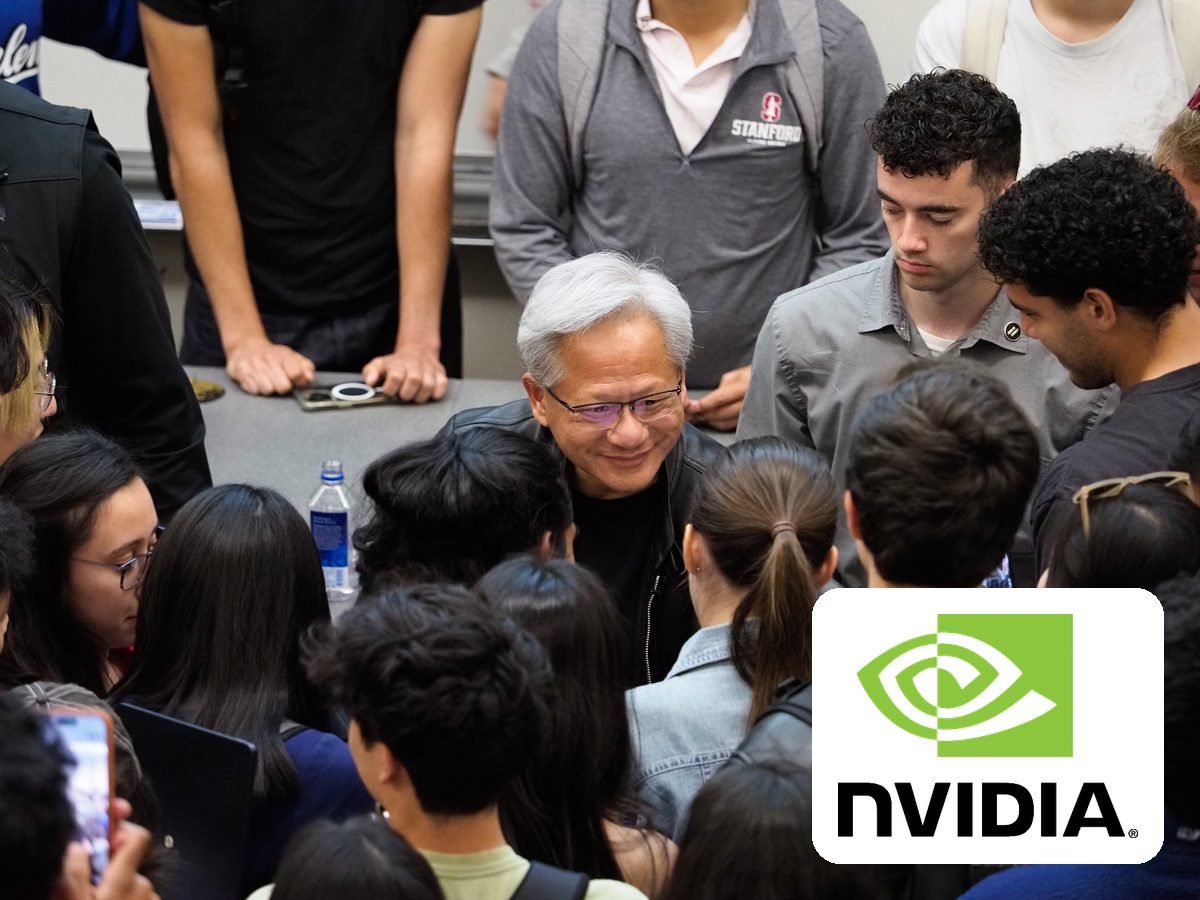
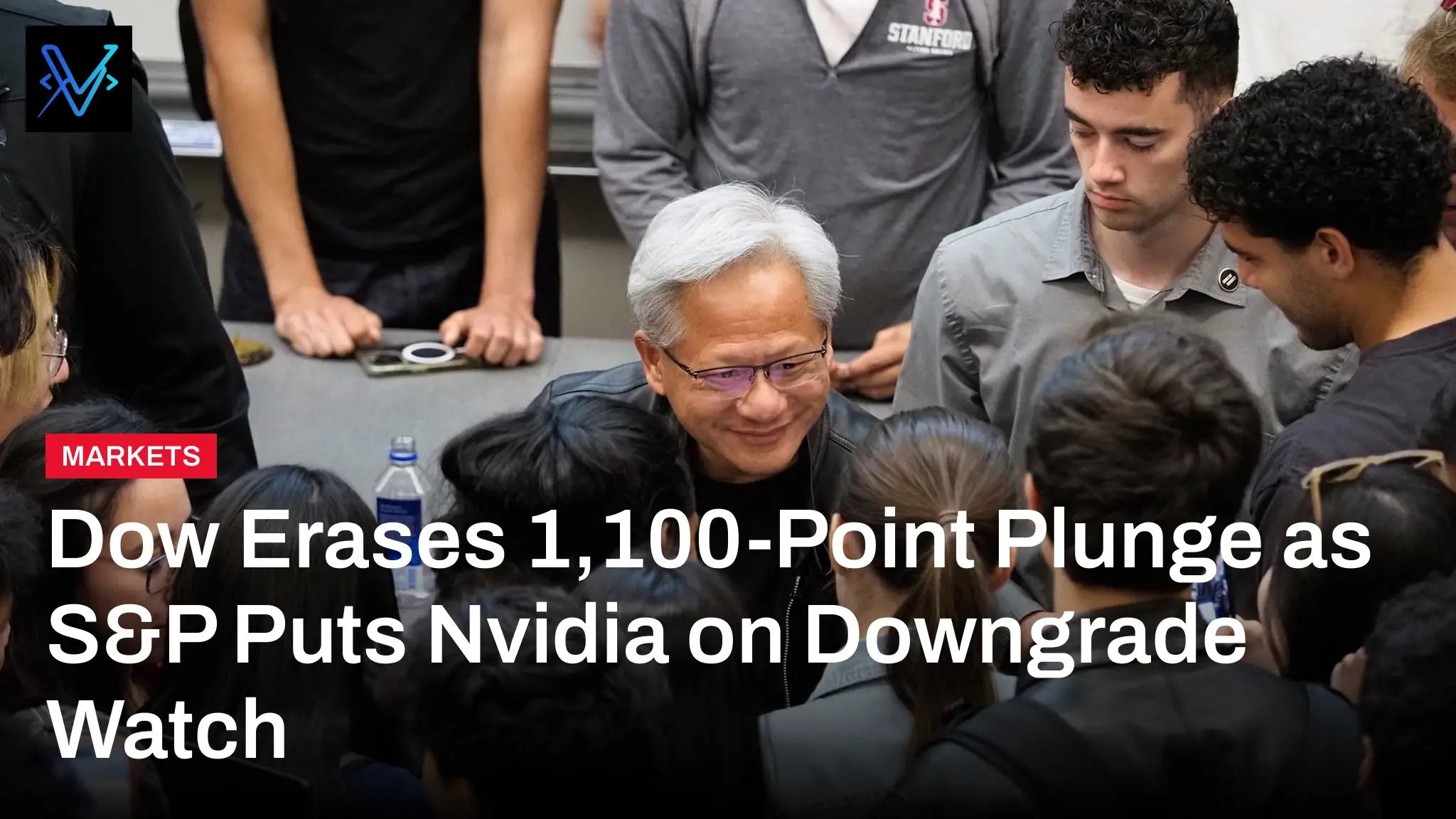
Nvidia chief executive Jensen Huang after a talk at Stanford University in April 2026. (Photo: Anders Eidesvik / Wikimedia Commons, CC BY 4.0; Nvidia logo: Wikimedia Commons, CC0)
The comeback in numbers
Wednesday morning looked like a rout. Futures had already slid overnight, hot inflation data landed before the open, and the White House’s new tariff proposals gave traders one more reason to sell. By mid-morning, the damage was severe — and then, slowly, buyers came back.
| Index / stock | Worst point on Wednesday | Close |
|---|---|---|
| Dow Jones | Down more than 1,100 points | +0.33% at 50,183 |
| S&P 500 | Down as much as 3.2%, below 7,000 | Down about 0.3% |
| Nasdaq Composite | Down as much as 4.6% | Down 0.6% at 23,586 |
| Nasdaq 100 | Briefly in bear-market territory | Down 0.64% |
| Nvidia | Down more than 9% | Down 3.9% at $149.30 |
| Anthropic | Down nearly 10%, briefly below a $1 trillion market value | Up 1.1% |
The comeback was broad, not just a tech story. Roughly three-quarters of the stocks in the S&P 500 rose on the day. Money rotated into the parts of the market investors see as safer: banks and payment companies climbed, with Visa up 1.8%, Mastercard up 1.9% and American Express up 1.2%, while Meta rose 3.4% and Salesforce gained 2%. HP jumped 11.5% after better-than-expected earnings. The message from the tape was not that investors have stopped worrying — it was that they have stopped selling everything at once.
Even so, the month’s damage is real. The S&P 500 is now down 5.2% for November, and the Cboe Volatility Index — Wall Street’s fear gauge — closed just above 28, a level that says traders still expect big swings. “At this point, between the AI angst and the newly announced tariffs, it doesn’t look like the Santa Claus Rally is in store for us this year,” Chris Zaccarelli, chief investment officer at Northlight Asset Management, said in a research note.
Why did Nvidia fall again on Wednesday?
Nvidia was the centre of the sell-off for the second day running, and this time the selling had a fresh trigger. S&P Global Ratings announced it was placing the company’s AA credit rating on CreditWatch with negative implications — the formal step before a possible downgrade. The agency said it would finish its review within 90 days and could cut the rating by one notch, to AA-.
The reason had nothing to do with Nvidia’s finances, which remain formidable. It was about governance. S&P said the departure and subsequent reinstatement of chief executive Jensen Huang had exposed “weak executive oversight and lack of succession planning” and a heavy dependence on one man — what the industry calls key man risk. The agency was blunt about the board: “We believe the long tenure of certain board members may have compromised their independence. The company’s corporate governance practices may also not have kept pace with Nvidia’s rapid growth and its role as a critical global technology enabler.”
It added that it was “unaware of any remedial action enacted by the board to address what could be meaningful management and governance deficiencies” — in other words, Huang is back, but nothing about the board that fired and rehired him in 11 days has changed.
Why a one-notch downgrade still matters
A cut from AA to AA- would leave Nvidia comfortably investment-grade, and on its own it would barely move the company’s borrowing costs. The reason markets care is what Nvidia’s credit rating underwrites. Huang’s dramatic return as chief executive steadied the shares for a day, but the financing machine behind the AI boom still runs on Nvidia’s name.
In August, Nvidia announced plans to arrange $500 billion in financing for AI infrastructure with six financial institutions, including Goldman Sachs, Apollo and Blackstone. Under the original terms, Nvidia would guarantee 25% of the loans — and lenders were already demanding bigger guarantees before Huang’s ouster. A downgrade would almost certainly push them to demand more. Nvidia also backstops the so-called neoclouds, smaller AI infrastructure companies that lack strong credit of their own; a lower rating could make their debt costlier or force them to post more collateral.
Moody’s struck a different note on Wednesday, saying Huang’s return eases near-term uncertainty around execution and leaving Nvidia’s Aa1 rating and stable outlook unchanged — while adding that governance and regulatory uncertainty persists. Last week, Moody’s had already cut Nvidia’s outlook from positive to stable over the same concerns.
One cloud over the saga lifted slightly on Wednesday. The Wall Street Journal reported that US officials found no evidence that tech executive Alice Huang was directed by Beijing to spy on Jensen Huang, after briefing congressional intelligence committees. Officials said she had contacted China’s spy agency but found no indication she provided significant intelligence. Reuters also reported that the Justice Department did not conduct a formal investigation into Huang before President Donald Trump pushed for his return.
Inflation and tariffs piled on
Nvidia was not the only problem on Wednesday. The Federal Reserve’s preferred inflation gauge, the personal consumption expenditures price index, showed prices rose 3.8% in October from a year earlier, up from 3.6% in September. Core inflation, which strips out food and energy, rose 3.3% — well above the Fed’s 2% target. Traders now see a December rate rise as near-certain, with futures implying a 98% chance of a 25-basis-point increase, and the CME FedWatch tool showing a 59% chance of another rise in January.
At the same time, the economy itself looks strong: third-quarter growth was revised sharply higher, to a 4.3% annual rate — the fastest in three years — powered by consumer spending and business investment in AI. That combination, hot inflation plus hot growth, is exactly what makes the Fed’s job difficult, and it is why bond yields fell even as stocks recovered: the 10-year Treasury yield dropped to 4.85%, an 11-week low, as investors rotated into government bonds for safety.
Then came tariffs. The White House proposed new duties on 14 major trading partners, including China, Japan and the European Union, aimed at what it calls structural excess industrial capacity. The one piece of good news, according to Capital Economics, is that the new duties will not stack on top of those imposed in July — so the increase in the effective tariff rate looks set to be “a touch lower than we’ve been assuming.” Brent crude still rose 3.5% to $94.61 a barrel, partly on the Houthi attacks on Saudi oil infrastructure reported earlier in the week.
Asia bounced back overnight
The recovery did not stop at the New York close. Asian shares rallied on Thursday after Wall Street fought back from its lows: Japan’s Nikkei gained 1.6% and South Korea’s main index rose 1.9%, with chip stocks leading the rebound. The MSCI Asia-Pacific index outside Japan edged up 0.6%, and US futures pointed higher early on Thursday, with S&P 500 futures up 0.5%.
Context matters, though. Japan is still down 8% for the month, South Korea has shed 16% and Taiwan 15% — the wreckage of the AI sell-off that swept Asia on Wednesday, when SoftBank plunged nearly 15% and Samsung and SK Hynix each fell about 10%. Thursday’s bounce is a recovery from a deep hole, not a return to calm, and gold — down almost 8% this month — is still telling the same story: investors are not sure the worst is over.
What it means for your money
For anyone holding a retirement account or an index fund, Wednesday was a reminder of how concentrated the market has become. A handful of AI stocks now decide whether the major indexes rise or fall on any given day, and Nvidia alone has lost $2.3 trillion from its October peak — down 38% since October 6. When the biggest stock in the market swings 9% before lunch, every diversified portfolio feels it.
The rotation underneath the headline numbers may matter more than the comeback itself. Investors bought banks, payment companies and dividend payers while selling the highest-priced growth names — the same pattern that has marked the worst days of this sell-off. And the question hanging over all of it — whether the hundreds of billions being poured into AI infrastructure can ever earn its money back — has not gone away. It has simply been joined by a new one: whether the company at the centre of the boom is properly governed.
What to watch next
Three things decide what happens from here. The first is Friday. US markets are closed on Thursday for Thanksgiving, and Friday is a half-day session — stocks close at 1pm Eastern — with thin volume that can make small orders move prices more than usual. A quiet Friday would help; another sharp swing would not.
The second is Nvidia’s board. S&P has given it 90 days, and the agency has said plainly it wants to see concrete steps on board independence, oversight and succession planning. Any shake-up, or any sign the board intends to carry on unchanged, will move the stock.
The third is the Federal Reserve’s December meeting. A rate rise now looks near-certain, but the market will be listening for what comes after it — and whether the central bank thinks the AI-driven economy can keep growing at 4.3% without inflation getting worse. Wednesday showed that Wall Street can still find buyers at the lows. It has not yet shown that it believes the AI boom’s problems are solved.
Looking to grow your business online? Explore Vertex Agency at vertexagency.in for professional website development, Meta Ads and social media growth.
Sources
- Associated Press — Wall Street recovers most early losses as pullback in AI stocks eases (Nov 25, 2026)
- TechCrunch — S&P considers Nvidia credit downgrade over governance and ‘key man’ risks (Nov 25, 2026)
- Reuters — Asia shares bounce, AI and tariffs lurk in background (Nov 26, 2026)
- Cboe — Call It Wall Street’s Turkey of a Trading Day (Nov 25, 2026)
- CNBC TV18 / Reuters — S&P Global Ratings placed Nvidia’s credit rating on watch for a possible downgrade (Nov 26, 2026)
- Motley Fool — Stock Market Today, Nov. 25: Dow Erases 1,100-Point Loss as Wall Street Stages Dramatic Late-Day Comeback (Nov 25, 2026)