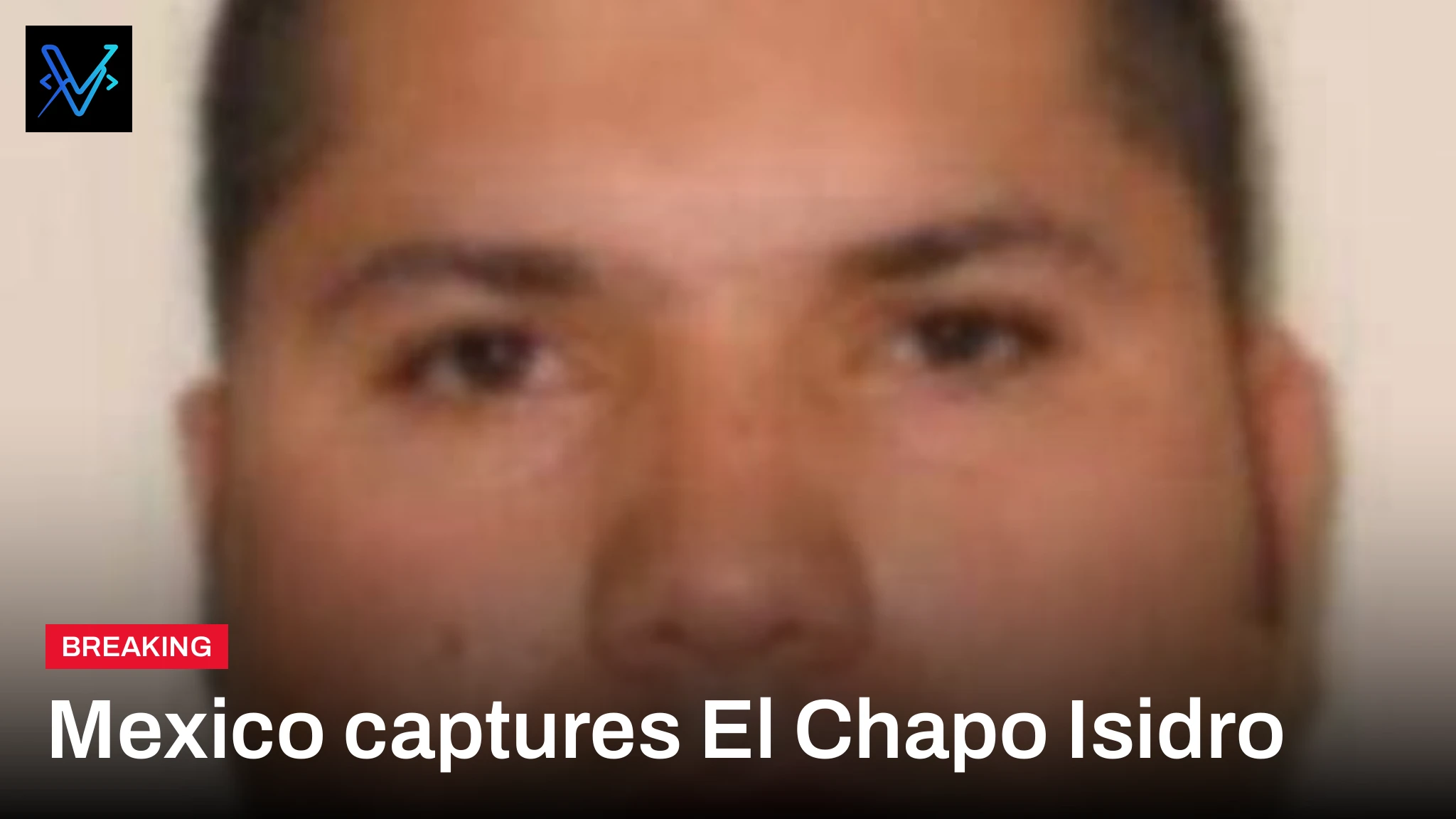
Mexican special forces captured Fausto Isidro Meza Flores, known as "El Chapo Isidro," one of the FBI's Ten Most Wanted fugitives, in an overnight raid on Friday in the city of Guasave, Sinaloa. The operation left 11 people dead — four Mexican soldiers and seven cartel gunmen — and set off a wave of cartel violence, with burning roadblocks, torched businesses and residents fleeing a baseball game as helicopters opened fire overhead.
KEY POINTS
- Meza Flores, 44, was captured on Friday night in Guasave, Sinaloa, along with two other leaders of his organisation. The United States had offered a $5 million reward for information leading to his arrest.
- Four Mexican Army soldiers and seven alleged cartel gunmen were killed in the raid. Eight people were arrested, and the three leaders were flown to Mexico City early on Saturday.
- The operation was carried out with intelligence shared between the United States and Mexico, and comes as President Donald Trump has pressed Mexico to do more against the cartels, even threatening unilateral military action.
This story is developing and will be updated as more details are confirmed.
The raid on Guasave
The firefight broke out at around 7 p.m. on Friday in Guasave, a municipality of about 290,000 people in north-western Mexico. Mexican authorities said they used "stealth and surprise" to move on Meza Flores, setting up a security perimeter around the building where he was staying. Then the shooting started.
Cartel gunmen attacked the soldiers with guns and explosives, and the troops forced their way into the house and detained him. Military helicopters and drones circled the city, and helicopters opened fire on targets on the ground. The fighting spread across Guasave. "The fighting was happening all over Guasave," Alma Camacho, a local journalist, told the Associated Press.
It spilled into ordinary life in the most jarring ways. Spectators fled a baseball game at Kuroda Park as gunfire rang out nearby, forcing the match between the Algodoneros de Guasave and the Venados de Mazatlán to be suspended. Thousands of people took shelter in grocery stores and other buildings. "Last night, many businesses were burned, including Oxxo stores, kiosks and pharmacies, along with cars and trucks," Paola Sánchez, a Guasave resident and firefighter, told AP. The city's firefighters had to shelter at their station and wait until Saturday morning before they could go out to check what was still burning.
Cartel members set up at least 10 roadblocks with burning vehicles on Guasave's streets, and the violence was so intense that the military could not get Meza Flores out of the city until 4 a.m. on Saturday, when he was flown to Mexico City aboard a Mexican Air Force aircraft. He arrived at 5:20 a.m. and was handed over to the Specialized Prosecutor's Office for Organized Crime, along with his cousin, who was his second-in-command, and his brother-in-law, who was his financial operator. Five other people arrested in the operation were turned over to the Attorney General's Office in Culiacán. Troops seized a .50-calibre rifle, a grenade launcher and two hand grenades in the raid.
By Saturday, the violence had substantially subsided. Sinaloa state authorities said "the situation is under control" and that residents could resume normal activities, though the mood in the city was still nervous — businesses stayed closed, streets were deserted, and burned-out trucks continued to line the freeway into town. Residents remained "very afraid," Camacho said, because security forces were absent from the streets.
Who 'El Chapo Isidro' is
The nickname invites confusion with Joaquín "El Chapo" Guzmán, the jailed Sinaloa Cartel boss. Meza Flores is a different man — and for more than a decade, he has been one of the Sinaloa Cartel's leading rivals.
Born in 1982 in Navojoa, in the state of Sonora, he rose through the Beltrán Leyva cartel and later led his own organisation, the Meza-Flores Transnational Criminal Organization, built around a gang known as Los Mazatlecos that operates in Guasave, Los Mochis and Mazatlán. According to the US State Department, he and his organisation smuggled vast amounts of heroin, methamphetamine, cocaine and marijuana into the United States for more than 20 years. The US Treasury froze his assets under the Kingpin Act back in January 2013.
He was added to the FBI's Ten Most Wanted Fugitives list on February 4, 2025 — the 533rd fugitive ever placed on the list — wanted on charges of conspiring to manufacture and distribute methamphetamine, cocaine, heroin and marijuana for importation into the United States, as well as firearms charges. The State Department's Narcotics Rewards Program offered up to $5 million for information leading to his capture.
His organisation had recently allied with the Los Mayos faction of the Sinaloa Cartel. That matters because the Sinaloa Cartel has been tearing itself apart since its founder, Ismael "El Mayo" Zambada, was taken into US custody in 2024, with the Los Chapitos and Los Mayos factions fighting for control of the cartel — and of Sinaloa state itself. The Trump administration designated the Sinaloa Cartel as a foreign terrorist organisation last year.
A US-Mexico operation
What made this raid different from the usual cartel takedown is how openly both governments are describing the cooperation behind it. Mexico's Defense Ministry said special forces from the army and the National Guard carried out the capture in coordination with US and Mexican intelligence agencies, with intelligence support from the Joint Interagency Task Force-Counter Cartel. The US ambassador to Mexico, Ronald Johnson, wrote on X that "the exchange of strategic intelligence between the United States and Mexico helped make this operation possible," adding: "Results like these are not achieved overnight. They are the product of sustained cooperation and trust."
Several US agencies applauded the operation. Homeland Security Investigations called it "a MAJOR blow to one of Mexico's most powerful cartel networks." US Northern Command said its counter-cartel task force had worked with other US interagency partners on information that led to the capture, and the Drug Enforcement Administration commended the Mexican authorities.
The timing is not accidental. Mexico has captured or killed a string of high-profile suspected drug traffickers in recent months, under heavy pressure from Washington. President Trump has threatened unilateral military action inside Mexico if the government does not do more against the cartels, and his administration has pushed Mexico's government to go after the criminal groups far more aggressively than before. In February, the military killed Nemesio Oseguera Cervantes, known as "El Mencho," the leader of the Jalisco New Generation Cartel.
Mexican President Claudia Sheinbaum has gone after the illegal groups more aggressively than her predecessors, and homicides have dipped significantly in her two years in office. Her security secretary, Omar García Harfuch, called the detention "an important step in pacifying Sinaloa" and said armed forces would remain deployed in the state to protect civilians. He also extended his condolences to the families of the four soldiers killed in the operation.
The raid in numbers
| Measure | Figure | Source |
|---|---|---|
| US reward for his capture | $5 million | FBI / US State Department |
| Killed in the raid | 11 — 4 soldiers, 7 gunmen | Mexico Defense Ministry |
| Arrested | 8, including Meza Flores, his No. 2 and his financial operator | Mexico Defense Ministry |
| Cartel roadblocks in Guasave | At least 10 | AP / federal official |
| Years smuggling drugs into the US | 20+ | US State Department |
| FBI Most Wanted listing | No. 533, added February 4, 2025 | FBI |
| Extraction from Guasave | 4 a.m. Saturday, after hours of gunfire | AP |
Why it matters
For Washington, this is the clearest win yet from its pressure campaign on Mexico. A man on the FBI's Ten Most Wanted list, with a $5 million price on his head and two decades of trafficking behind him, is now in Mexican custody — caught with direct help from US intelligence. It is the kind of result the Trump administration has been demanding, and both governments are treating it as proof that the cooperation works.
For Mexico, it is a test of a strategy. Sheinbaum's government has moved faster against cartel leaders than its predecessors, and the falling homicide numbers suggest the approach is having an effect. But every high-profile capture carries the same risk, and Guasave showed it in real time: within hours of the arrest, the cartel's gunmen had the city under siege, with roadblocks, burning vehicles and families hiding in grocery stores.
For the people of Sinaloa, the question is simpler and more immediate. The violence subsided by Saturday, but the fear did not. The cartel's network — its gunmen, its street dealers, its businesses and its political and police connections — is still there. Taking the man at the top does not, on its own, take the organisation apart.
The catch: taking the kingpin doesn't take the cartel
That is the warning security experts are already sounding. Mexican security analyst David Saucedo told AP that the capture of Meza Flores is another case of the two governments falling back on the so-called kingpin strategy — zeroing in on cartel bosses as the way to fight organised crime. The problem, critics say, is that it often triggers violent power struggles, like the one now tearing Sinaloa apart, without dismantling the organisation itself.
"What is evident is this is a product of pressure from the United States," Saucedo said. "What they do is capture high-profile kingpins — the leaders — but they don't dismantle the entire organization. They arrested the No. 1 and No. 2, but the entire network of hit men, street-level drug dealers, businesses and political and police connections remains intact."
That pattern is familiar in Mexico. The Beltrán Leyva cartel itself was born out of a split: after its leader Arturo Beltrán Leyva was killed by the military in 2009, the organisation fractured, and the violence that followed killed thousands. Meza Flores stayed loyal to the family. Now his own removal could set off another round of jockeying for control of the smuggling routes around Mazatlán and the mountains of Sinaloa.
What to watch next
Three questions will decide what this capture actually means. The first is whether Washington seeks Meza Flores's extradition, and how quickly — he faces US drug trafficking and firearms charges, and the $5 million reward suggests the US case against him is substantial. The second is whether the violence in Sinaloa flares again, either as his organisation fights over succession or as the rival Los Chapitos faction tries to take advantage. And the third is what Trump does next: whether a success like this eases his threats of unilateral action inside Mexico, or whether he uses it as proof that more pressure works and demands even more.
The capture caps a crowded foreign-policy stretch for Trump, who has just returned from the first trilateral summit with Xi Jinping and Vladimir Putin in Shenzhen. It was a violent weekend beyond Mexico, too — Saudi defences intercepted Houthi missiles over Riyadh for a third straight day. And Trump discussed the weekend's news in a round of Fox News interviews on Saturday — the same interviews in which he pledged to work with Democrats on a 10% cap on credit card interest rates.
For now, one of the FBI's most wanted men is in a cell in Mexico City. The network he built is still standing. What happens next depends on whether anyone can take that apart too.
Looking to grow your business online? Explore Vertex Agency at vertexagency.in for professional website development, Meta Ads and social media growth.
Sources: Reuters — Mexico captures top drug lord 'El Chapo Isidro,' latest in string of arrests; AP — Cartel leader captured in northern Mexico in a bloody firefight that left 11 dead; Wikipedia — Fausto Isidro Meza Flores. Photo: FBI / Wikimedia Commons (public domain).