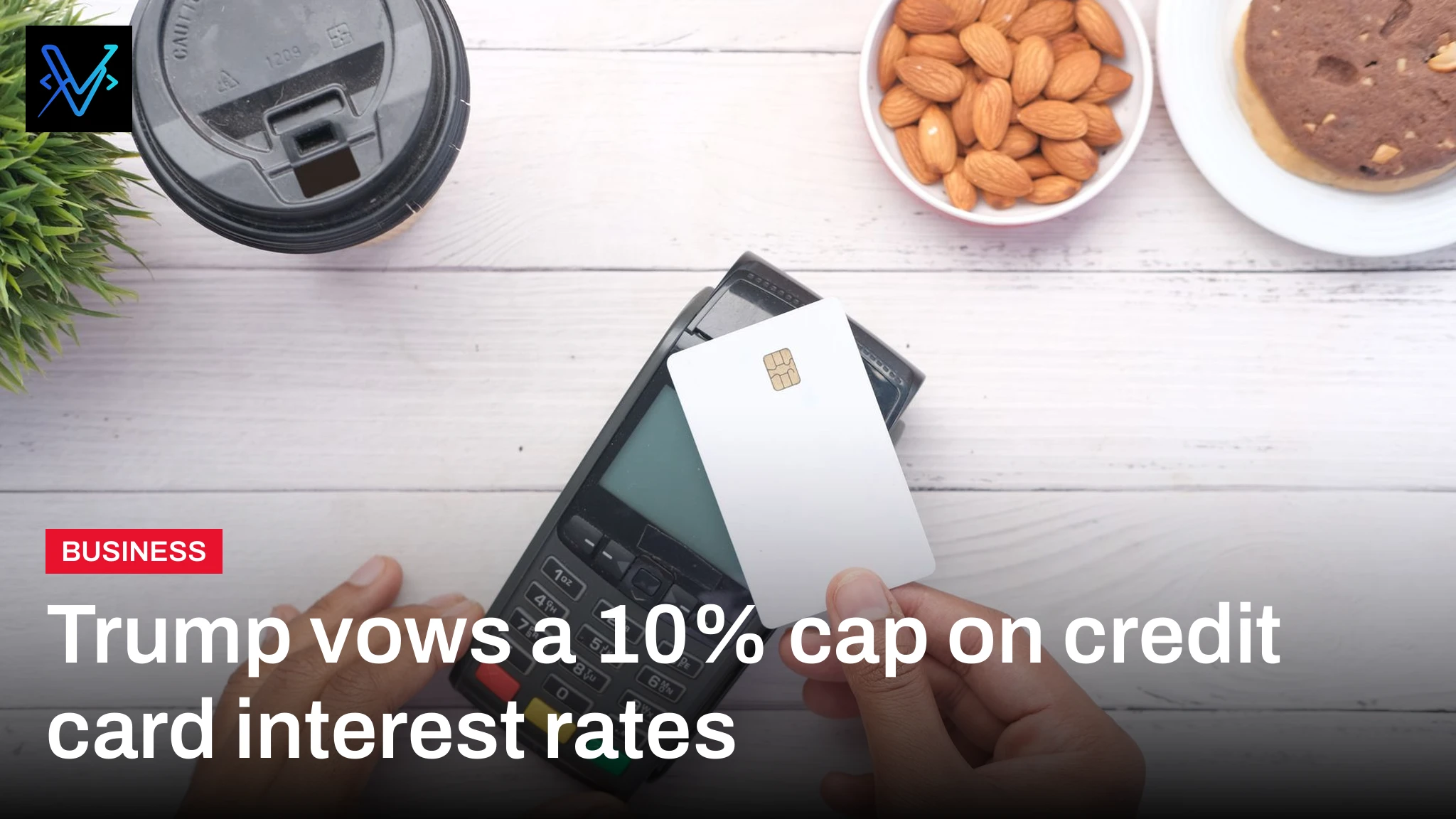
President Donald Trump said on Saturday that he would work with the incoming Democratic Congress to cap credit card interest rates at 10%. If it happens, it would be the biggest change to American borrowing in decades — and the average cardholder, paying about 22% interest right now, would feel it straight away.
KEY POINTS
- Trump told Fox News Channel's "Saturday in America" that he would work with the incoming Democratic Congress to cap credit card interest rates at 10%, saying: "These credit card companies have made a lot."
- The median credit card interest rate is roughly 22.2%, according to an August survey by the New York Federal Reserve, and the average rate on accounts charged interest was 22.36% in the third quarter of 2026, according to Federal Reserve data.
- A cap is not something Trump can impose on his own — it needs an act of Congress. But the politics have flipped: Democrats won both chambers in the November 3 midterm elections and take control in January, and bipartisan cap bills already exist in both chambers.
What Trump said on Saturday
"I would do it. These credit card companies have made a lot," Trump said in the Fox News interview, adding that he would work with the incoming Democratic Congress to get a cap done. It is a promise he first made on the 2024 campaign trail, and one he revived in January this year with a Truth Social post calling for a one-year cap on credit card interest rates of 10%, saying his administration would not allow Americans to be "ripped off" by rates reaching 20 to 30%.
Back then, the idea went nowhere. Banks and credit card companies opposed it immediately and aggressively, and the Republican-controlled Congress showed little appetite for it. House Speaker Mike Johnson warned in January that a cap could have "negative secondary effects", and no bill ever came close to a vote. Bank of America and Citigroup reportedly considered offering a card with a 10% cap for a year to satisfy the president's demand, but neither bank followed through.
The numbers behind the cap
The gap between what Americans pay and what Trump is proposing is enormous. The median credit card interest rate sits at roughly 22.2%, and many cards — especially those for borrowers with lower credit scores — charge well above 25%. Cutting that to 10% would more than halve the cost of carrying a balance.
| Measure | Figure | Source |
|---|---|---|
| Median credit card APR | ~22.2% | New York Fed, August survey |
| Average rate on accounts charged interest | 22.36% | Federal Reserve, Q3 2026 |
| Proposed cap | 10% | Trump / bipartisan bills |
| Estimated annual savings if capped | ~$100 billion | Researchers studying the pledge |
| Americans with credit cards (2024) | ~195 million | Consumer Financial Protection Bureau |
| Interest assessed in 2024 | $160 billion | Consumer Financial Protection Bureau |
| Total US credit card debt | ~$1.23 trillion | New York Federal Reserve |
Researchers who studied Trump's campaign pledge found that Americans would save roughly $100 billion a year in interest if rates were capped at 10%. The same researchers found that the credit card industry would take a major hit but would still be profitable — although rewards and other perks might be scaled back.
Why it stalled — and what changed
The obstacle was never public opinion. Lawmakers from both parties have spent years complaining about high rates, and bills to cap them have been sitting in Congress since long before Trump revived the idea. In February 2025, Senators Bernie Sanders and Josh Hawley — a pairing that spans the political spectrum — introduced the 10 Percent Credit Card Interest Rate Cap Act, which would cap rates at 10% for five years. Representatives Alexandria Ocasio-Cortez and Anna Paulina Luna introduced a similar bill in the House. Neither passed.
What changed is the election. In the November 3 midterm elections, Democrats flipped control of the Senate and won the House. The new majorities take over when the next Congress convenes in January 2027, which means the Republican leaders who were reluctant to advance a cap will no longer control the agenda. Senator Elizabeth Warren, who is expected to become chair of the Senate Banking Committee, said on November 8 that she is ready to work with Trump on a cap. After Saturday's interview she put it bluntly: "Let's cap credit card interest rates and save Americans money." Representative Maxine Waters, a senior Democrat on the House Financial Services Committee, has endorsed the idea as well, and Hawley has urged Congress to "pass my bipartisan bill to cap these rates and deliver relief right away".
The catch: Trump can't do this alone
For all the Saturday headlines, one fact matters more than the rest: the president has no authority to impose a nationwide cap on credit card interest rates by himself. That kind of move requires an act of Congress. The Constitution gives Congress the power to regulate interstate commerce, and credit cards plainly fall under it — but the president cannot write the law himself, and the Consumer Financial Protection Bureau has not been given the power to set interest rate caps either.
That is why the January deadline Trump set — a cap effective January 20, 2026 — came and went with rates essentially unchanged. A bill has to pass both chambers and be signed into law, and lawmakers still need to settle the details: whether a cap would last one year, as Trump proposed, or five, as the Sanders-Hawley bill provides. The politics are suddenly favourable. The arithmetic of passing a law is still the hard part.
What the banks say
The industry's argument has not changed since January. In a joint statement, banking groups said a cap would "be devastating for millions of American families and small businesses who rely on and value their credit cards". Their warning is specific: if lenders cannot charge high rates to offset the risk of lending to borrowers with poor credit, they will cancel those cards, cut credit lines, or stop offering cards to subprime borrowers altogether — and trim the rewards programmes that interest income helps to fund.
JPMorgan chief executive Jamie Dimon has publicly warned that a cap could harm the US economy and hurt the very consumers it aims to protect by restricting access to credit for riskier borrowers. The counter-argument, from the researchers who ran the numbers, is that the industry would remain profitable at 10% — just less so, with fewer perks attached.
Why it matters
Credit card debt is the most expensive debt most Americans carry, and there is more of it than ever — about $1.23 trillion, according to New York Fed figures. For a household carrying a $5,000 balance at 22%, the interest alone runs to more than $1,100 a year. At 10%, that falls to $500. Multiply that across 195 million cardholders and the stakes of this fight become obvious.
The timing adds pressure of its own. Households are already squeezed: Friday's market rout erased the Nasdaq's gains for the whole of 2026, and affordability has become the defining domestic issue of Trump's second term. A credit card cap is one of the few policies that lets a Republican president and a Democratic Congress claim the same win — cheaper borrowing, delivered together, just as both sides face voters again.
What to watch next
The first test comes in January, when the new Congress is seated and the Banking Committee gets a new chair. Watch whether Warren puts a cap bill on the agenda early, whether Hawley's bipartisan bill becomes the vehicle, and whether the White House backs a specific text or keeps the pressure general. The second test is the banks: whether any major issuer pre-empts legislation by voluntarily offering a 10% card, as Bank of America and Citigroup considered doing earlier this year. And the third is the fine print — one year or five, and what happens to rewards and credit access if a cap actually passes.
The cap push comes at the end of a crowded week for Trump, who has just returned from the first trilateral summit with Xi Jinping and Vladimir Putin in Shenzhen. The diplomacy made the headlines abroad. The credit card fight is the one that will be felt at home.
A 10% cap has gone from a campaign line to a live negotiation in less than a year. The president wants it. The incoming Congress wants it. The only question left is whether the two sides that agree on almost nothing can agree on this — and whether the banks let them.
Looking to grow your business online? Explore Vertex Agency at vertexagency.in for professional website development, Meta Ads and social media growth.
Sources: AP — Trump vows to work with Democrats to cap credit card interest rates at 10%; Nolo — 10% Credit Card Interest Rate Cap: Is It Legal?. Photo: Towfiqu barbhuiya / Pexels.