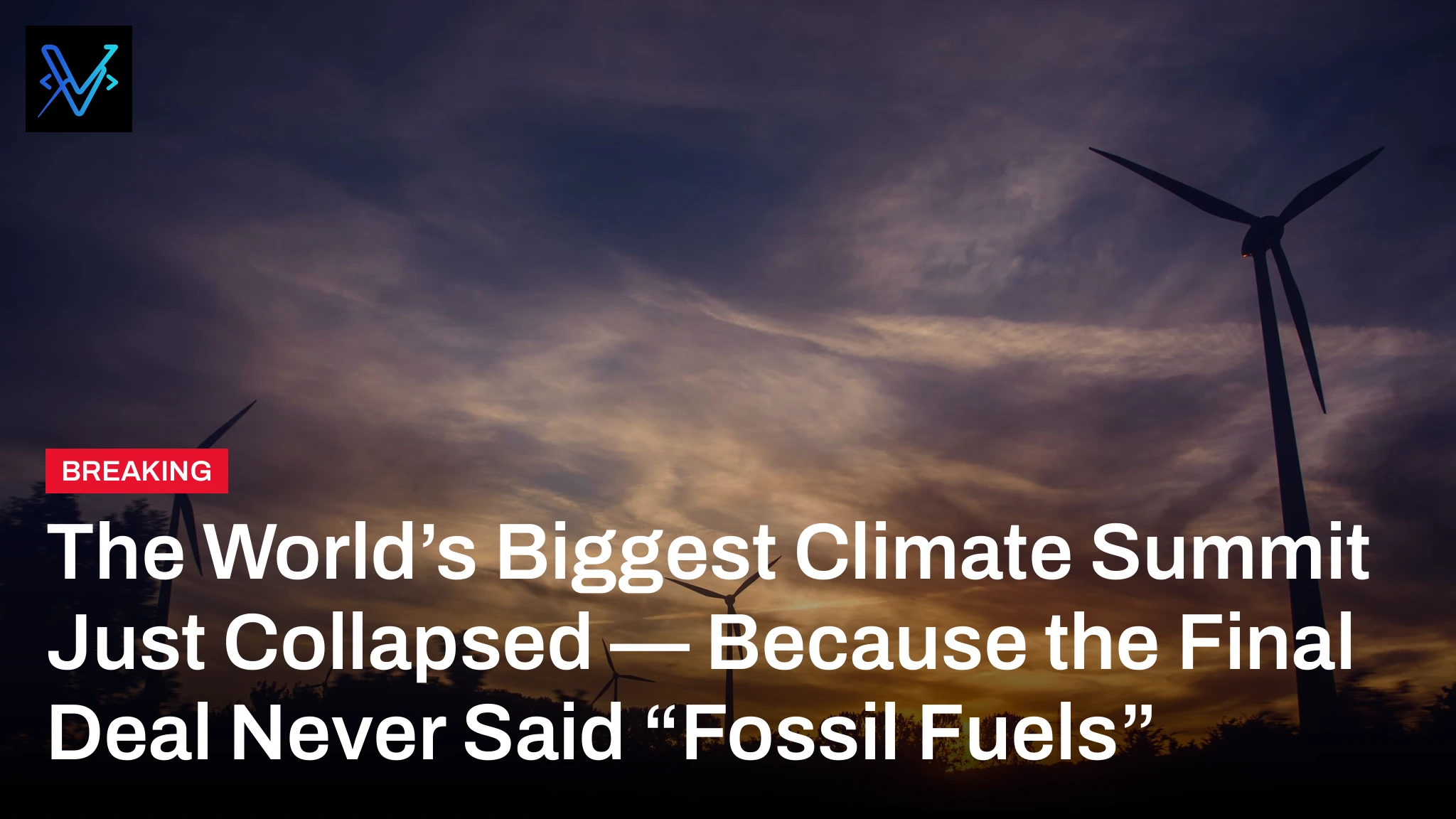
Two weeks of talks, 92,000 registered attendees, a record 44 hours of overtime — and in the end, nothing. The COP31 climate summit in Antalya, Türkiye, closed on Sunday without an agreement, after the European Union and more than 130 countries refused to sign a final text that never once mentioned fossil fuels.
KEY POINTS
- COP31 ended on Sunday, November 22, with no overarching agreement — the first time UN climate talks have failed to adopt a deal by consensus since Copenhagen in 2009. The summit ran a record 44 hours past its scheduled end, making it the longest climate summit ever held.
- The draft “Antalya Pact” was rejected because it contained no mention of fossil fuels. Saudi Arabia and Russia refused to allow the words in the text; the EU and up to 130 countries, led by Ireland’s Darragh O’Brien, refused to sign a deal that “greenwashes fossil fuel.”
- Not everything died in Antalya: about 90 countries signed a pledge to raise electricity’s share of final energy use from around 22% today to 35% by 2035, and 47 countries backed a goal on methane and other super-pollutant gases. The unresolved issues now go to COP32 in Addis Ababa, Ethiopia, next year.
| What was at stake | What happened | Status |
|---|---|---|
| The “Antalya Pact” (cover decision) | Final draft omitted any mention of fossil fuels; EU and 130+ countries rejected it | Not adopted |
| Electrification pledge (“35 by 35”) | Raise electricity’s share of final energy use from ~22% to 35% by 2035 | ~90 countries + 180 businesses signed |
| Methane and super-pollutants | Goal to cut methane and other gases far more potent than carbon | 47 countries on board |
| Cutting emissions (mitigation) | No agreement on how fast countries cut emissions; Saudi Arabia and Russia blocked a decision | No dedicated process left under the Paris Agreement |
| Adaptation finance | No progress on tripling funds for climate adaptation, pledged at COP30 | Unresolved; Pacific fund A$450m short of its $749m target |
| The 1.5°C goal | Draft would have acknowledged for the first time that warming is on course to pass 1.5°C | Acknowledgement died with the text |
Source: Reuters Breakingviews, Australian Geographic / The Conversation and Al Jazeera reporting, November 23, 2026.
How two words sank a summit
The closing plenary on Sunday was chaotic. COP31 President Murat Kurum, Türkiye’s environment minister, put the final draft to the hall and got his answer within minutes. “It is clear that there are parties in this hall who oppose this text. We recognise that there is no consensus on this document. Therefore, these decisions have not been adopted,” he said.
The draft had been the product of two days of overtime — the talks were supposed to end on Friday — and nearly 200 delegations. It acknowledged, for the first time in any COP text, that global warming is on course to exceed the 1.5°C threshold countries had pledged to preserve in Paris in 2015. But it never said why. The words “fossil fuels” appeared nowhere in it.
That was not an oversight. An opening draft tabled by Australia on the first Monday of the summit had called for a faster phase-out of fossil fuels. By Thursday, a slimmer version had removed every mention of them, after Saudi Arabia and other major oil and gas producers objected. The final text referred only obliquely to the 2023 Dubai agreement to “transition away” from oil, gas and coal — the first time fossil fuels had ever been named in a COP decision — and offered carbon capture and storage as a climate solution instead.
The numbers on carbon capture tell their own story. The technology, decades old, can trap around 50 million tonnes of carbon a year at best — roughly 0.1% of global greenhouse gas emissions, according to Reuters Breakingviews. “Carbon capture is one of the biggest scams of the overshoot era,” said Sara Shaw of the campaign group 350.org.
The revolt: 130 countries said no
This time, the countries that usually swallow a weak text did not. The European Union led the revolt, backed by as many as 130 countries. Ireland’s climate minister Darragh O’Brien, speaking for the EU presidency, told the closing session the bloc “objected” to the pact because it “does not meet the moment.”
“We will not endorse a cover decision, or an Antalya Pact, that does not even mention fossil fuels, which is the key driver of climate change,” O’Brien said. “We will not accept negotiating backwards in time. And we will not accept a COP that greenwashes fossil fuel.” France’s ecological transition minister, Monique Barbut, called the proposal a “backward” step. Panama, the Marshall Islands, Vanuatu and Belize formally objected alongside the EU.
The split was not only between producers and everyone else. The two co-hosts were themselves compromised. Turkish President Recep Tayyip Erdoğan used his opening speech to announce two huge new oilfields. Australian Prime Minister Anthony Albanese spoke of the existential risk to Pacific nations while making no commitment to stop approving new Australian coal and gas projects. Chris Bowen, Australia’s climate minister and the summit’s president of negotiations, said afterwards that his team had left “nothing on the field” but had faced “unbridgeable red lines.”
Outgoing UN Secretary-General António Guterres blamed “powerful fossil fuel interests”, including exporters and corporate lobbyists. Friends of the Earth’s Asad Rehman said the failure “has abandoned millions of people affected by climate-related disasters” — though he also called the EU hypocritical for walking out over fossil fuels while expanding them at home.
What actually survived Antalya
Calling COP31 a total failure misses what did get done outside the formal negotiations. The co-hosts’ flagship pledge — to lift electricity’s share of final energy use from around 22% today to 35% by 2035 — drew support from about 90 countries and 180 businesses, including the EU and China. It was meant to sit inside the cover text; it survives as a voluntary commitment instead.
Forty-seven countries signed on to a goal on methane and other super-pollutant gases, which trap far more heat than carbon dioxide. Negotiators also moved forward on a “just transition” framework for shifting to clean energy fairly, and on aligning climate adaptation plans for the poorest nations.
And the failure itself may push countries outside the UN process. Brazil’s roadmap for phasing out fossil fuels, launched at COP31, attracted support from Germany and Nigeria among others, and EU countries are drawing up similar plans. Earlier this year, 57 nations attended the first conference on transitioning away from fossil fuels in Santa Marta, Colombia; another is planned next year, co-hosted by Tuvalu and Ireland.
But the gaps are stark. There is now no dedicated negotiating process on cutting emissions under the Paris Agreement. No progress was made on tripling adaptation finance, a pledge from COP30 in Brazil. And the Pacific Resilience Facility — the fund for island nations on the front line of rising seas — is still A$450 million short of its $749 million target for 2026, after rich nations merely re-announced existing pledges. The most notable new money came from the Solomon Islands, whose prime minister, Matthew Wale, pledged $600,000 to the Green Climate Fund. “The Pacific did not create this crisis,” he said. “But we will not stand by and wait for others to act.”
Why it matters
First, the timing. This is the first UN summit since it was officially confirmed that the world will overshoot the Paris Agreement’s 1.5°C goal by 2030 — and it was held in a year of climate-linked disasters from Europe to Nepal and Indonesia, with a supercharged El Niño pushing temperatures higher. The summit was billed as an “implementation COP”, focused on delivering pledges already made. It delivered almost none of them.
Second, the energy backdrop. Soaring energy prices and the war in Iran have put energy security at the top of every government’s agenda, and the same governments that talk about transition are the ones signing new oil and gas deals. Even the three biggest nuclear powers, meeting in Shenzhen last week, could agree on little more than that energy supplies should keep flowing. In that climate, a summit that cannot name the cause of the crisis looks less like diplomacy and more like theatre — which is why some civil society groups called Antalya “the worst COP ever”.
Third, the process itself is now in question. COP decisions need consensus from nearly 200 nations, which means any single oil producer can veto language the rest of the world wants. Some nations are calling for urgent reform, including replacing consensus with majority voting. But changing the voting rules would itself require a consensus decision — the very thing Antalya could not produce. Saudi Arabia, which blocked the fossil fuel language in Antalya, is also the country whose defences have been shooting down missiles over Riyadh for three straight days — a reminder that the politics of oil and the politics of war are the same politics.
There is a counter-reading, and it matters. Former UN climate chief Christiana Figueres has argued that the refusal of more than 130 countries to sign an inadequate deal should not be seen as a failure, but as “a sign of courage”. A bad deal, in that view, would have been worse than no deal — it would have let everyone claim progress while the emissions kept rising. Reuters Breakingviews makes a similar point: the deals that matter, from Paris onwards, still stand, and the energy transition is now driven more by economics than by communiqués. Solar and wind are cheaper than the fossil fuels they replace — even Saudi Arabia was a top-five importer of Chinese solar panels in 2024.
What to watch next
The unresolved issues — the fossil fuel phase-out, the electrification target, adaptation finance — all return at COP32 in Addis Ababa, Ethiopia, next year. Watch whether the reform debate gathers force before then: if a critical mass of countries backs majority voting, the consensus rule that let two producers sink a summit could itself be on the table.
Watch, too, what happens outside the UN. The phase-out roadmap launched in Antalya, the Colombia process, and the EU’s own plans will be where the real action is if the COP process stays paralysed. And watch the money: the Pacific fund’s shortfall and the missing adaptation finance will be the test of whether rich countries’ promises mean anything when the next disaster hits.
Antalya was supposed to leave a legacy of “working together”. Instead it leaves a question that will hang over every climate negotiation from now on: if nearly 200 countries cannot agree to name the cause of the crisis, what is the point of gathering them in one room at all? The answer may be that the room matters less than it used to — and that the countries willing to act will simply have to do it without waiting for the ones that are not.
Looking to grow your business online? Explore Vertex Agency at vertexagency.in for professional website development, Meta Ads and social media growth.
Sources: Reuters Breakingviews — COP31 failure is both healthy and a sideshow (Nov 23, 2026); Australian Geographic / The Conversation — How the COP31 climate agreement fell apart (Nov 23, 2026); Al Jazeera — COP31 talks break down as EU rejects deal without reference to fossil fuels (Nov 23, 2026). Photo: Irina Iriser / Pexels.