The US Commerce Department on Monday added Singapore-based Megaspeed — the cloud company at the centre of the Nvidia chip-smuggling scandal — to its trade blacklist, cutting off its access to American technology more than two years after investigators first began looking into whether it diverted advanced AI chips to China.
KEY POINTS
- The Commerce Department added Megaspeed International to its Entity List on Monday, November 23 — US firms now need a licence, which is likely to be denied, to sell it American goods, software or technology. Six other companies in Singapore, Malaysia and Thailand linked to Megaspeed were added too.
- Megaspeed has been under US investigation since 2024 over whether it diverted Nvidia AI chips to China. The Information reported that at least $7.5 billion worth of chips — about 240,000 H100, H200 and A100 processors — reached Chinese firms.
- The move came on the same day Nvidia reinstated Jensen Huang as chief executive and its shares jumped 31%. Treasury Secretary Scott Bessent had publicly pressed Commerce to act, and Democratic lawmakers have opened a probe into Nvidia’s influence over the investigation.
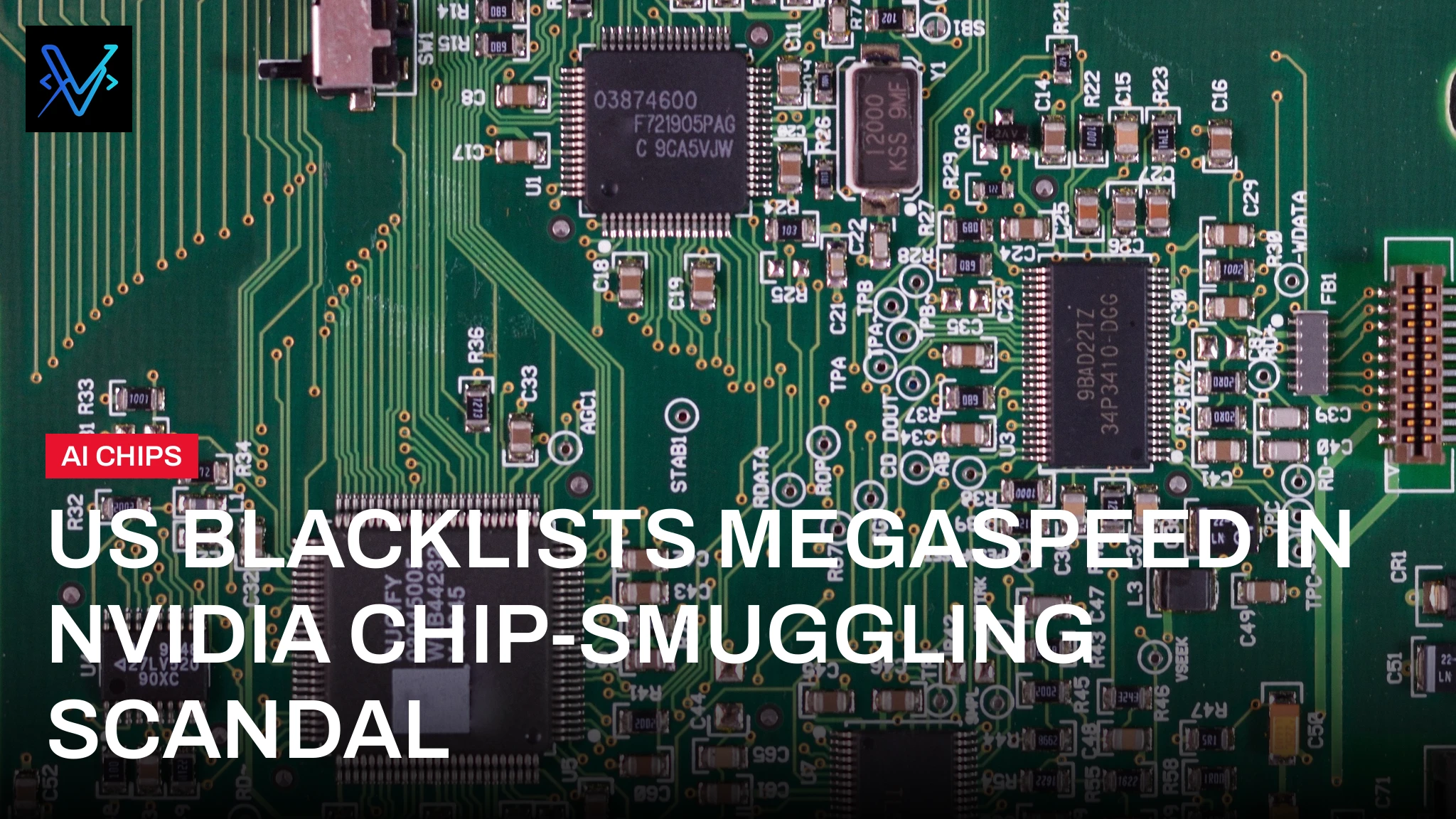
A circuit board with microprocessors. The US has added Singapore-based Megaspeed to its trade blacklist over alleged Nvidia AI chip smuggling to China. (Photo: Miguel Á. Padriñán / Pexels)
What the blacklist actually does
Being placed on the Entity List does not shut a company down overnight, but it cuts off the supply lines that matter. From now on, American companies cannot ship goods, software or technology to Megaspeed without a licence from the Commerce Department — and Reuters reports such licences are likely to be denied. Firms on the list also find it harder to get US-origin spare parts, software updates and licences for intellectual property.
For a cloud provider whose entire business is renting out computing power built on American hardware, that is a slow strangulation. Megaspeed built its business as an Nvidia cloud partner, leasing data-centre capacity in Singapore, Malaysia and Indonesia to customers — including, investigators believe, Chinese firms that could not legally buy the chips themselves.
The timing is striking. The blacklisting landed on the same day Nvidia’s board reinstated Jensen Huang as chief executive, less than two weeks after he resigned, and Nvidia’s shares surged 31% in the session. It was also the first time the Commerce Department had added any new entities to the list since October 2025.
The Megaspeed case in numbers
| Figure | What it is |
|---|---|
| $7.5 billion | Value of Nvidia chips The Information reported reached Chinese firms |
| ~240,000 | H100, H200 and A100 chips allegedly moved into China |
| 2024 | Year US authorities began investigating Megaspeed |
| 7 | Companies added to the Entity List on Monday, including Megaspeed |
| August 2025 | When Megaspeed says former executive Alice Huang left the company |
| October 2025 | Last time Commerce added entities to the list before Monday |
How we got here
The Megaspeed story broke into the open in October 2025, when The New York Times reported the company was under US investigation over whether it was helping Chinese customers obtain advanced Nvidia chips subject to Washington’s export controls. Then came the detail that turned a trade case into a scandal: US intelligence agencies had concluded that Alice Huang, a top Megaspeed executive, was a Chinese intelligence asset who passed information to Beijing — a claim Reuters has said it could not independently verify, and which China has dismissed as “groundless.”
Last month, The Information reported that Huang’s relationship with Nvidia chief Jensen Huang helped move at least $7.5 billion worth of Nvidia AI chips to Chinese companies since 2023, through a web of companies across Singapore, Malaysia and China. At the centre of that network was Shanghai Century Litong, a company linked to Huang’s sister that was granted preferred cloud partner status by Nvidia four months after it was founded. The chips — about 240,000 H-series and A-series processors — were either installed in Southeast Asian data centres and rented remotely to Chinese customers, or physically shipped into China, according to the reporting. Some of the computing power reportedly served Alibaba and Tencent, as well as smaller Chinese AI labs.
Jensen Huang admitted to employees that he had been unfaithful to his wife, and Nvidia’s board launched an inquiry into whether he was the target of a foreign intelligence effort. He resigned as chief executive on November 12. The board said it did not intend to bring him back — then reversed itself unanimously on Sunday, reinstating him with immediate effect after President Donald Trump said he had persuaded the directors to do so.
Through it all, Megaspeed has denied wrongdoing. A week ago the company issued a statement saying it conducts legitimate and lawful business, including complying with US export controls, and that Alice Huang officially left in August 2025. Nvidia, for its part, has said its board has no reason to believe national security or “Nvidia secrets” were compromised, and says it recently formed an export control committee to oversee trade compliance and national security risks.
The pressure that forced the move
The blacklisting did not happen quietly, and it did not happen without a push. For months, the striking fact about Megaspeed was its absence from the Entity List, even as the investigation widened and the Justice Department took the lead. Treasury Secretary Scott Bessent complained publicly that Commerce had not yet acted, and turned the spotlight on Nvidia itself. “The real story here should be: Did Nvidia know their client and was there a robust effort at Nvidia to make sure that there was no leakage and that they were selling to what were obviously pass-through shell companies?” Bessent told CNBC’s “Squawk Box” programme.
Lawmakers from both parties piled on. Senator Pete Ricketts said the department still owed an explanation for why the move took so long. Democratic lawmakers this week opened a probe into what influence Nvidia was able to wield over the Commerce Department’s investigation. And last week, the Justice Department and the Commerce Department issued a joint statement saying they would “bring the full extent of the law against Megaspeed for any criminal conduct that may have occurred.” The Commerce Department has also launched a criminal probe into the company, TechCrunch reported.
The pressure worked — but it also raises a question the administration will now have to answer. Reuters reported in June that the US has held off adding China’s AI startup DeepSeek, memory chipmaker CXMT and more than 100 other companies flagged as national security risks to the trade blacklist, as the Trump administration tried to avoid escalating tensions with Beijing. Megaspeed is on the list now. The others are not.
Why it matters
Export controls are the front line of the US-China race for AI supremacy, and the Megaspeed case is the biggest test yet of whether they actually work. Washington can ban the direct sale of advanced chips to China, but the controls only matter if the chips cannot simply be routed through a friendly third country and rented back across the border. The alleged $7.5 billion that flowed through Megaspeed’s network suggests the detour was wide open for years.
For Nvidia, the blacklisting does not close the questions — it sharpens them. The company was Megaspeed’s supplier and partner, and the market has already shown how much is at stake: its shares lost around half their value in the weeks after the scandal broke, then added nearly $1 trillion in a single day when Huang returned. Investors now have to weigh a different risk — that the export-control regime tightens further, and that Nvidia’s sales practices in Southeast Asia come under formal scrutiny.
For the rest of the AI industry, the message is that the enforcement gap is closing. Cloud providers in Singapore, Malaysia and Thailand that built businesses on American chips will be watching whether the six other companies added on Monday are the end of it, or the start of a wider sweep.
What to watch next
The criminal probe is the next chapter. The Justice Department is now leading the investigation, and any charges would turn a trade sanction into a courtroom case with names, dates and evidence on the public record. Huang is due to testify at an open Senate Banking Committee hearing on December 3, where lawmakers are expected to press him on what he knew about Megaspeed and its customers.
Watch, too, whether Commerce moves on the names it has so far held back. If DeepSeek or CXMT join the list, it would signal that the administration is willing to accept the diplomatic cost of a much broader crackdown. If they do not, the Megaspeed blacklisting will look like a response to political pressure over one company, rather than a change in the rules for everyone.
And the market will keep score. Nvidia’s 31% surge on Monday was a vote of confidence in Huang’s return, not a verdict on the investigation. The board’s independent inquiry is still running, and the reported Securities and Exchange Commission examination of the company’s disclosures has not gone away. The scandal that cost Huang his job for eleven days is not over — it has just moved from the boardroom to the blacklist.
Looking to grow your business online? Explore Vertex Agency at vertexagency.in for professional website development, Meta Ads and social media growth.
Sources
- Reuters via BusinessWorld — US blacklists Megaspeed cloud company linked to Nvidia scandal (Nov 24, 2026)
- TechCrunch — Megaspeed, the company at the center of the Jensen Huang scandal, appears headed for a US blacklist (Nov 23, 2026)
- Digital Trends — FBI looks into Nvidia CEO’s alleged spy affair as report claims $7.5 billion in smuggled AI chips to China (Nov 10, 2026)