Eleven days after resigning in disgrace, Jensen Huang is Nvidia’s chief executive again. The board that pushed him out voted unanimously on Monday to reinstate him as president, CEO and director, effective immediately — and investors answered with a 30% surge in the share price at the open.
KEY POINTS
- Nvidia’s board voted unanimously to reinstate Jensen Huang as president, CEO and board director on Monday, November 23, effective immediately — 11 days after he resigned on November 12. The board said it was satisfied with his candor and ability to lead, and that input from senior US government officials left it confident his return poses no national security risk.
- Shares surged more than 31% in premarket trading, opened 30% higher, and were trading at $159.95 — up 27% — at 9:51 a.m. ET, recovering from an 18-month low but still well below last month’s high of $243.
- The reversal follows days of pressure from President Donald Trump, a petition signed by more than 180,000 people including Elon Musk, and a board that had said only last week it did not intend to bring Huang back. The independent investigation into Huang will continue, and he is due to testify before Congress next month.
| The comeback by the numbers | Figure |
|---|---|
| Days between resignation and reinstatement | 11 |
| Premarket surge on Monday | More than 31% |
| Gain at the open | 30% |
| Share price at 9:51 a.m. ET | $159.95, up 27% |
| Last month’s high | $243 |
| Signatures on the petition to bring him back | More than 180,000 |
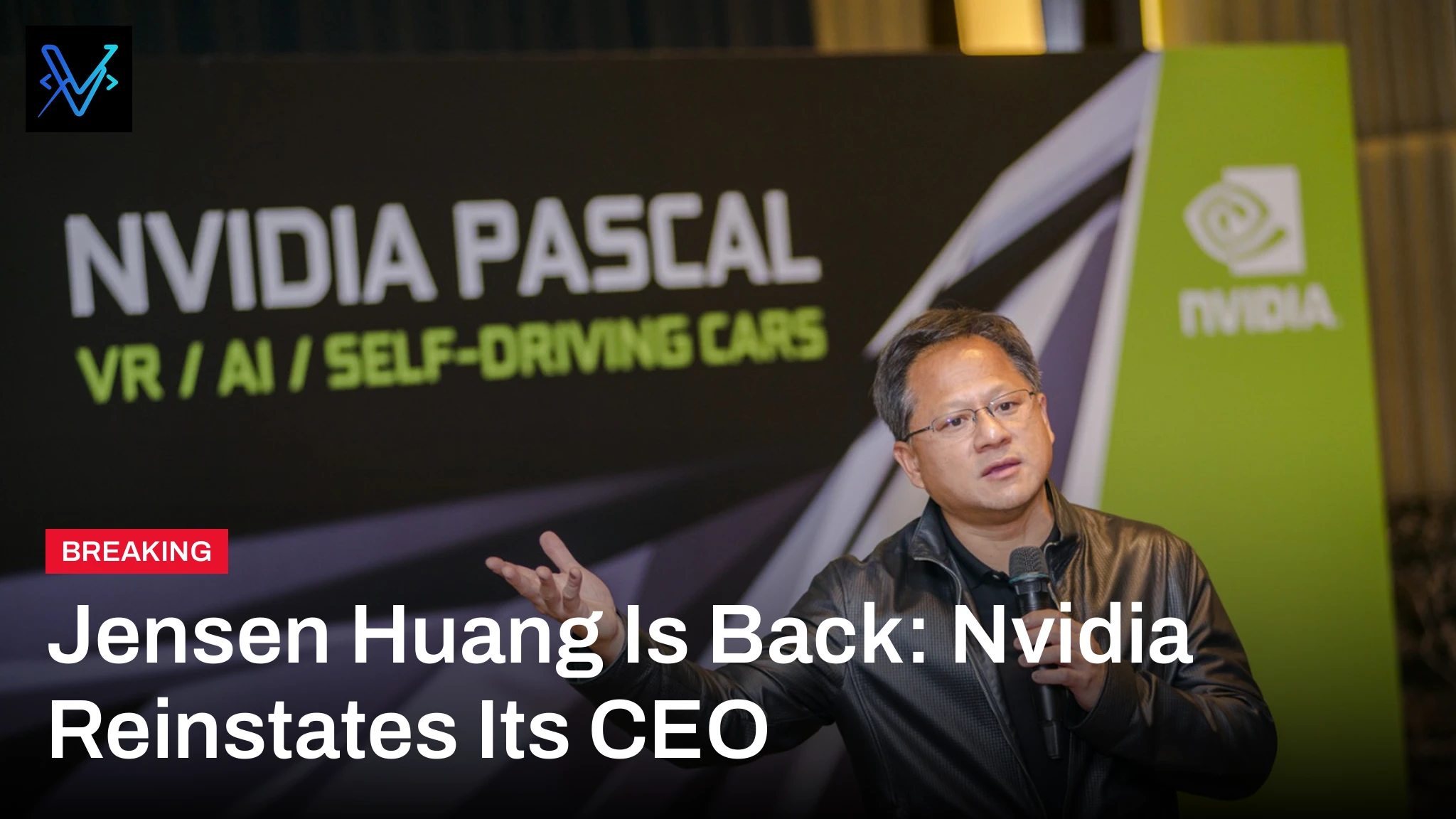
Jensen Huang at Computex Taipei in 2016. (Photo: NVIDIA Taiwan via Wikimedia Commons, CC BY 2.0)
Eleven days that shook the world’s biggest chipmaker
Huang resigned on November 12 after admitting to at least two extramarital affairs, one of them with Alice Huang, a former executive at the Singapore-based data centre firm Megaspeed. US authorities suspect Alice Huang of spying for China — an allegation Beijing denies. The New York Times reported on Monday that US intelligence believed Alice Huang was in touch with an officer of China’s Ministry of State Security from the spring of 2025 until the autumn of this year, and that her business partner Kang Wei worked with the same agency.
The fallout was immediate and brutal. The Justice Department and the Commerce Department are investigating Megaspeed over whether it broke export rules by selling advanced chips to China. Nvidia’s board formed a committee of independent directors to investigate, and the company’s shares slid to an 18-month low as investors wondered who could possibly run the company that makes the chips powering the AI boom. The questions went beyond one man’s private life: Huang co-founded Nvidia in 1993 and built it from a video-game chip designer into the dominant supplier of AI processors, personally shaping its chip roadmap, its biggest customer relationships and its ties with Washington.
That context matters, because it explains why this story is about much more than a scandal. When the founder of the world’s most valuable chipmaker walks out, the company doesn’t just lose a CEO — it loses the person its customers, its suppliers and the US government all call first. The board’s problem was never only finding a replacement. It was finding anyone who could replace him.
The board said no — then changed its mind
Just a few days ago, the board looked immovable. During Nvidia’s third-quarter earnings call, board chair Harvey Jones said the directors did not intend to reinstate Huang. The company had even retained executive search firm Heidrick & Struggles to find a permanent replacement, and chief financial officer Colette Kress was running the company as interim CEO.
Then the pressure built from every direction at once. President Donald Trump said last week that he wanted Huang back in the job, and on Monday posted on Truth Social that the board had “made the correct and proper decision” to return him, adding that the US government has no reason to believe Nvidia poses any risk to national security. Trump also said the Attorney General had confirmed the government has no evidence Huang engaged in any illegal activity. Treasury Secretary Scott Bessent, asked on Sunday’s Meet the Press whether Nvidia needed an outsider to run it, replied: “Well, Jensen is on the outside now.”
A petition calling for Huang’s reinstatement drew more than 180,000 signatures, including one from Elon Musk. Other signatories included Replit chief executive Amjad Masad, Epic Games chief executive Tim Sweeney and Y Combinator chief executive Garry Tan. Employees, shareholders and business partners all pushed in the same direction. On Monday morning, the board gave in — unanimously.
“The Board believes Jensen is the right person to lead NVIDIA, and that his reinstatement is in the best interests of our stockholders, employees, partners and customers,” Jones said in the company’s statement. Huang, for his part, struck a humble note: “I am honored to return to NVIDIA and lead one of the most consequential technology companies in the world at the beginning of a new industrial revolution. I take this responsibility with the greatest humility and renewed commitment.” Kress, thanked for her service as interim CEO, continues as chief financial officer.
The market’s verdict: a 30% surge
Investors did not wait for the details. Nvidia shares surged more than 31% in premarket trading, opened 30% higher, and were at $159.95 — up 27% — by 9:51 a.m. ET. The rally spilled across the whole chip sector: the iShares Semiconductor ETF rose 12% as Intel, SanDisk and other chipmakers bounced off their lows after a brutal week for the sector. The surge is a reminder of how far Nvidia had fallen — the stock is still down sharply from as high as $243 last month, and the wider market only just clawed its way back after its worst week since Covid.
But the scale of the move tells its own story. A 30% jump in a single morning is not a normal reaction to a routine appointment. It is the market pricing in the one thing it wanted most: the founder back in charge of the company he built. Arm Holdings, meanwhile, announced that chief executive Rene Haas will stay through 2033 and become vice chairman of SoftBank, its majority owner — Haas had been seen as one of the possible successors for Huang’s job.
Why it matters
The reinstatement settles the leadership question — for now. But it also leaves an uncomfortable one hanging in the air, and Reuters put it plainly: the board’s decision “highlights his deep influence over Nvidia and raises questions about how dependent one of the world’s most valuable companies remains on its co-founder.” A company that rises 30% on one man’s return is a company that fell just as far on his departure. That dependence is now Nvidia’s biggest governance risk, and investors know it.
There is also the small matter of timing. Nvidia reports quarterly results on Tuesday — the earnings call that was supposed to be about life after Jensen Huang is now, suddenly, about life with him back. The numbers will be judged against the same doubts that have hammered AI stocks for weeks: whether the enormous spending on AI infrastructure is paying off, and whether demand for Nvidia’s chips is holding up. Those questions did not disappear while Huang was away. If anything, his return raises the stakes — he is now the man who has to answer them.
The affair and the espionage allegations have not gone away either. The independent board committee’s investigation will proceed to its conclusion, and Huang has pledged to cooperate fully. Nvidia has also formed a new National Security and Export Control Committee, made up solely of independent directors, and is searching for a chief compliance officer. The company says it will keep cooperating with government investigations and inquiries — including the Megaspeed export probe that sits at the centre of this whole affair.
What to watch next
Tuesday’s earnings are the first test. With Huang back at the helm, the call will be watched for his own account of the last eleven days, for guidance on chip demand, and for any hint of how the board plans to handle the governance questions his comeback raises. The second test comes in Washington: Huang is due to testify publicly before the Senate Banking Committee next month, and separately before three House committees in closed session. Nvidia’s general counsel, Tim Teter, is also expected to be interviewed by the House committees.
The third test is the one nobody can schedule. The investigations into Megaspeed and the alleged Chinese intelligence effort are still running, and the board’s own committee has yet to report. The board said on Monday that, based on input from senior levels of the US government, it is confident Huang’s return poses no national security risk. That confidence will now be tested in public, in Congress and in the courts of opinion that matter to Nvidia’s customers.
For now, though, the founder is back, the stock is soaring, and the most dramatic eleven days in Nvidia’s history have ended the way they began — with Jensen Huang in charge.
Looking to grow your business online? Explore Vertex Agency at vertexagency.in for professional website development, Meta Ads and social media growth.
Sources
- NVIDIA Newsroom — NVIDIA Board Reinstates Jensen Huang as President, CEO and Board Director (Nov 23, 2026)
- TechCrunch — Nvidia reverses course and brings Jensen Huang back as CEO (Nov 23, 2026)
- Reuters — Nvidia reinstates Jensen Huang as CEO (Nov 23, 2026)
- Morningstar / MarketWatch — Nvidia stock soars as Jensen Huang returns as CEO (Nov 23, 2026)
UPDATE — 24 NOVEMBER 2026
Wall Street roared back the day after Huang’s return: the Nasdaq jumped 6.5% and the S&P 500 rose 4.7% as Nvidia surged 31.5%, adding nearly $1 trillion in market value in a single session. Read our full report on Wall Street’s best day since April.