Sanofi agreed on Tuesday to buy American biotech Insmed for $41 billion in cash, the biggest pharmaceutical acquisition in three years. The French drugmaker will pay $175 a share — a 46% premium — for a lung-disease specialist whose star drug went from US approval to blockbuster in barely a year.
KEY POINTS
- Sanofi will pay $175 per share in cash, valuing Insmed at about $41.0 billion (€37.6 billion) — a 46% premium to Insmed’s unaffected closing price on November 18, the day before reports of a possible deal emerged. Both boards have approved the deal, which is expected to close in the first half of 2027.
- The prize is Brinsupri, the first and only approved treatment for non-cystic fibrosis bronchiectasis. Approved in the US in August 2025, it has already generated $1.09 billion in revenue through September 30, 2026. Sanofi also gets Arikayce and the late-stage TPIP program; analysts at Guggenheim estimate the three assets could reach combined peak sales above $15 billion.
- The deal is Sanofi’s answer to the Dupixent cliff. Its bestselling drug accounts for nearly 40% of total sales and loses patent protection in 2031. At $41 billion, it is Sanofi’s largest acquisition since the 2004 Aventis merger — and far above the €25 billion ceiling its own finance chief set in April.
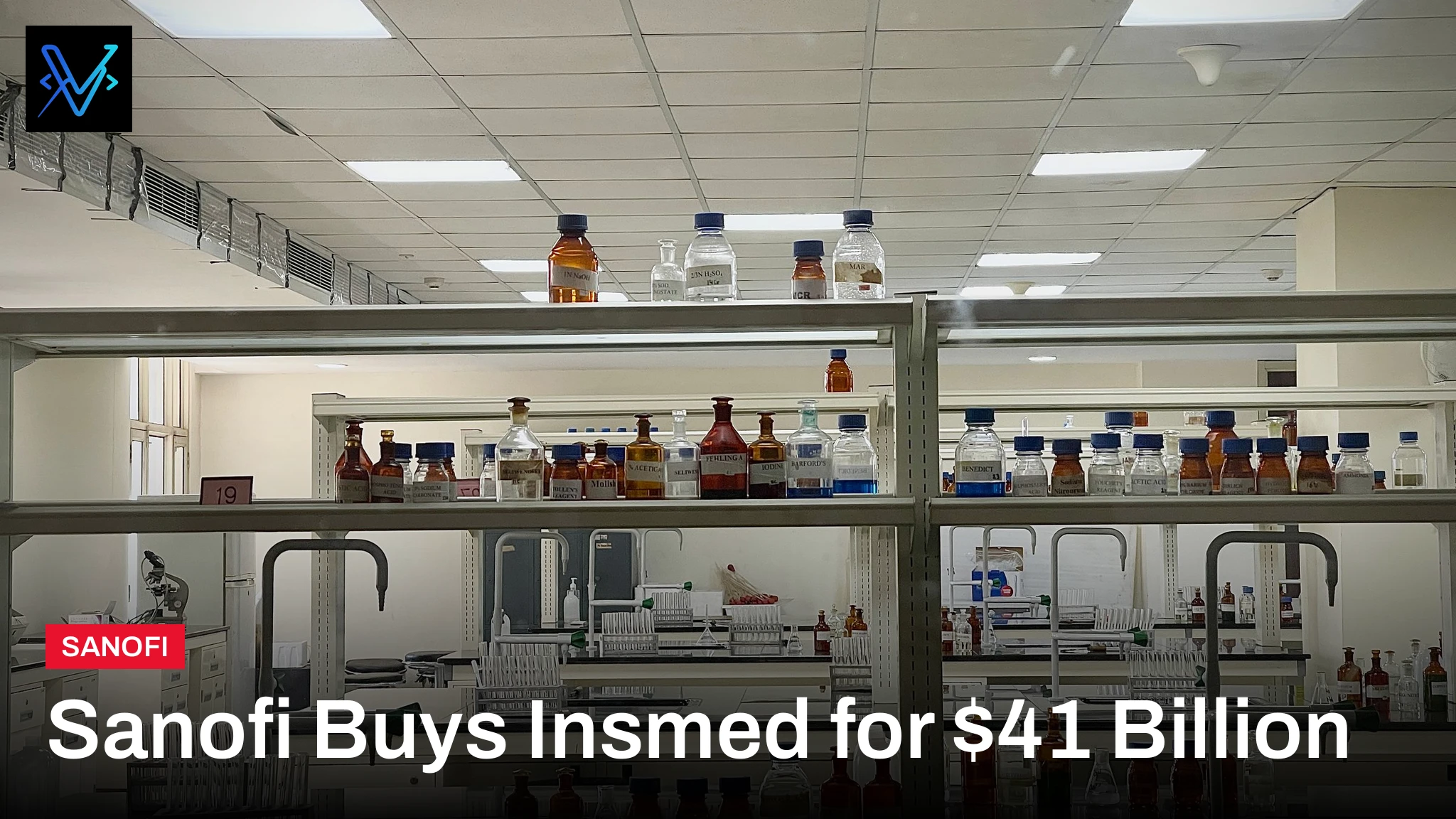
Reagent bottles and test tubes in a pharmaceutical laboratory. Sanofi is buying Insmed for $41 billion in cash. (Photo: Nishant Aneja / Pexels)
The Dupixent problem Sanofi is buying its way out of
Every big pharma deal has a patent clock ticking behind it, and Sanofi’s is louder than most. Dupixent, its bestselling medicine for conditions from asthma to eczema, accounted for nearly 40% of Sanofi’s total sales in the third quarter. Its patent protection runs out in 2031, and when it goes, so does the engine of the company’s growth.
Chief executive Belen Garijo has been blunt about the problem. She told investors on an earnings call late last month that Sanofi is “laser-focused on ensuring growth” beyond the Dupixent patent loss, and named later-stage and approved drugs as the particular focus for the deal team. Insmed is exactly that: de-risked, already selling, and in a disease area Sanofi already knows.
The size of the cheque is what turns heads. In January, Sanofi chief financial officer François Roger said €15 billion (about $16 billion) was the upper limit of what the company could spend while maintaining its credit rating. In April he raised that to €25 billion. This deal, at €37.6 billion, is roughly $14 billion above even the raised ceiling. Sanofi says it will still maintain a strong credit rating and its progressive dividend, funding the purchase with a mix of debt and cash on hand, with committed financing already secured.
What $41 billion actually buys
The centrepiece is Brinsupri, a once-daily oral pill and the first drug ever approved for non-cystic fibrosis bronchiectasis, a serious chronic lung disease in which the airways widen permanently, causing constant coughing and repeated infections. The US Food and Drug Administration approved it in August 2025, and it is now also approved in the EU, the UK and Japan.
Its commercial start has been remarkable. In just over a year since launch, Brinsupri has already reached blockbuster status, with $1.09 billion in revenue through September 30, 2026, and is on course for $1.35 billion to $1.4 billion in its first full year on the market. Insmed estimates about 500,000 patients in the US are diagnosed with the disease, along with 600,000 across France, Germany, Italy, Spain and the UK combined, and 150,000 in Japan.
“In just over a year since launch, we made Brinsupri the standard of care for NCFB patients,” said Will Lewis, Insmed’s chair and chief executive, announcing the deal. “This transaction delivers immediate, certain cash value for Insmed shareholders.”
The second asset, Arikayce, is an inhaled antibiotic for MAC lung disease, a rare and often chronic infection that can cause irreversible lung damage. It brought in $433.8 million in 2025, up 19% on the year, and the FDA accepted an application in September to approve it as a first-line treatment, with a decision expected in January. Guggenheim analysts say approval is likely, which would widen its market considerably.
The third piece is TPIP, a once-daily inhaled therapy still in phase 3 trials for several forms of pulmonary hypertension and fibrotic lung disease, with a further phase 3 study in idiopathic pulmonary fibrosis due to start in the first half of 2027. Sanofi says TPIP could become a significant growth driver beyond 2030 if the trials succeed.
“This acquisition is a major strategic step to significantly accelerate our mid- and long-term growth trajectory,” said Garijo. “Together, we have the opportunity to build on these achievements, reach more patients globally and reinforce our leadership in diseases of significant unmet medical need.”
The price, the premium and the market’s verdict
Sanofi is not getting Insmed cheap. The $175-a-share offer is a 46% premium to Insmed’s unaffected closing price of $119.90 on November 18, and about 17% above Monday’s $149.09 close. Insmed’s shares had already jumped 21% last week when reports emerged that it was a takeover target, partly reversing a bruising 12 months for the stock.
Even so, Sanofi is buying below the level Insmed traded at a year ago, when the shares commanded more than $200. And the deal is the biggest the French company has struck since its 2004 merger with Aventis, comfortably exceeding the $20.1 billion upfront fee it paid for Genzyme in 2011.
| Item | Figure |
|---|---|
| Offer price | $175 per share, all cash |
| Total equity value | $41.0 billion (€37.6 billion) |
| Premium to Nov 18 close | ~46% ($119.90) |
| Premium to Monday close | ~17% ($149.09) |
| Brinsupri revenue (through Sep 30, 2026) | $1.09 billion |
| Arikayce revenue (2025) | $433.8 million (+19%) |
| Combined peak sales estimate | Above $15 billion (Guggenheim) |
| Expected close | First half of 2027 |
| EPS accretive | By end of 2028 |
The deal is expected to add to Sanofi’s business earnings per share by the end of 2028. J.P. Morgan advised Sanofi; Goldman Sachs advised Insmed.
Why it matters
It is the second mega-deal announced on Tuesday, after CrowdStrike’s $43.9 billion agreement to buy Zscaler — a near-$85 billion day for dealmaking, and a sign that big companies are willing to pay up for growth again after a cautious stretch. For pharma specifically, the message is that patent cliffs are now driving the biggest cheques in the industry: when your bestseller has a known expiry date, buying a ready-made replacement beats a decade of research.
The deal also lands as Washington squeezes drug prices from the other side. Medicare has just negotiated lower prices for 13 expensive medicines, including an 84% cut for the diabetes drug Trulicity. Sanofi is effectively betting that owning the only approved treatment for a disease with no competition is worth $41 billion even in a world where governments are pushing prices down.
And the timing, for Sanofi’s shareholders, is favourable: the deal comes a day after Wall Street posted its best session since April, with risk appetite returning across the market.
What to watch next
Three things decide whether this deal delivers. First, the approvals: Insmed shareholders must vote for it, and US and non-US regulators must clear it, with the deal expected to close in the first half of 2027. Second, the January FDA decision on Arikayce as a first-line treatment, which would expand its market at a stroke. And third, the TPIP phase 3 readouts over the coming years — the long-term growth Sanofi is really paying for.
Sanofi also says it retains capacity for further early-stage deals, so this may not be the last cheque Garijo writes. For now, though, the French giant has placed the biggest bet of its modern history on a simple idea: that a lung drug approved fifteen months ago can carry a company through the loss of its biggest seller.
Looking to grow your business online? Explore Vertex Agency at vertexagency.in for professional website development, Meta Ads and social media growth.
Sources
- Sanofi to Acquire Insmed in Strategic Step that Strengthens Long-Term Future — Sanofi via PRNewswire
- Sanofi Seals $41 Billion Insmed Deal to Offset Patent Loss — Bloomberg
- Sanofi to Buy Insmed for $41.0 Billion — Dow Jones via Morningstar
- Sanofi inks massive $41B Insmed buyout for post-Dupixent growth drivers — Fierce Pharma