Hewlett Packard Enterprise just posted the fastest revenue growth in its history — sales up 50% to $14.5 billion — and raised its forecast for the year ahead. Its stock still fell about 14% in Tuesday morning trading, because the market was not looking at the sales line. It was looking at the profit on each server.
KEY POINTS
- HPE’s fiscal fourth-quarter revenue rose 50% to $14.5 billion and adjusted earnings hit $1.43 a share, beating Wall Street’s estimate of about $1.28 — and the company raised its fiscal 2027 outlook sharply.
- The stock fell anyway: down about 7% in after-hours trading on Monday, then roughly 14% from Monday’s close in Tuesday morning trading, after HPE said its Cloud & AI operating margin would drop to about 14% next year, from 18.4% this quarter.
- AI demand is not the problem. Server revenue jumped 95%, AI systems orders rose more than 130% to $4.5 billion, and total orders were up 88% on a year ago. The problem is what each AI server earns.
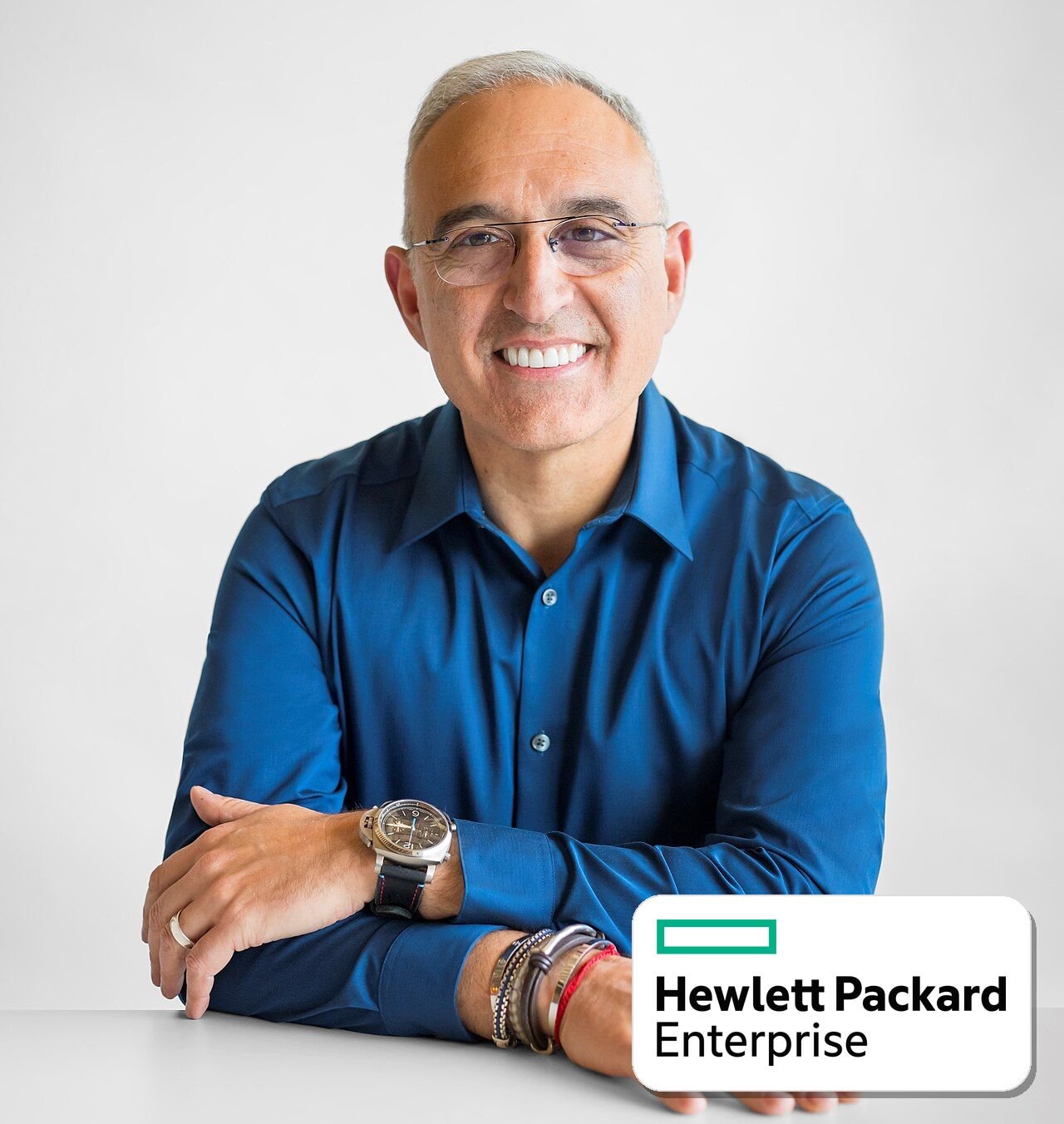
HPE president and chief executive Antonio Neri. (Photo: HPEupdate / Wikimedia Commons, CC BY-SA 4.0; HPE logo: Wikimedia Commons, public domain)
Why is HPE’s stock falling?
Start with what the market liked. HPE reported its fiscal fourth-quarter results after the US close on Monday, and almost every line beat expectations. Revenue of $14.55 billion was up 50% on a year earlier — the fastest quarterly growth the company has ever posted, according to Morningstar — and slightly ahead of the roughly $14.47 billion analysts expected. Adjusted earnings of $1.43 a share beat the consensus of about $1.28, and cleared HPE’s own outlook of $1.20 to $1.30. On the bottom line, GAAP net income surged to $1.79 billion from $146 million a year ago.
Then came the guidance, and it was strong too. HPE raised its fiscal 2027 revenue growth forecast to 27% to 35% — $59.4 billion to $63.1 billion — from a previous range of 13% to 17%. It lifted adjusted earnings guidance to $5.05 to $5.35 a share, from $4.40 to $4.60, and said free cash flow would be at least $5.5 billion. It added $5 billion to its share buyback programme, taking total authorisation to about $7.3 billion, and raised the quarterly dividend to $0.17 a share.
So why did the shares fall? Because of one line buried in the outlook: the operating margin of the Cloud & AI division — the unit that sells the AI servers — is forecast to fall to about 14% in fiscal 2027, from 18.4% in the quarter just reported. Gross margin already slipped in the quarter, with non-GAAP gross margin down 2.2 percentage points from the prior quarter to 38.2%. Chief financial officer Marie Myers told investors HPE expects “gross margin to moderate” as the year goes on, “driven largely by mix and the timing of significant AI systems ramps throughout the year.”
In plain terms: the more AI servers HPE sells, the thinner its margins get. Servers now make up about 60% of revenue, and AI hardware — expensive to build, packed with costly memory and Nvidia chips — earns less per dollar of sales than the networking and software businesses it is displacing. Revenue is growing faster than profit, and the market decided that is the number that matters. Piper Sandler analysts said the outlook implies a second-half slowdown and margin compression, with a “peak growth and peak multiple” dynamic likely behind the selloff, and cut their price target to $54 from $69. JPMorgan analysts called margin mix “the key debate” for investors.
There was also a timing problem. HPE shares had jumped 17.4% on Monday to $48.02, swept up in the broad AI rally that followed Nvidia’s decision to reinstate Jensen Huang as chief executive — a rally we covered here. The stock had more than doubled in 2026 before its own results landed. A beat that arrived after a 17% jump faces a much higher bar than the same beat on a quiet day.
The quarter in numbers
| Metric | Q4 fiscal 2026 | Comparison |
|---|---|---|
| Revenue | $14.55 billion | +50% year on year; about $14.47 billion expected |
| Adjusted EPS | $1.43 | About $1.28 expected; $0.62 a year ago |
| GAAP EPS | $1.26 | $0.11 a year ago |
| Cloud & AI revenue | $11.3 billion | +68.6% year on year; 18.4% operating margin |
| Server revenue | $8.8 billion | +94.7% year on year |
| Networking revenue | $3.1 billion | +12.3% year on year; 22.1% operating margin |
| Non-GAAP gross margin | 38.2% | Down 2.2 points from the prior quarter |
| Free cash flow | $1.9 billion | Flat on a year ago |
Source: HPE fiscal 2026 fourth-quarter results; LSEG/FactSet consensus via Reuters and Morningstar.
The segment split tells the story. Cloud & AI, at $11.3 billion, is now more than three-quarters of HPE’s revenue, and its 18.4% operating margin — double the 9.3% of a year ago — is still well below networking’s 22.1%. Networking grew a far more modest 12.3% to $3.1 billion, and its margin slipped from 23.4% a year ago. Storage, inside Cloud & AI, grew 33.8% to $1.5 billion. The mix is moving, quarter by quarter, towards the lower-margin business.
The AI demand is real
None of this is a demand problem. Total orders in the quarter rose 88% on a year earlier, and AI systems orders rose more than 130% to $4.5 billion. HPE said it ended the quarter with a record backlog. For the full fiscal year, revenue reached a record $46.7 billion.
“Fiscal 2026 was a defining year for HPE as we built a new networking industry leader and expanded our role in the AI infrastructure market,” said president and chief executive Antonio Neri. “We are now a fundamentally different company, with greater earnings power, a stronger competitive position, and a portfolio built to capitalize on the next phase of AI.” His chief financial officer, Marie Myers, said the company enters fiscal 2027 “in a position of strength, with a significantly higher outlook for revenue, operating profit, and free cash flow.”
HPE’s pitch is that it sells the picks and shovels of the AI boom: servers running Nvidia’s chips, and increasingly AMD-based systems too, wired together with networking gear from its Juniper Networks acquisition — the largest deal in the company’s history. That positioning is exactly why the stock more than doubled this year. It is also why Tuesday’s reaction matters beyond one company.
Why it matters: the question hanging over the AI trade
This has been a brutal week for the AI trade’s assumptions. Nvidia added nearly $1 trillion in a day on Monday, then gave a chunk of it back on Tuesday. Anthropic fell below its $83 IPO price five days after the biggest listing in history, and AI stocks slid across the board as investors asked whether the sums being poured into computing infrastructure will ever earn their keep.
HPE’s quarter is the most concrete answer yet to that question — and it cuts both ways. The spending is undeniably real: customers are ordering AI systems faster than HPE can build them, and the company’s own forecast has revenue growing as much as 35% next year. But the profit on that spending is thinner than investors assumed, and getting thinner as AI hardware takes a bigger share of the mix. Rising component costs and supply shortages for memory and other parts add to the squeeze, a problem Barron’s noted has weighed on HPE’s shares since mid-October.
That is the tension at the heart of the AI boom: the companies building the infrastructure are growing at rates most businesses never see, while the economics of each sale quietly deteriorate. Nvidia, which sells the chips inside HPE’s servers, keeps the fattest margins in the chain. Everyone else in the chain — the server builders, the memory makers, the assemblers — fights over what is left. HPE just showed the market the size of that remainder.
What could steady the stock
It is not all one-way traffic. HPE is returning serious cash to shareholders: $979 million in dividends and buybacks in the quarter alone, a raised dividend, $5 billion of fresh buyback capacity, and a target of returning at least 75% of free cash flow in fiscal 2027. Analysts are, on average, still positive — the average rating on the stock is “buy” and the median price target is $67.24, according to LSEG data cited by Reuters, well above where the shares traded on Tuesday.
The other lever is networking. If the Juniper business can grow faster — Cisco’s networking product revenue jumped 43% in its latest quarter, against HPE’s 12% — the higher-margin side of the portfolio can offset the AI server squeeze. That is the bet HPE’s management is making when it talks about a “fundamentally different company”. The market, for now, wants to see it in the numbers.
What to watch next
Three things matter from here. First, Dell reports after the US close on Tuesday — the next big read on AI server demand and, crucially, on whether Dell’s margins are holding up any better than HPE’s. Second, HPE’s own first quarter of fiscal 2027, when revenue is guided to $14.0 billion to $14.6 billion: the test is whether the Cloud & AI margin starts its guided slide towards 14% or stabilises. Third, component costs — if memory prices keep climbing, the squeeze gets worse before it gets better.
HPE beat Wall Street on every number that mattered, raised its forecast, increased its dividend and announced a $5 billion buyback. The stock fell 14% anyway. In a week when the market is re-examining every assumption behind the AI boom, that is the most honest verdict yet: demand is not the question any more. Profit is.
Looking to grow your business online? Explore Vertex Agency at vertexagency.in for professional website development, Meta Ads and social media growth.
Sources
- HPE — HPE reports fiscal 2026 fourth quarter results (Nov 23, 2026)
- Reuters — HPE shares fall as margin worries overshadow raised outlook (Nov 24, 2026)
- Morningstar — HPE just posted its strongest growth ever — but its stock is sinking (Nov 24, 2026)
- Barron’s — HPE’s 14% Stock Drop After Earnings Isn’t Due to a Lack of AI Demand (Nov 24, 2026)