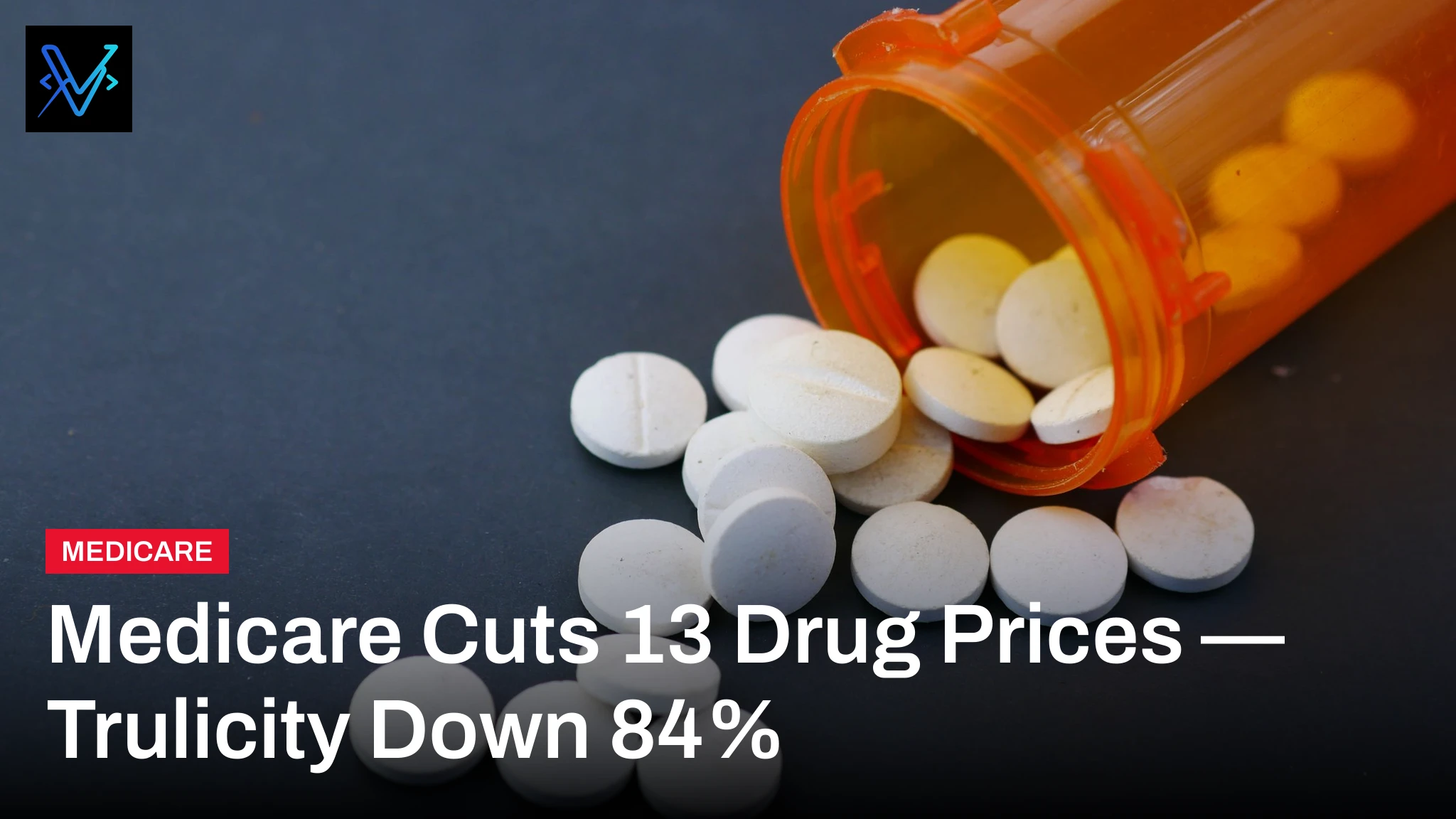
A diabetes drug that cost Medicare $965 a month will cost $150. That is the headline number in the latest round of Medicare drug-price negotiations, announced on Monday, which cut the prices of 13 expensive prescription drugs by between 34% and 84% — and will save the programme an estimated $9.2 billion.
KEY POINTS
- Medicare has negotiated lower prices on 13 costly prescription drugs, effective January 1, 2028. The cuts range from 34% to 84%, and the agency estimates they would have saved $9.2 billion had they applied to 2025 spending — about 45% less than Medicare spent on these drugs.
- The deepest cut is Eli Lilly’s diabetes drug Trulicity, down 84% from $965 to $150 for a 30-day supply. It is taken by 582,000 Medicare enrollees, more than any other drug on the list. Boehringer Ingelheim’s Tradjenta, also for type 2 diabetes, falls 83% to $81.
- Beneficiaries themselves are projected to save $464 million in out-of-pocket costs — $69 million on pharmacy drugs and $395 million on drugs given in hospitals and clinics. This is the third round of negotiations under the 2022 Inflation Reduction Act, and the first to cover drugs administered in a doctor’s office or hospital.
Prescription drugs are about to get cheaper for millions of Americans on Medicare. The latest negotiated prices take effect on January 1, 2028. (Photo: Towfiqu barbhuiya / Pexels)
What got cheaper — and by how much
The 13 drugs span diabetes, cancer, HIV, arthritis, Crohn’s disease and depression. Together they accounted for about $22.3 billion in Medicare spending in 2025, roughly 6% of everything the programme spends on prescription drugs. About 1.4 million people with Medicare drug coverage used them last year.
| Drug | Treats | New 30-day price | Cut |
|---|---|---|---|
| Trulicity (Eli Lilly) | Type 2 diabetes | $150 (was $965) | 84% |
| Tradjenta (Boehringer Ingelheim) | Type 2 diabetes | $81 | 83% |
| Anoro Ellipta (GSK) | COPD | $130 | 72% |
| Cosentyx (Novartis) | Psoriasis | $2,600 | 67% |
| Orencia | Arthritis | $1,750 | 57% |
| Erleada | Prostate cancer | $7,004 | 51% |
| Lenvima | Kidney, liver, thyroid cancer | $12,985 | 46% |
| Verzenio | Breast cancer | $8,650 | 44% |
| Kisqali (Novartis) | Breast cancer | $8,650 | 43% |
| Rexulti (Otsuka / Lundbeck) | Depression, schizophrenia | $780 | 41% |
| Cimzia | Crohn’s, arthritis, psoriasis | $1,375 | 37% |
| Biktarvy (Gilead) | HIV | $2,600 | 37% |
| Entyvio (Takeda) | Crohn’s, ulcerative colitis | $2,645 | 34% |
Trulicity is the drug that matters most to the most people. More than half a million Medicare enrollees take it, and the new price is less than a sixth of what Medicare was paying. Tradjenta, used by 248,000 enrollees, is the only drug on the list whose price was renegotiated — it had already been through the process once. Anoro Ellipta, the COPD inhaler used by 273,000 people, drops to $130 a month.
Even after the cuts, some of these medicines remain very expensive. Lenvima, a cancer drug, still costs nearly $13,000 for a month’s supply. But the direction of travel is unmistakable: every drug on the list is now at least a third cheaper than Medicare was paying.
Why this round is different
Until now, Medicare could only negotiate the prices of drugs people pick up at a pharmacy. This is the first round to include Part B drugs — medicines administered in a hospital or doctor’s office, such as infusions for cancer and Crohn’s disease. Four of the 13 fall into that group. About 120,000 people used those four drugs in 2025, at a cost of $3.3 billion to Medicare, and they paid $785 million out of pocket between them.
It is also the third annual round of a programme created by the Inflation Reduction Act of 2022, the law that finally gave Medicare the power to bargain with drugmakers after decades in which it was barred by law from doing so. The first negotiated prices, on 10 pharmacy drugs, took effect this year. A second batch of 15 — including the weight-loss drugs Ozempic, Wegovy and Rybelsus — takes effect on January 1, 2027. With this third round, 37 drugs in total now carry a negotiated Medicare price.
The process itself was a negotiation, not a decree. For nine of the drugs, the agency and the manufacturer went back and forth with offers and counteroffers; in five of those cases, Medicare accepted a revised counteroffer from the company. For the other four, the manufacturers accepted Medicare’s written final offer. The agency will publish its explanation of how each price was reached by March 2027.
“The Trump administration is committed to use every tool at our disposal to negotiate fairer, more affordable prices to ease the burden on Medicare beneficiaries,” said Mehmet Oz, the administrator of the Centers for Medicare & Medicaid Services, in a statement announcing the prices.
What it means for your wallet
The $9.2 billion is what Medicare itself saves. For the people who actually take these drugs, the projected saving is $464 million a year in out-of-pocket costs — $69 million for people on pharmacy drugs and $395 million for people on the hospital-administered ones. That is real money, but it is worth keeping in proportion: enrollees spent $522 million out of pocket on the pharmacy drugs and $785 million on the hospital-administered drugs in 2025, so the saving is roughly a third of what they were paying.
Two things are worth knowing if you or a family member takes one of these drugs. First, nothing changes until January 1, 2028 — the prices announced this week do not apply to prescriptions filled today. Second, once they do take effect, every Medicare drug plan and every Medicare Advantage plan with drug coverage must cover these drugs at the negotiated price. Nobody needs to switch plans to get the lower price.
The politics of the programme have been contested from the start. Drugmakers have fought the negotiation law in court, arguing it amounts to government price-setting, and several lawsuits are still working their way through the courts. But the programme has survived every challenge so far, and each round has gone ahead on schedule. AARP, which campaigned for the 2022 law, called the announcement “another victory” in its fight for lower drug prices, and pointed to its own survey finding that almost three in five adults over 50 worry about affording their prescriptions in the next few years.
The timing matters for household budgets more broadly. Americans are already absorbing higher costs on several fronts at once — mortgage rates have jumped back above 7% even as the Fed cuts, and families are weighing how much to put into retirement accounts, where the 401(k) limit rises to $25,500 in 2027. A cheaper prescription is one of the few bills that is actually going down.
The drugs that didn’t make the cut
Not every drug selected for this round ended up with a negotiated price. Two of them — Pfizer’s arthritis drug Xeljanz and Roche’s asthma drug Xolair — were dropped from the programme because a generic or biosimilar version is now on the market, which in practice does the job of bringing the price down anyway. AbbVie’s Botox was also excluded, but for a different reason: a court order in the company’s lawsuit against the Department of Health and Human Services, and that litigation is still going on.
The drugmakers, for their part, have been open about the cost to them. Gilead warned last month that the new $2,600 monthly price for its HIV drug Biktarvy would cut sales by about $1.5 billion, although it still expects its overall HIV revenue to grow compared with 2027. That tension — lower prices for patients, lower revenue for manufacturers — is the argument that will shape every future round.
What to watch next
The programme does not stop here. By February 1, 2027, Medicare will select up to 20 more drugs for negotiation, with those prices taking effect on January 1, 2029. After that, up to 20 additional drugs can be selected each year, so the list of cheaper medicines should keep growing — and the drugs chosen next will be the ones with the biggest Medicare price tags that still have no generic competition.
Before that, two dates matter. On January 1, 2027, the second round of negotiated prices takes effect, including the GLP-1 weight-loss drugs Ozempic, Wegovy and Rybelsus — the most closely watched price cuts in the programme so far, given how many Americans now take them. And by March 2027, Medicare will publish its explanations for the prices announced this week, which will show how much of each cut came from the negotiation itself and how much reflected the drug’s value.
For now, the message for the 67 million Americans on Medicare is simple: 13 of the most expensive drugs in the programme are getting materially cheaper, the biggest cut is 84%, and the savings start in just over a year. In a year when almost every other household bill has gone up, that is a rare piece of good news — and, as markets stay choppy and household budgets stay tight, it is worth knowing exactly which of your prescriptions is on the list.
This article is general information only, not personal financial or medical advice. Talk to your doctor or pharmacist before changing any medication.
Looking to grow your business online? Explore Vertex Agency at vertexagency.in for professional website development, Meta Ads and social media growth.