CrowdStrike is buying Zscaler for $43.9 billion in an all-stock deal, the largest cybersecurity acquisition ever recorded. The two companies announced the agreement on Monday, uniting the biggest name in endpoint protection with the pioneer of zero-trust network security — a bet that the age of AI agents demands one company that can guard both the device and the network.
KEY POINTS
- CrowdStrike agreed on Monday, November 23, to acquire Zscaler in a $43.9 billion all-stock deal — the biggest acquisition of a pure-play cybersecurity company ever, topping Google’s $32 billion purchase of Wiz earlier this year.
- Zscaler shareholders will receive 1.135 CrowdStrike shares for each Zscaler share they own, worth about $260.41 a share — a premium of roughly 34% over Zscaler’s closing price on Friday, November 20.
- The combined company is expected to start life with more than $10 billion in annual recurring revenue, including about $3.9 billion from Zscaler, and CrowdStrike projects about $1 billion in additional annual revenue within 30 months of closing.
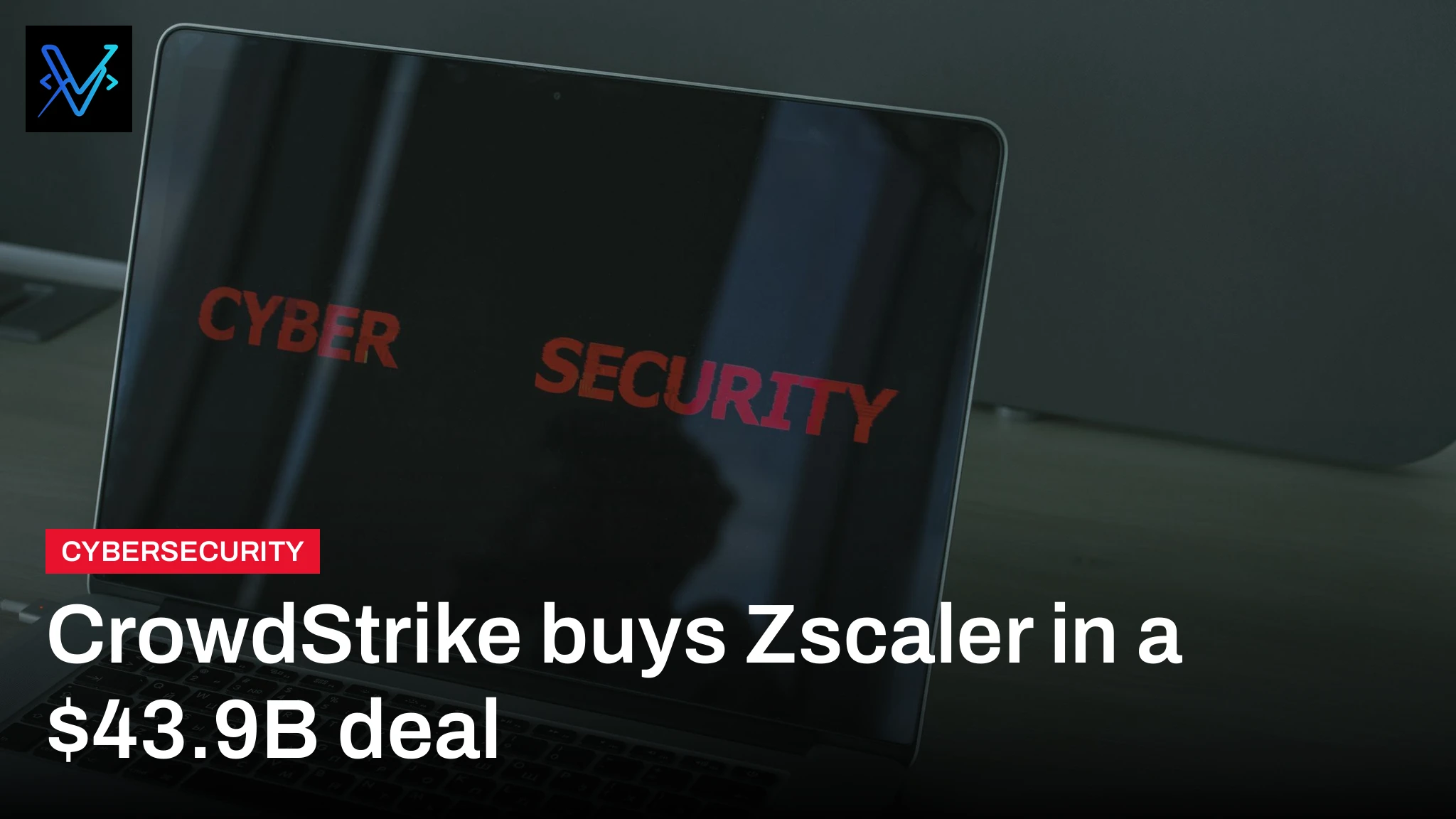
A laptop displays the words “cyber security”. CrowdStrike is buying Zscaler in a $43.9 billion all-stock deal, the biggest cybersecurity acquisition on record. (Photo: cottonbro studio / Pexels)
The deal in numbers
| Figure | What it is |
|---|---|
| $43.9 billion | All-stock value of the deal, announced Monday, November 23 |
| 1.135 shares | CrowdStrike shares for each Zscaler share — about $260.41 a share |
| ~34% | Premium over Zscaler’s closing price on Friday, November 20 |
| >$10 billion | Combined annual recurring revenue at closing, including ~$3.9 billion from Zscaler |
| ~$1 billion | Additional annual revenue CrowdStrike expects within 30 months of closing |
| >$185 billion | Expansion of CrowdStrike’s addressable market from the deal |
| $1.4 billion | Breakup fee Zscaler would owe if it walks away, for example to accept a rival offer |
| 84.1% / 15.9% | Ownership split: existing CrowdStrike holders / existing Zscaler holders |
Why CrowdStrike is paying $44 billion
The two companies do different jobs, and that is the point. CrowdStrike’s Falcon platform protects the devices on a company’s network — laptops, servers, phones — while Zscaler’s zero-trust platform controls which employees and systems can reach which applications and data. Zscaler serves about 8,000 enterprise customers, including Unilever and United Airlines. Put together, CrowdStrike gets what it has never had: a serious presence in network security, the largest single segment of the cybersecurity market.
The driving force, both companies say, is artificial intelligence. Attacks are getting faster and more sophisticated as AI makes it easier to find and exploit software flaws, and at the same time companies are rushing to deploy AI agents that can act on their own inside corporate systems. “With Zscaler, we’re building cybersecurity’s operating system: a single control plane to deploy AI, control AI, and enable any agentic application to run safely,” CrowdStrike co-founder and chief executive George Kurtz said in the announcement. “We see a path to become the largest AI safety and security company the world has ever seen.”
The two companies are not strangers. They already share more than 2,000 customers and have 16 product integrations, and in September they deepened a partnership that lets CrowdStrike’s software assess user risk and feed it into Zscaler’s access controls. Zscaler founder and chief executive Jay Chaudhry called the combination the “natural evolution of our longstanding partnership”. He will keep running the Zscaler business and join CrowdStrike’s board once the deal closes. Kurtz will lead the combined company.
The timing is no accident either. The deal landed on a day of extraordinary market drama — Wall Street had just staged its best session since April, with the Nasdaq jumping 6.5% as Nvidia’s board brought Jensen Huang back as chief executive. CrowdStrike’s own shares have been riding the same AI wave, which makes its stock — the currency of this deal — an expensive one to spend.
The market’s verdict: not so fast
Investors did not greet the deal with unqualified applause. Zscaler shares jumped more than 13% on Monday to $220.52 — but that is still well below the $260.41 a share the deal implies, a gap that suggests traders are not convinced the price will be paid in full, or that regulators will wave it through. CrowdStrike shares fell nearly 12% in the same session, the market’s way of saying the buyer may be paying too much.
Regulatory scrutiny is the obvious risk. The deal would combine two of the industry’s biggest players, and antitrust review is a near-certainty. “Antitrust scrutiny is certainly possible given the size of the transaction and the importance of both companies, but it would be premature to assume that regulators will necessarily try to block it,” Axel Rudolph, chief technical analyst at IG Group, told Reuters. “The key issue is likely to be how much overlap regulators see between the two businesses and whether customers would genuinely have fewer competitive alternatives as a result.”
Both boards have approved the deal unanimously, and it is expected to close in the second half of CrowdStrike’s fiscal 2028 — between August 2027 and January 2028 — subject to Zscaler shareholder and regulatory approval. The companies will keep operating separately until then. If Zscaler walks away, for example to accept a rival offer, it owes CrowdStrike a $1.4 billion breakup fee.
A consolidation wave, not a one-off
CrowdStrike and Zscaler are the latest — and largest — step in a cybersecurity land grab. Customers are tired of buying dozens of separate security tools and are pushing vendors to sell them one broad platform instead, so the industry’s giants are racing to assemble every piece. Google’s $32 billion acquisition of cloud security firm Wiz, which closed in March, held the record for a pure-play cybersecurity deal until Monday. Palo Alto Networks, the industry’s biggest platform player, has been buying aggressively too, and this deal puts two of its top rivals under one roof.
The numbers behind the deal suggest both companies are in strong shape. CrowdStrike reported third-quarter revenue up 28% to $1.58 billion, beating expectations of $1.53 billion, and forecast fourth-quarter revenue of $1.638 billion to $1.644 billion, above the $1.62 billion analysts expected. Zscaler reported first-quarter revenue up 20% to $949.3 million, also ahead of estimates. The deal was announced alongside both sets of results — a deliberate signal that this is a merger of two healthy companies, not a rescue.
The same AI boom driving this deal is reshaping the rest of the industry too. Anthropic, the AI lab behind Claude, is borrowing on a scale that has bond investors talking about a junk rating — a reminder of how much money, and how much risk, is now flowing through the AI economy. And the security stakes keep rising: Washington blacklisted the cloud firm Megaspeed on Monday over alleged Nvidia chip smuggling to China, the same day this deal was announced.
Why it matters
For the millions of people who work at companies that use CrowdStrike or Zscaler, this deal will eventually mean one vendor, one contract and one platform instead of two — which is exactly what corporate IT departments say they want. The pitch is that a single system watching both the device and the network can spot an attack faster than two systems passing notes to each other. If that works, the combined company becomes very hard to displace.
For the industry, the deal raises the bar for everyone else. A $10 billion-plus recurring-revenue cybersecurity company with a foothold in every major segment forces rivals to answer with scale of their own — through deals, or through price wars. And for investors, Monday’s share moves were a warning: the market likes the idea of this combination a lot more than it likes the price.
There is also a wider lesson. The AI era is not just creating new companies; it is forcing old ones to merge, because the threats AI creates cannot be fought with the tools built for the last decade. CrowdStrike is betting $43.9 billion that the winner will be the company that can secure AI itself — not just the computers it runs on.
What to watch next
The first test is regulatory. Watch for early signals from US and European antitrust authorities, and for whether any rival bidder emerges — the $1.4 billion breakup fee is large, but for a prize this size, it may not be large enough to deter one. The second is execution: integrating two companies of this size, with different sales cultures and overlapping channel partners, is where big mergers most often stumble, and CrowdStrike has a year or more to plan it before the deal closes.
Then there is the share price. Zscaler trading well below the deal’s implied value is the market pricing in doubt — about the timetable, about regulators, about whether the combination delivers the $1 billion in synergies CrowdStrike has promised. If that gap narrows in the coming weeks, investors are buying the story. If it widens, they are not.
Finally, watch Palo Alto Networks. The industry’s biggest platform company now faces a rival almost its equal in size and ambition, and its response — a deal of its own, or a price fight — will shape what cybersecurity costs for every business that buys it.
Looking to grow your business online? Explore Vertex Agency at vertexagency.in for professional website development, Meta Ads and social media growth.
Sources
- Reuters via Global Banking & Finance Review — CrowdStrike Acquires Zscaler in $44 Billion Deal to Counter AI-Era Cyber Threats (Nov 23, 2026)
- TechCrunch — CrowdStrike to acquire Zscaler for $44 billion (Nov 23, 2026)
- CRN — CrowdStrike To Acquire Zscaler In $43.9B Blockbuster Cybersecurity Deal (Nov 23, 2026)
- SecurityWeek — CrowdStrike to Acquire Zscaler in $43.9 Billion Deal (Nov 23, 2026)