US inflation went the wrong way in October — and Wall Street got the message within minutes. The Federal Reserve’s preferred inflation gauge rose to 3.8% from a year earlier, its core measure beat forecasts, and traders now treat a December interest-rate hike as a near-certainty. Stocks fell sharply in early trading, with the Nasdaq down more than 3%, as the last big inflation report before the Fed’s final meeting of the year landed alongside a surprisingly strong reading on economic growth.
KEY POINTS
- US inflation rose to 3.8% in October from a year earlier, while core PCE — the Fed’s preferred gauge, which strips out food and energy — accelerated to 3.3%, above the 3.2% economists expected.
- Traders now price a December rate hike at around 97%, with a further increase in January at around 56%, after the economy also grew a stronger-than-expected 4.3% in the third quarter.
- Stocks tumbled in early Wednesday trading — the Dow down 1.5%, the S&P 500 down 2.3% and the Nasdaq down 3.3% — as the AI sell-off deepened and fresh tariff headlines added to the pressure the day before Thanksgiving.

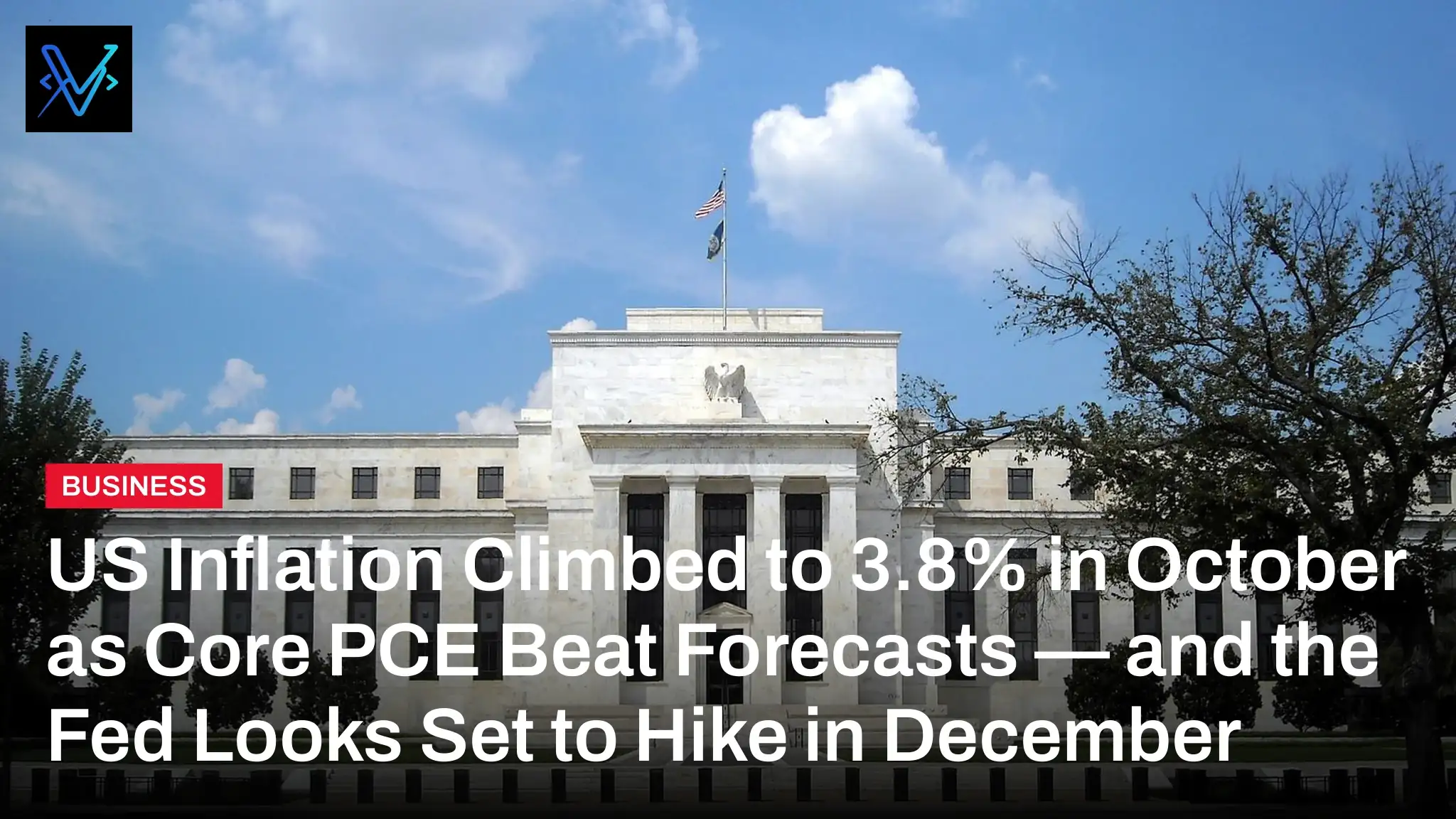
Federal Reserve Governor Christopher Waller, who has signalled he could support a bigger half-point interest-rate increase to bring inflation under control. (Photo: Federal Reserve / Wikimedia Commons, Public domain; Federal Reserve seal: Wikimedia Commons, Public domain)
The numbers: hotter core, flat spending
The Bureau of Economic Analysis released the October figures at 8:30 a.m. ET on Wednesday, and the details were mixed in a way that makes the Fed’s job harder, not easier. Headline inflation rose 0.3% on the month, slowing from 0.5% in September, and 3.8% on the year — up from 3.7% in September after an upward revision, and exactly in line with what economists had forecast. The problem is the core number. Excluding food and energy, prices also rose 0.3% on the month, but the annual rate climbed to 3.3% from 3.1% in September, above the 3.2% consensus. That is the Fed’s primary gauge, and it is moving away from the central bank’s 2% target, not towards it.
The same release showed the other side of the American economy: households earned more but spent it cautiously. Personal income jumped 0.7% in October, far above the 0.3% economists expected, and disposable income rose 0.8%. But personal spending rose only 0.3%, missing forecasts, and once inflation is stripped out, real spending was flat — effectively unchanged after a 0.1% rise in September. The saving rate climbed to 4.1%, a sign that the extra income was not turning into extra demand. Part of the income jump was one-off: government benefit payments linked to a Medicare premium rebate, alongside stronger wages and dividend income.
| Indicator | October 2026 | September 2026 | What was expected |
|---|---|---|---|
| PCE inflation, year on year | 3.8% | 3.7% (revised) | 3.8% |
| Core PCE inflation, year on year | 3.3% | 3.1% | 3.2% |
| PCE inflation, month on month | 0.3% | 0.5% | 0.3% |
| Core PCE inflation, month on month | 0.3% | 0.3% | 0.3% |
| Personal income, month on month | 0.7% | 0.3% | 0.3% |
| Personal spending, month on month | 0.3% | 0.6% | 0.4% |
| Real personal spending, month on month | 0.0% | 0.1% | — |
Look inside the spending, and the pattern is familiar: services did the work, goods did not. Spending on services rose by $52.1 billion, led by housing, recreation and healthcare, while goods spending rose just $11.8 billion, with purchases of motor vehicles and parts falling. In other words, Americans kept paying for the essentials and the experiences, but held back on big-ticket items — and higher prices absorbed most of what they did spend, rather than stronger volumes.
A strong economy, at the worst moment for the Fed
The inflation report did not arrive alone. Released at the same time, the second estimate of third-quarter GDP showed the US economy grew at a 4.3% annual rate — far above the 3.5% economists had forecast. Weekly jobless claims, also out on Wednesday, came in at 189,000, below the 200,000 expected. And the October consumer price index, reported earlier in the month, had already risen 0.4% on the month, above forecasts, while employers added 165,000 jobs.
Put together, the picture is an economy that is still growing fast, still hiring, and still generating price pressures — the exact combination that pushes a central bank towards higher rates rather than lower ones. That is why the PCE report matters so much this week: it is the last major inflation reading before the Fed’s December 8–9 meeting, and it gave the hawks fresh evidence.
Why a December hike now looks certain
The market’s verdict was immediate. According to the CME FedWatch Tool, traders now price a 25-basis-point rate hike in December at around 97% — effectively a done deal — with the chance of another increase in January holding at around 56%. The Fed’s current target range is 3.75% to 4.00%, after it raised rates by a quarter point in September and then held them steady in October. Two policymakers voted for another hike at that October meeting, and the minutes released on November 18 showed broad support for further tightening.
Fed Governor Christopher Waller has gone further, signalling he could support a bigger half-percentage-point increase to bring inflation under control. A half-point move would be a sharp escalation, and it is not the base case — but the fact that it is being discussed openly by a governor tells you how seriously the Fed is taking a core inflation rate that has now risen for two months in a row.
The market’s verdict: a rough morning before Thanksgiving
Stocks were already falling before the data, and the inflation print gave sellers a second reason. At 8:34 a.m. ET, Dow futures were down 661 points, or 1.32%, S&P 500 futures were down 2.08% and Nasdaq 100 futures were down 3.11%. In early trading, the Dow dropped 1.5%, the S&P 500 sank 2.3% and the Nasdaq tumbled 3.3%. The dollar was steady, trading around 103.90 on the dollar index, up 0.10% on the day.
The selling was concentrated where it has been all week: chips and AI. Nvidia fell about 8% in early trading, extending a brutal run that has already seen the Philadelphia semiconductor index drop 7.9% on Tuesday. The rout started in Asia, where SoftBank plunged on Wednesday, and it has now spread to every corner of the AI trade. Our explainer on whether the AI bubble is bursting lays out why investors have stopped taking the build-out on trust — and why even good earnings no longer lift the shares.
| Index / stock | Wednesday early trading | Tuesday close |
|---|---|---|
| Dow Jones | −1.5% | 50,018.70 (+0.85%) |
| S&P 500 | −2.3% | 7,201.09 (−0.50%) |
| Nasdaq Composite | −3.3% | 23,733.54 (−1.48%) |
| Nvidia | About −8% | −5.86% Tuesday |
| Dell | Down more than 6% | $295.28 (−12% Tuesday) |
Dell is the clearest example of the mood. The company reported quarterly revenue of $54.9 billion — up 103% from a year earlier — with adjusted earnings of $9.45 a share against the $6.59 analysts expected. AI server sales jumped 291% to $22 billion, it booked $60.2 billion of new AI orders, and it raised its full-year revenue forecast to $202 billion from $192 billion. Its shares still fell more than 6% on Wednesday, after closing 12% lower on Tuesday. When a company doubles its revenue, raises its forecast and still gets sold, the market is not questioning the demand — it is questioning the price.
Fresh tariff headlines added to the pressure. The Trump administration announced new 20% tariffs on Wednesday morning, and the move follows the Section 301 investigation into excess industrial capacity that we reported earlier this week. Tariffs push up the cost of imported goods, which is one more reason inflation is proving hard to bring down.
What it means for your money
For most people, the PCE report is not about the stock market — it is about borrowing costs. A December rate hike means the cost of money stays high for longer: mortgage rates, credit-card rates and car loans all take their cue from where the Fed is heading, not just from where it is. Savers, on the other hand, keep earning more on cash — the flip side of the same coin.
The inflation picture also matters for retirement. Social Security’s 2027 cost-of-living adjustment is 3.6%, and the new PCE numbers show why that increase is needed — and why it may still feel thin once Medicare premiums take their share. The tension in today’s report is the same one households feel: incomes are rising, but prices are rising too, and the spending data shows people are already pulling back on the things they can postpone.
What to watch next
The calendar now compresses. US markets are closed on Thursday for Thanksgiving and close early, at 1 p.m. ET, on Friday, so traders have a short window to reposition before the weekend. The next big test is the Fed itself: its December 8–9 meeting, where a quarter-point hike is now priced as a near-certainty, and where the question will shift from whether the Fed hikes to how many more hikes follow in early 2027. The November jobs report, due in early December, will be the last major data point before that meeting.
Three things will decide whether Wednesday’s sell-off is a wobble or the start of something worse. First, whether the Fed’s December statement hints at a pause after the hike or at a longer tightening path — Waller’s half-point talk suggests the hawks are not done. Second, whether the AI sell-off broadens into the rest of the market or stays contained in tech: Tuesday’s split, with the Dow above 50,000 while the Nasdaq fell, shows money is rotating, not fleeing. And third, whether the tariff proposals turn into actual duties in January, which would add a fresh cost pressure to an economy already struggling to bring inflation back to 2%.
The short version of today’s report is simple: inflation is not beaten, the economy is not slowing, and the Fed is now expected to respond by raising rates again. That is a difficult combination for stocks, for borrowers and for anyone hoping the cost of living would start easing before Christmas. The data that could change the story does not arrive until December — and until then, the market is pricing in a hike.
Looking to grow your business online? Explore Vertex Agency at vertexagency.in for professional website development, Meta Ads and social media growth.
Sources
- Reuters — US stock futures extend losses after economic data (Nov 25, 2026)
- FXStreet — Breaking: US core PCE inflation rises to 3.3% YoY in October (Nov 25, 2026)
- ActionForex — US Core PCE Inflation Rises to 3.3% as Real Consumer Spending Stalls (Nov 25, 2026)
- BusinessToday — US Stocks Tumble On Hot Inflation, Trump Tariffs (Nov 25, 2026)
- Motley Fool — Dell Just Reported Earnings and Raised Its Forecast by $10 Billion (Nov 24, 2026)