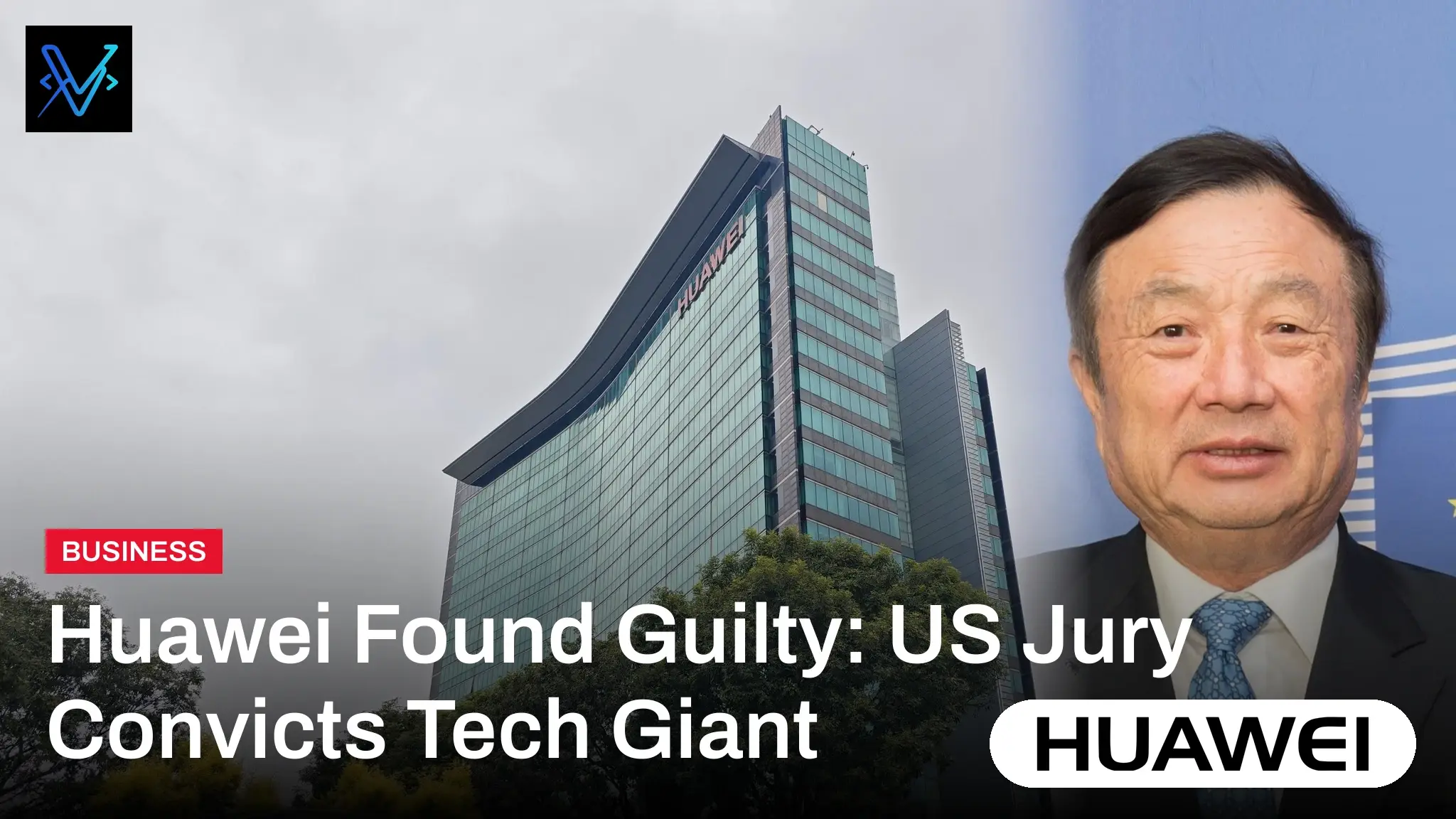
A federal jury in Brooklyn convicted Huawei on Tuesday of bank fraud, sanctions violations and conspiracy to steal American trade secrets, ending a criminal case that began eight years ago. The Chinese telecom giant was found guilty on 10 of the 12 counts it faced — but cleared of the most serious charge prosecutors brought, racketeering conspiracy.
KEY POINTS
- A Brooklyn jury convicted Huawei and three subsidiaries on 10 of 12 criminal counts, including bank fraud, wire fraud, sanctions violations and conspiracy to steal trade secrets, after a three-month trial.
- Jurors acquitted Huawei of racketeering conspiracy and conspiracy to obstruct justice. The company says it will appeal, calling the racketeering acquittal a vindication of its position.
- Sentencing is set for September 14, 2027, when Huawei faces criminal fines, forfeiture and restitution.
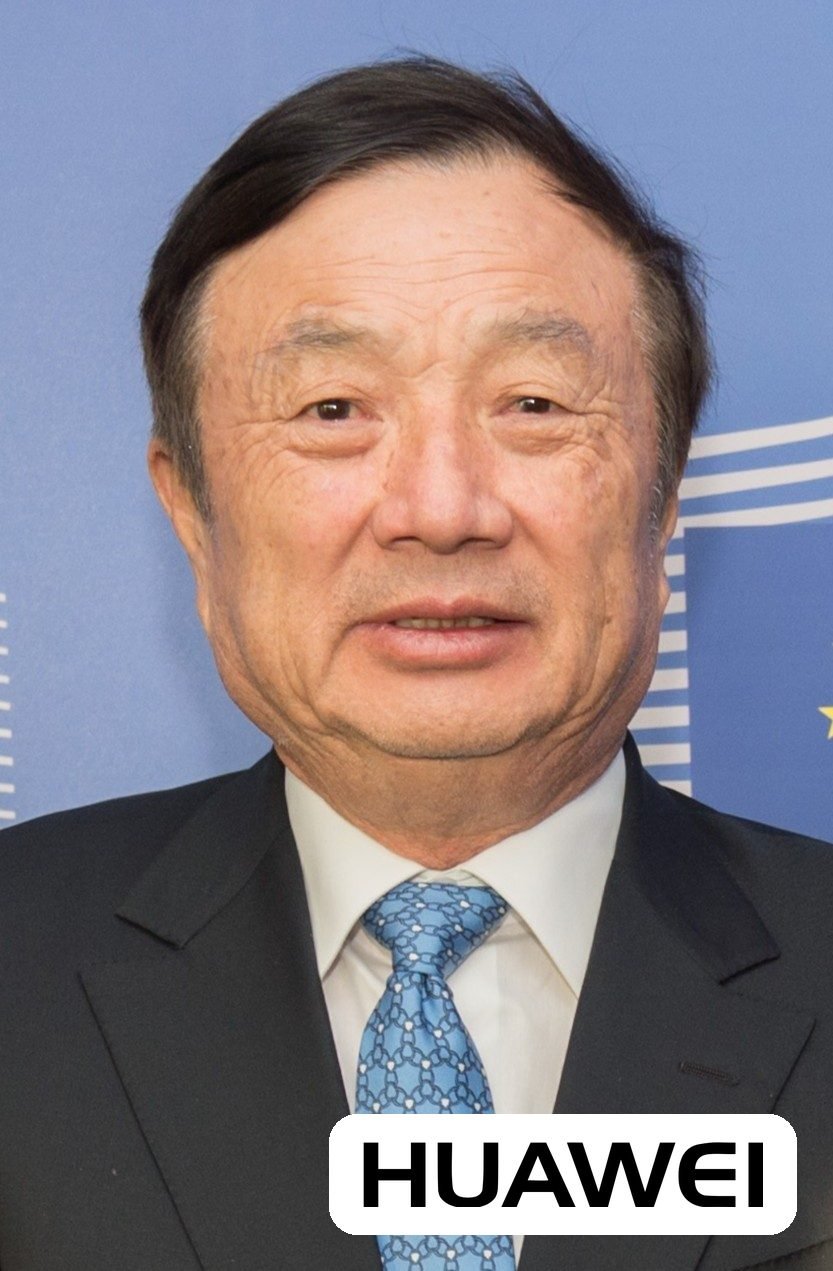
Huawei founder Ren Zhengfei. (Photo: Georges Boulougouris / European Commission / Wikimedia Commons, CC BY 4.0; Huawei wordmark: Wikimedia Commons, public domain)
| The verdict at a glance | Detail |
|---|---|
| Guilty counts | 10 of 12 — trade-secret theft conspiracy, bank fraud, wire fraud, sanctions violations, money-laundering conspiracy and related counts |
| Acquitted | Racketeering conspiracy (RICO); conspiracy to obstruct justice |
| Trial | Three months in Brooklyn federal court; more than 60 prosecution witnesses, 15 for the defence |
| Defendants | Huawei Technologies, Huawei Device, Futurewei Technologies and Huawei Device USA |
| Sentencing | September 14, 2027, before US District Judge Ann M. Donnelly |
| Penalties at stake | Criminal fines, forfeiture and restitution |
Source: US Department of Justice; Reuters.
What the jury decided
The verdict, delivered on Tuesday, November 24, found Huawei and three of its subsidiaries guilty of conspiracy to steal trade secrets, conspiracy to commit wire and bank fraud, wire fraud, bank fraud, conspiracy to defraud the United States, conspiracy to violate the International Emergency Economic Powers Act, substantive violations of that act, and money-laundering conspiracy. The jury was not persuaded on the two remaining counts: the racketeering conspiracy charge, which accused the company of operating as a criminal enterprise, and conspiracy to obstruct justice.
The split matters. Prosecutors had framed the case as a two-decade criminal enterprise — a company that, in the words of prosecutor Meredith Arfa, had its tone “set at the top by Huawei leaders and executives who themselves engaged in criminal conduct, like lying to Congress, lying to banks, violating US sanctions and trying to interfere with the very criminal investigation that led to this case.” The jury accepted the fraud, theft and sanctions charges, but rejected the claim that it all added up to a racketeering conspiracy.
The Justice Department presented the verdict as a landmark. “No person or company is above the law,” Attorney General Todd Blanche said. “For decades, Huawei and three of its subsidiaries conducted their business in the United States on the basis of lies and theft.” Assistant Attorney General Tysen Duva added: “For over two decades, Huawei built its global empire on a foundation of fraud, theft, and deception.” US Attorney Joseph Nocella said the verdict was “a step towards accountability for Huawei’s criminal activities, which includes yearslong collaboration with sanctioned entities in Iran, repeated lies to banks, and blatant thefts from US technology companies.”
The evidence: a robot in a backpack, and Cisco’s code spelled backwards
The trial turned on episodes prosecutors said showed a pattern, not a one-off. The most vivid was T-Mobile’s testing robot, Tappy, which checks smartphone touchscreens by mimicking a human finger. According to the Justice Department, Huawei signed a non-disclosure agreement with T-Mobile fully intending to violate it, photographed the robot and sent technical details back to China, and when that was not enough, one employee stole part of the robot in his backpack and carried it out of T-Mobile’s controlled laboratory.
Then there was Cisco. Prosecutors said Huawei copied the source code used in Cisco’s routers — technology the Justice Department called the “crown jewel” of Cisco’s business — and tried to hide it by referring to Cisco by its name spelled backwards, “ocsic,” in internal notes. Other episodes included a Huawei employee caught photographing proprietary Fujitsu equipment while wearing a badge falsely identifying him as an employee of “Weihua” rather than Huawei; a university researcher hired to get Huawei access to a circuit board made by the US chip company CNEX, without disclosing he was acting for Huawei; and confidential antenna technology from the US manufacturer Quintel, obtained under a non-disclosure agreement and then used in a Huawei patent application.
The financial charges were just as detailed. Prosecutors said Huawei ran its business in Iran under the name Skycom, falsely telling banks, journalists and the US government that it did not assist Iran’s government, military or intelligence services, that it had begun restricting its Iranian business in 2011, and that Skycom was an independent business partner rather than a wholly-owned subsidiary. The 2018 indictment alleged Huawei misled HSBC, Standard Chartered and BNP Paribas about its Iranian dealings. The Justice Department said those lies won Huawei billions of dollars in credit and access to US-dollar clearing services, and that the company also helped Iran’s government monitor and censor internet users, and supplied surveillance cameras that let the Iranian authorities monitor protest activity.
The eight-year road to the verdict
This case has shadowed Huawei since 2018. In December of that year, Canadian authorities detained Huawei’s chief financial officer, Meng Wanzhou — the daughter of founder Ren Zhengfei — on a US warrant, triggering a diplomatic crisis between the United States, China and Canada. Meng was accused of misleading an HSBC banker about Huawei’s business in Iran. She fought extradition for nearly three years before entering a deferred prosecution agreement and flying home to China to a hero’s welcome; the charges against her were dropped. She did not testify at the trial, though the HSBC banker she met with in 2013 did.
The following year, the US government placed Huawei on a trade blacklist that restricted its access to American technology, citing national security concerns. Prosecutors added the trade-secret charges in 2020, alleging theft from US technology companies over two decades. Reuters’ own reporting from 2012 and 2013 helped expose Huawei’s activities in Iran and was discussed during the trial.
The trial itself overlapped with an extraordinary piece of timing: a summit in Shenzhen, the technology city where Huawei is based, between President Donald Trump, China’s Xi Jinping and Russia’s Vladimir Putin. The verdict landed in the middle of a US-China relationship that is already strained — the Trump administration is separately preparing new tariffs on goods from 16 countries, as we reported in our account of the Section 301 investigation.
What Huawei says
Huawei disputes the convictions and says it will fight them. In a statement issued from Shenzhen on Wednesday, November 25, the company welcomed its acquittal on the racketeering charge, saying the decision vindicated its position that the allegations lacked a factual basis. It argued that the five trade-secret disputes presented by the US government were civil matters resolved over the past two decades, adding: “No court ever found Huawei liable for willful intellectual property misappropriation, and the company was never ordered to pay damages for trade secret misappropriation.” The company said it would review the verdicts and take the legal action needed to defend its interests, and pointed to more than $270 billion invested in research and development since 2007 and more than 165,000 active granted patents.
Its lawyer, Brian Heberlig, told reporters the company was disappointed by the convictions but said the racketeering acquittal vindicated its “good-faith compliance culture” and added: “We fully expect to appeal.” He also said the acquittal on that charge could make a significant difference to the penalties. In court, Heberlig argued prosecutors had “cherry-picked” a handful of disparate incidents to support a 20-year conspiracy claim, and that Huawei succeeded through “hard work, innovation, and investment in research and development.” He noted that Huawei paid billions of dollars in licensing fees over the years, three-quarters of it to US companies, and that when Cisco source code was found in Huawei software more than two decades ago, the company recalled the routers it had sold in the US and offered to replace them with Cisco routers.
Why it matters
The verdict is the most significant legal blow yet in the technology rivalry between the United States and China — a rivalry that has expanded from telecoms equipment and smartphones into semiconductors and artificial intelligence. Huawei has not been allowed to sell equipment to US carriers for years, and it has been blacklisted by other Western allies, including Canada and Britain. But it has kept doing a robust business elsewhere, and more recently it has expanded into chipmaking, becoming an important alternative inside China to chips made by companies such as Nvidia — the same chip trade now convulsing markets, as we reported in our account of the AI sell-off sweeping Asia and the Nvidia scandal that ended with Jensen Huang’s return as chief executive.
Experts cited by Reuters said the case had not undermined Huawei’s business, because the company diversified and became a key player in China’s push for artificial intelligence. The company has more than 200,000 employees and operates in about 170 countries. The conviction does not change any of that overnight — but it does put a US federal jury’s stamp on the American government’s core claim: that Huawei’s rise was built, at least in part, on stolen technology and lies to banks. That finding will be quoted in every future debate about whether Huawei’s equipment, chips and AI systems can be trusted, and in every negotiation over US-China technology rules.
What to watch next
Three things decide what happens from here. First, the appeal: Huawei’s lawyers have said they expect to challenge the convictions, and the appeal will test whether the trade-secret evidence — much of it two decades old — was properly put to a jury as a criminal conspiracy rather than a series of civil disputes. Second, sentencing on September 14, 2027: the penalties are financial — criminal fines, forfeiture and restitution — and the racketeering acquittal may reduce them, but the sums could still run into the billions. Third, the political fallout: whether the verdict hardens the US position in its technology standoff with Beijing, or becomes a bargaining chip in the wider trade talks. Either way, the eight-year case is no longer an accusation. It is a conviction — and Huawei’s next decade will be shaped by how it answers it.
Looking to grow your business online? Explore Vertex Agency at vertexagency.in for professional website development, Meta Ads and social media growth.
Sources
- US Department of Justice — Chinese Tech Giant Huawei and Subsidiaries Convicted of Sanctions Violations, Fraud, Conspiracy to Steal Trade Secrets, and Money Laundering (Nov 24, 2026)
- Reuters — China’s Huawei convicted in sprawling US criminal trial over Iran business (Nov 25, 2026)
- Associated Press — Chinese tech giant Huawei is guilty of conspiracy to steal trade secrets, US jury finds (Nov 24, 2026)
- People Daily — US finds Huawei guilty of stealing American technology and secretly aiding Iran (Nov 25, 2026)