If you searched for “butterball turkey recall” this morning, you were not alone. By Thursday morning in the United States, it was the number one trending search in the country, according to Google Trends. The short answer is: no, there is no Butterball turkey recall. But the investigation behind the searches is real, and its numbers are stark. Federal inspectors found salmonella in just under 43% of the ground and chopped turkey sampled at four Butterball plants over the past year — more than three times the limit the US Department of Agriculture sets for a single plant.
KEY POINTS
- Federal inspection data for fiscal years 2025 and 2026, analysed by SourceMaterial with The Guardian, found salmonella in just under 43% of ground and chopped turkey samples from four Butterball plants. The USDA limit for a single plant is 13.5%.
- There is no recall. A plant that exceeds the limit faces no fine and is not required to pull products from shelves — the USDA only requires it to explain how it will fix the problem. No contamination was found in Butterball’s whole birds or ready-to-eat products.
- At Mount Olive, North Carolina — the country’s biggest turkey slaughterhouse, processing 285,000 birds a week — 36% of ground turkey samples tested positive. Two-thirds of the germs found in Butterball birds’ intestines resisted at least one antibiotic.
What the investigation found
The numbers come from routine testing, not a single incident. The USDA’s Food Safety and Inspection Service, along with some state agencies, regularly checks for salmonella and other bacteria in commercial poultry plants. SourceMaterial analysed that inspection data for fiscal years 2025 and 2026, provided by Slingshot Investigates, the investigative arm of the animal rights group Project Slingshot, in a project published with The Guardian on November 25.
The headline figure covers all four of Butterball’s slaughterhouses: just under 43% of ground and chopped turkey sampled over the past year contained salmonella. That is well above the industry average, and far above the 13.5% the USDA sets as the acceptable limit for an individual plant.
The worst single figure is at the company’s biggest site. At Mount Olive in North Carolina — the largest turkey slaughterhouse in the country — inspectors found salmonella in 36% of ground and chopped turkey samples. The plant processes about 285,000 birds a week and sells raw ground turkey, burgers and sausages across the country. Butterball, America’s biggest turkey company, supplies the three largest US supermarkets — Walmart, Costco and Kroger — as well as fast-food chains.
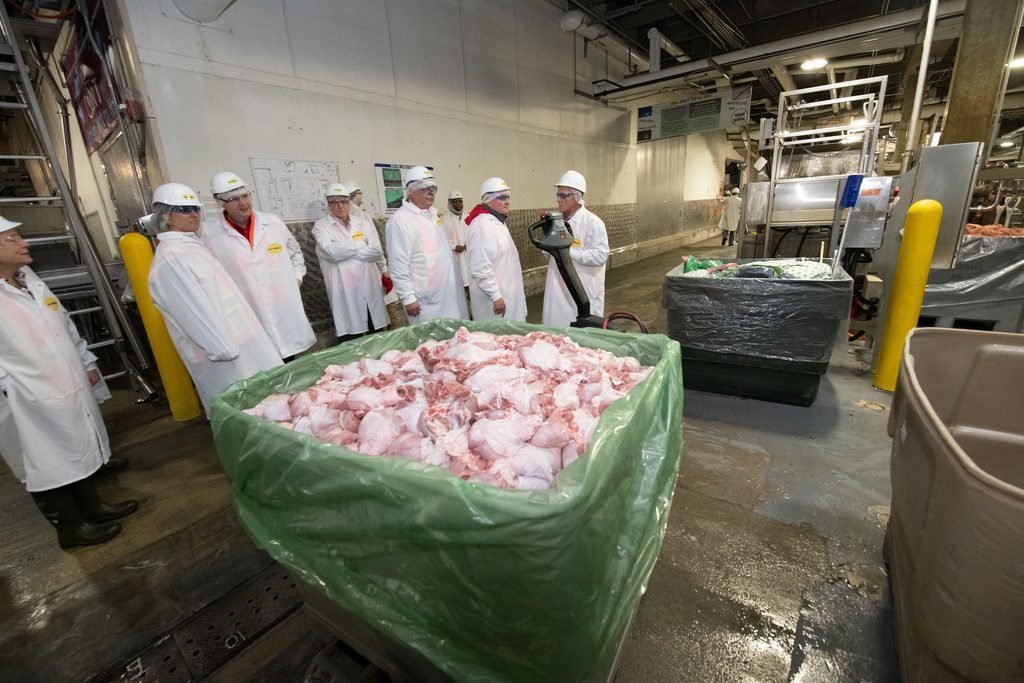
Inside Butterball’s Mount Olive slaughterhouse in North Carolina, where inspectors found salmonella in 36% of ground turkey samples. Photo: Lance Cheung / USDA
How Butterball compares
The gap between Butterball and its rivals is what makes the findings hard to dismiss as an industry-wide problem. At Jennie-O, Butterball’s main competitor, 7% of ground and chopped turkey samples tested positive over the past year. Two other large producers also came in lower than Butterball: Foster Farms at 29% and Koch Foods at 27%.
| Producer | Ground / chopped turkey samples testing positive | Against the USDA limit |
|---|---|---|
| Butterball (four plants) | Just under 43% | More than 3x the limit |
| Butterball, Mount Olive NC | 36% | Nearly 3x the limit |
| Foster Farms | 29% | More than 2x the limit |
| Koch Foods | 27% | 2x the limit |
| Jennie-O | 7% | Below the limit |
| USDA limit, individual plant | 13.5% | — |
For the US meat industry as a whole, the government data showed an average of 12% of samples contaminated with any pathogen. Butterball’s ground turkey figure is more than three times that.
Why there is no recall
This is the part that surprises most people, and it explains the confusion online. Under the current rules, a slaughterhouse that exceeds the USDA’s salmonella limit does not face a fine, and it does not have to recall its products. The USDA requires the plant to explain how it is addressing the problem — and that is where the process, for now, ends.
That is why there is no recall to look up, and no product to return. The findings are about inspection data, not an outbreak. No recall was announced alongside the investigation, and none has been announced by the USDA since.
Butterball disputes the way the numbers are counted. Alice Johnson, the company’s senior vice-president of food safety, quality and animal care, said the USDA should measure the quantity of salmonella in samples, not simply whether it is present. Experts interviewed for the investigation disagreed. Sarah Sorscher, director of regulatory affairs at the Center for Science in the Public Interest, put it plainly: having less contamination is better than having more — but “having no salmonella in your food” would be better still.
There is also a structural argument behind the numbers. Thomas Gremillion, director of food policy at the Consumer Federation of America, said contamination is worsened by fast line speeds at slaughterhouses, and noted that the Trump administration has allowed poultry processors to run their lines faster. Faster speeds, he said, make it harder to keep the contents of the digestive tract — where the bacteria concentrate — off the meat.
Butterball has been here before. In 2019, the company recalled almost 80,000 pounds of turkey products from Mount Olive after an outbreak of illness across two states likely caused by salmonella linked to its products. That history is part of why today’s numbers set off so many alarms.
Your Thanksgiving bird is not the problem
Here is the distinction that matters most today, on Thanksgiving itself: the investigation found no contamination in Butterball’s whole birds or in its ready-to-eat cooked products. The problem is confined to raw ground and chopped turkey — the kind sold as mince, burgers and sausages, which needs thorough cooking.
That is the good news for anyone with a whole turkey in the oven right now. The bird on the Thanksgiving table is not what the data is about. The risk sits with ground turkey products, where every extra processing step is another chance for contamination — exactly as Sorscher explained it: each step in grinding and chopping is another opportunity for the meat to pick up bacteria.
So the practical rules for today are the standard ones, and they matter more than usual. Cook ground turkey thoroughly, all the way through. Keep raw turkey — and anything that has touched it — away from foods that will not be cooked. Wash hands, boards and utensils after handling raw meat. And if you bought ground turkey recently and want to check whether anything you own is affected, the USDA’s recalls page is the official place to look.
The second problem: drug-resistant germs
The investigation found a second warning inside the same data. Tests on samples taken from birds’ intestines across all of Butterball’s slaughterhouses in fiscal year 2026 found that two-thirds of the samples containing salmonella and campylobacter — another pathogen that can make people sick — carried strains resistant to at least one antibiotic. At Butterball, 65% of positive samples were resistant to at least one antibiotic drug, compared with 61% at Jennie-O. Across the whole US meat industry, the figure was 33%.
That matters because doctors use antibiotics to treat severe cases of both infections, and resistance is associated with longer illness, a greater likelihood of hospitalisation and a greater likelihood of death. Each year, about 25,500 Americans are hospitalised after exposure to salmonella and campylobacter, leading to 435 deaths, according to the Centers for Disease Control and Prevention.
Butterball said 60% of its turkeys did not receive antibiotics last year, and said it follows responsible antibiotic use practices. The company also pointed out that the drug-resistance tests use samples from whole birds, so they do not necessarily show contamination in finished products on shelves. The World Health Organization, for its part, strongly recommends against the routine use of antibiotics on healthy animals — a practice the industry has long defended as disease prevention.
What Butterball says
A Butterball spokesperson said food safety is “critically important” at the company, and that it works to ensure consumers can feel confident in the products they prepare and serve to family and friends. The company said it continues to invest in new technologies, strengthen its processes and work with food safety experts to reduce pathogens, including salmonella.
Butterball also said it is taking part in a pilot programme with the USDA’s Food Safety and Inspection Service evaluating the cause of foodborne illness, and pointed out that none of its pre-cooked products contained salmonella. Jennie-O, meanwhile, said its food safety programme is “robust” and that its results compare favourably with industry averages and remain well below the regulatory limits.
What to watch next
The first thing to watch is what the USDA does with Butterball’s explanation. The rules require the company to say how it will fix the problem; whether that answer satisfies the agency — and whether the numbers improve in the next round of testing — will decide whether this ends as a bad news cycle or becomes a longer enforcement fight.
The second is the pilot programme. The USDA rolled out a pilot in 2026 aimed at cutting salmonella in raw poultry plants, using approaches such as biomapping and validated control points in food safety plans. Butterball is taking part. If it works, the next set of numbers should show it.
And the third is the shopping. Thanksgiving weekend is the biggest spending weekend of the American year, and millions of households are buying food for the days ahead. Our guide to Black Friday 2026 explains how to shop the sales without taking on debt. Household budgets are already being squeezed from several directions at once: US inflation climbed to 3.8% in October, and new tariffs have been proposed on 14 trading partners. Whether shoppers start asking harder questions about the turkey on their list — and whether retailers do — is the open question after today.
The numbers will not change what is already in the oven. But they have changed the conversation about what is in the packet next to it. A 43% positive rate, no recall, no fine, and a rule that asks a company to explain itself rather than pull its product: that is the system working as it is currently designed. The question now is whether anyone thinks that design is good enough.
Looking to grow your business online? Explore Vertex Agency at vertexagency.in for professional website development, Meta Ads and social media growth.
Sources
- The Guardian — “High levels of salmonella found in some products from nation’s biggest turkey producer” (November 25, 2026): https://www.theguardian.com/environment/2026/nov/25/turkey-salmonella-butterball
- SourceMaterial — “High levels of salmonella found from largest US turkey producer” (November 25, 2026): https://www.source-material.org/butterball-turkey-salmonella-antimicrobial-resistance/
- USDA Food Safety and Inspection Service — Recalls & Public Health Alerts (where to check current recalls): https://www.fsis.usda.gov/recalls
- Google Trends, United States (via Trendoday) — trending searches, November 26, 2026: https://trendoday.com/google-trends/us