The Federal Communications Commission has given SpaceX permission to put up to one million data centers in orbit. Not one million satellites that beam internet to the ground — one million satellites that run artificial intelligence workloads in space, powered by the sun, linked by lasers, and cooled by the vacuum around them. The agency calls it the first authorisation of its kind in US history, and the company behind it has 14 years to make it real.
KEY POINTS
- The FCC has authorised SpaceX to deploy up to one million satellites for its Starmind constellation, which would work as orbital data centers processing AI workloads — the first such authorisation in US history.
- The licence sets a 14-year clock: the first satellite must be operating by November 2033, 100,000 by 2035, half a million by 2038, and the full million by 2040.
- Each satellite is set to carry Nvidia Rubin GPUs and Vera CPUs, and the whole plan depends on Starship — the giant reusable rocket still in development — to lift them at a pace no existing rocket could match.
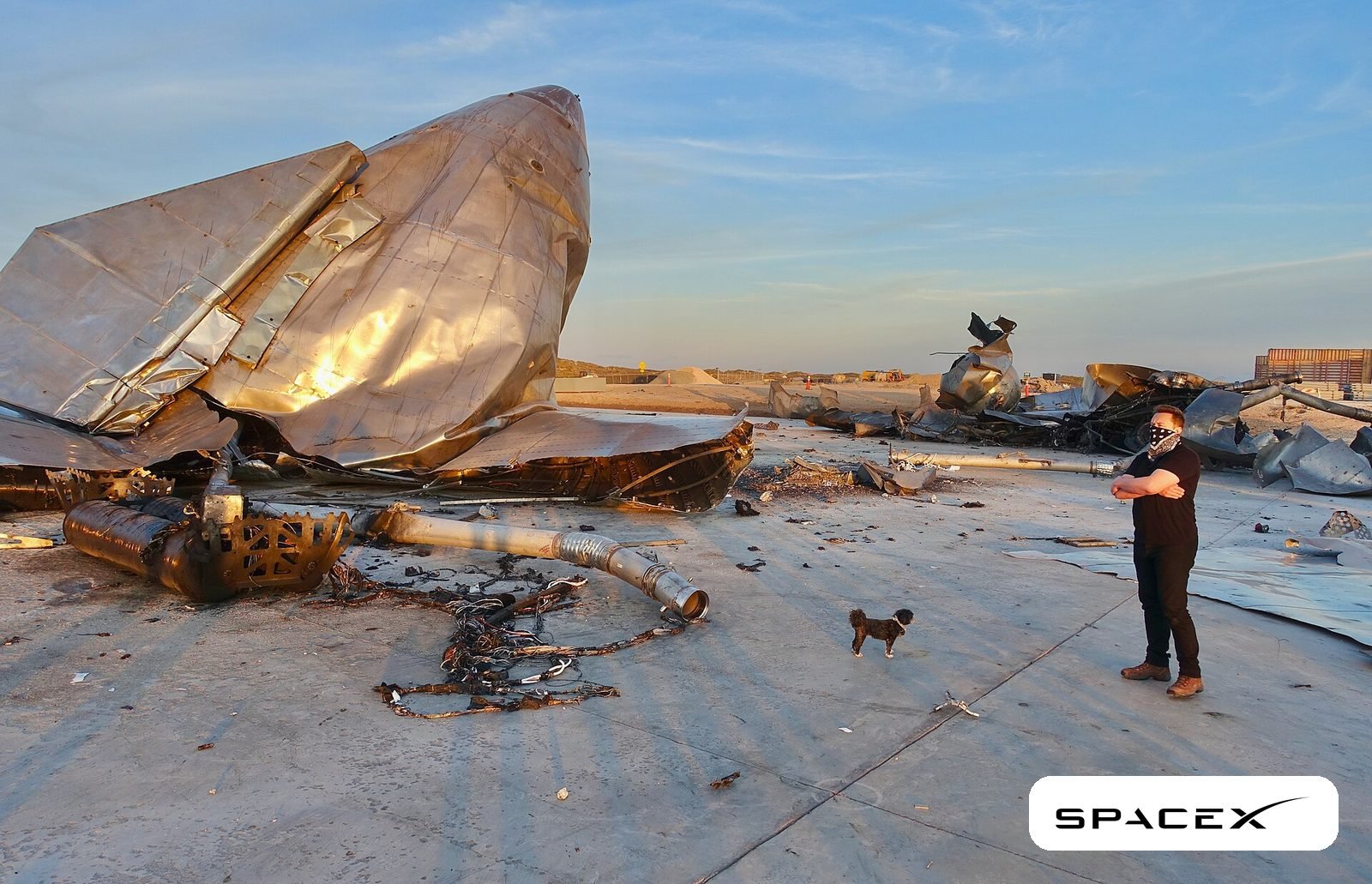
SpaceX CEO Elon Musk beside the wreckage of the Starship SN8 prototype in December 2020. (Photo: Steve Jurvetson / Wikimedia Commons, CC BY 2.0; SpaceX logo: Wikimedia Commons, Public domain)
One million satellites, against 17,000 in orbit today
The number is the story. Right now, there are only about 17,000 satellites in orbit around Earth in total — and SpaceX already owns most of them, with just over 11,000 Starlink satellites in space. Starmind, at its full size, would be almost 60 times bigger than everything humanity has ever put up there.
SpaceX asked the FCC for permission in an application filed on January 30. It describes Starmind as “capturing solar energy in space to power low-cost, high-performance AI compute for Earth.” The satellites would not be another broadband network. They would be interconnected data centers, processing information in orbit and sending the results back down — linked to each other by high-bandwidth laser communications, with radio as a backup.
The FCC’s licence comes with a strict timetable, and the agency was blunt about the scale of what it had just approved. “It promises to bring the human race closer to a Kardashev II civilization — one that can harness the full power of the sun,” the agency said in its announcement, borrowing the language SpaceX itself used in its application.
| Starmind milestone | Deadline | Scale |
|---|---|---|
| First operational satellite | November 2033 | 1 satellite |
| 10% of the constellation | November 2035 | 100,000 satellites |
| 50% of the constellation | November 2038 | 500,000 satellites |
| Full constellation | 2040 | 1,000,000 satellites |
| Satellites in orbit today (all operators) | Now | ~17,000 |
| Starlink satellites in orbit today | Now | Just over 11,000 |
Those dates matter, because satellite operators have a habit of asking for far more than they ever launch. SpaceX sought approval for 42,000 Starlink satellites before it had deployed a single one, and a decade later it has about a quarter of that number in space. Reuters made the same point about Starmind: it was unclear whether SpaceX would ever actually put a million satellites up there. The licence is a ceiling, not a promise.
Why put a data center in space at all?
The pitch is simple, and it is the same argument driving the frantic build-out of data centers on Earth. AI needs enormous amounts of power, land and water for cooling — and those are exactly the things that are getting harder to find. In orbit, sunlight is near-constant, cooling means radiating heat into space, and there is no land to buy and no neighbours to object.
“By directly harnessing near-constant solar power with little operating or maintenance costs, these satellites will achieve transformative cost and energy efficiency while significantly reducing the environmental impact associated with terrestrial data centers,” SpaceX told the FCC.
FCC Chairman Brendan Carr went further, calling the decision one that “opens a bold new frontier for the computing infrastructure needed to power America’s leadership and growth.” He framed it as part of the administration’s push for rapid data center expansion, arguing that “compute campuses or data centers are essential to sustaining America’s leadership” in artificial intelligence. “By moving compute capacity beyond Earth, SpaceX and the many competitors working on their own orbital data centers are meeting the moment,” he said.
Elon Musk replied to Carr on X, saying his praise was “much appreciated” and adding: “This will be a great asset to America and the world.”
The Nvidia connection
Starmind is not a SpaceX-only project. In August, SpaceX announced it was partnering with Nvidia to design the compute payload for the first Starmind satellite. “Each of the Starmind satellites will include Nvidia Rubin GPUs and Vera CPUs for datacenter-class space compute,” the company said at the time.
That puts the world’s most valuable chipmaker at the centre of the most ambitious satellite plan ever approved — just days after Jensen Huang’s dramatic return as Nvidia’s chief executive sent its shares soaring 31% in a single day. Nvidia’s next-generation Rubin chips were designed for the giant data centers being built on Earth; now they are also the brains of the ones planned for orbit. SpaceX said its operation in Bastrop, Texas, would be put in charge of producing the AI compute satellites, while its Redmond, Washington, facility keeps building Starlink spacecraft.
The timing is no coincidence. The AI industry is spending hundreds of billions of dollars on computing capacity — and investors are openly asking whether that spending can ever pay for itself. SpaceX’s answer is to change where the computing happens, and how much it costs to power it.
The objections the FCC swept aside
Not everyone is cheering. The FCC rejected formal opposition from Amazon and Viasat, as well as from the American Astronomical Society, which warned the constellation could seriously interfere with ground-based astronomy. The society said it was “disheartened and dismayed” by the decision. The Secure World Foundation had urged regulators to assess the cumulative risks to orbital sustainability before granting approval.
Amazon’s rival satellite unit, Leo, had argued that SpaceX was unlikely ever to deploy all the satellites and that doing so could take centuries. Carr rejected that criticism back in March, in terms that left little doubt about where he stood: “Amazon should focus on getting Amazon’s house in order with their own launches and their own satellite constellation, rather than worrying about other people that are actually out there launching satellites at the pace and cadence that SpaceX is.”
The FCC did not give SpaceX everything it asked for. The company had sought a waiver to move satellites operating above 600 kilometres into so-called graveyard orbits at the end of their lives, instead of bringing them down to burn up in the atmosphere. The agency said SpaceX had not provided enough information about its proposed disposal process, and held the waiver back. It also declined to carry out a comprehensive environmental assessment, saying several of the concerns raised fell outside its regulatory jurisdiction. The licence does, however, require communications backups, regular progress updates and a detailed plan for dealing with orbital debris.
A race, not a one-horse bet
SpaceX is first through the door, but it is not alone. The FCC said it is still reviewing other orbital data center proposals and intends to decide them quickly. The field already includes Blue Origin, which has proposed a 51,600-satellite constellation for its Project Sunrise initiative; Starcloud, which has applied to operate 88,000 data center satellites; Cowboy Space, formerly Aetherflux, with a 20,000-satellite application; and Google, which is testing satellites for a data-processing constellation called Project Suncatcher, with its first launches planned on Blue Origin’s New Glenn rocket no earlier than 2029.
That is the real significance of Wednesday’s decision. The FCC has now said, for the first time, that a constellation of data centers in space is a legitimate thing to authorise. Every rival application will now be judged against the Starmind precedent — and the conditions attached to it.
What to watch next
Three things will decide whether Starmind becomes a working network or a very large piece of paper. The first is Starship. The whole plan bets on the giant reusable rocket bringing launch costs down far enough to make deploying hundreds of thousands of satellites economically possible — a launch cadence and payload capacity far beyond what conventional rockets can provide. Until Starship is flying regularly, the 2033 deadline is the only hard date that matters.
The second is debris. The FCC’s approval only covers satellites below 600 kilometres, where the thin atmosphere drags dead hardware down within a few years. Anything flying higher needs a disposal plan the agency is willing to accept, and SpaceX has not produced one yet. How that argument is resolved will shape the constellation’s design.
The third is the competition. The FCC’s next decisions — on Blue Origin, Starcloud and the rest — will show whether Starmind was a one-off or the start of an orbital land grab. If the rivals get similar licences, the night sky and the economics of AI computing are both about to change at the same time. And the company that just had the biggest IPO in history, Anthropic, is only one of the AI labs that will be bidding for that compute.
For now, the licence is real, the deadline is 2033, and the number is one million. Whether the satellites follow is the next decade’s question.
Looking to grow your business online? Explore Vertex Agency at vertexagency.in for professional website development, Meta Ads and social media growth.