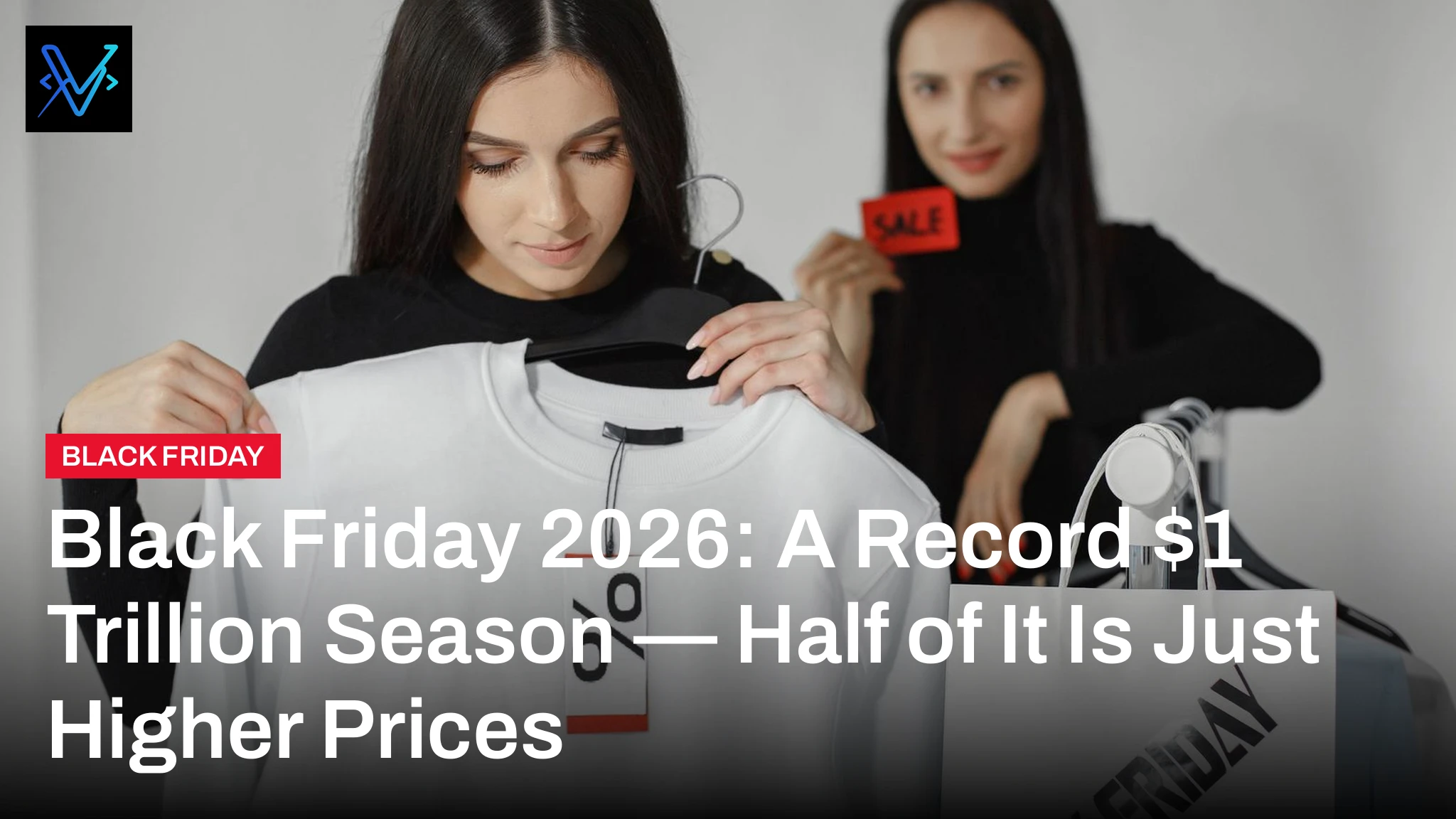
Black Friday 2026 opens the biggest holiday shopping season in American history — the National Retail Federation forecasts $1.013 trillion in November and December retail sales, the first trillion-dollar holiday season on record. But the record comes with an asterisk the headlines skip: the NRF's own chief economist says nearly half of that 4.2% growth is higher prices, not more shopping. And the average shopper plans to spend $624 across the Black Friday to Cyber Monday weekend — exactly the same as last year.
KEY POINTS
- The National Retail Federation forecasts November–December 2026 US retail sales of $1.013 trillion, up 4.2% on 2025's $972 billion — the first trillion-dollar holiday season. But NRF chief economist Mark Mathews says nearly half of that growth will come from higher prices, not from shoppers buying more.
- Adobe expects $275.1 billion online this season, up 6.7%: Black Friday itself should drive $12.9 billion online (up 9.2%), Cyber Monday $15.1 billion (up 6.2%), and the five-day Cyber Week $47.5 billion. Discounts peak at 30% off, and buy now, pay later is set to finance $21.3 billion of it.
- Deloitte's survey finds 87% of shoppers plan to shop Black Friday–Cyber Monday — a 10-year high — yet average planned spending is flat at $624, and half of shoppers say they have already faced higher holiday prices. Gen Z is the exception: average planned spend of $752, up 23%, with 40% planning to use buy now, pay later.
| Forecast | 2026 figure | Change vs 2025 | Source |
|---|---|---|---|
| Total holiday retail sales (Nov–Dec) | $1.013 trillion | +4.2% | NRF |
| Online holiday sales (Nov–Dec) | $275.1 billion | +6.7% | Adobe |
| Black Friday online sales (Nov 27) | $12.9 billion | +9.2% | Adobe |
| Cyber Monday online sales (Nov 30) | $15.1 billion | +6.2% | Adobe |
| Cyber Week online sales (Nov 26–30) | $47.5 billion | +7.4% | Adobe |
| Buy now, pay later (Nov–Dec) | $21.3 billion | +6.6% | Adobe |
| Average planned BFCM spending | $624 | Flat | Deloitte |
| Shoppers planning to shop BFCM | 87% | 10-year high (82% in 2025) | Deloitte |
| People expected to shop Thanksgiving weekend | 182.7 million | 126M on Black Friday | NRF / Prosper |
Sources: National Retail Federation holiday forecast (Oct 15, 2026); Adobe holiday shopping forecast (Sep 28, 2026); Deloitte 2026 Black Friday–Cyber Monday Survey. All figures are forecasts and survey results — no Black Friday or Cyber Week sales have been recorded yet.
The record, and the asterisk
The headline number is genuinely historic. The National Retail Federation's annual holiday forecast, released October 15, puts November and December retail sales at $1.013 trillion — up 4.2% on last year's $972 billion, which itself rose 3.1%. It is the first time the NRF's measure of the season has crossed a trillion dollars. The forecast covers core retail only: it excludes car dealers, petrol stations and restaurants, and it counts November 1 through December 31.
But a trillion dollars does not mean Americans are buying a trillion dollars' worth of more stuff. The NRF's figure is nominal — it is not adjusted for inflation. On the forecast call, NRF chief economist Mark Mathews was blunt about what that means: core goods inflation, measured by the Fed's preferred PCE price index, is expected to average 2.5% in 2026, up from 1.6% in 2025, and "our expectation is that of our holiday forecast of 4.2% growth, nearly half of this will result from real consumer spending growth." In other words, roughly half the record is shoppers paying more for the same basket.
That split is the story of this holiday season. Retailers are hiring 325,000 to 375,000 seasonal workers, in line with last year, and the NRF points to 12 consecutive months of retail sales growth. But Mathews also warned that inflation, rising gas prices and pressure on household spending "will affect consumers differently across income groups" — and the surveys bear that out.
What Black Friday itself looks like
Adobe, which measures online transactions directly across more than a trillion visits to US retail sites, expects $275.1 billion in online spending this season, up 6.7%. Black Friday, tomorrow, November 27, is forecast at $12.9 billion online — up 9.2% on last year and growing faster than any other big day, driven by the season's deepest discounts on TVs, apparel and appliances. Cyber Monday, November 30, remains the biggest single online day at $15.1 billion, up 6.2%. The five days from Thanksgiving to Cyber Monday should drive $47.5 billion online, 17.3% of the whole season's online spend. Thanksgiving Day itself is expected to bring in $6.9 billion online, up 8.5%, with a record 63% of it coming through phones.
NRF's Thanksgiving-weekend survey expects 182.7 million people to shop over the five days, including 126 million on Black Friday and 66.1 million on Cyber Monday. Deloitte's survey adds the human detail: 72% of shoppers have deliberately delayed purchases until this weekend because they expect a better deal, and 61% of the Black Friday–Cyber Monday budget is expected to be spent online, with 39% in stores.
The discounts are real but not extraordinary. Adobe expects them to peak at up to 30% off listed price during Cyber Week — electronics at 30%, toys at 29%, and TVs, computers and apparel at 23%. The timing matters: the deepest discounts for electronics and computers land on Cyber Monday, while the best deals for TVs, toys, apparel, appliances and furniture are expected on Black Friday, and sporting goods peak on Thanksgiving Day.
Who is spending — and who is pulling back
Deloitte's survey, which polled more than 1,000 shoppers, found participation at a 10-year high: 87% plan to shop Black Friday–Cyber Monday, up from 82% last year. Yet the average planned spend is $624 — flat year over year. Half of respondents say they have already experienced higher holiday prices on gifts they bought. More people are showing up; nobody, on average, is spending more.
The averages hide a sharp income split. Households earning under $50,000 plan to spend 17% more than last year, at $433 — stretching to cover the same holidays at higher prices. Households earning $100,000 to $199,000 are the only group planning to spend less, down 7%, and 84% of those cutting back cite higher everyday living costs as the reason. It is a season where the lowest earners are spending more because they have to, and middle earners are spending less because they feel squeezed.
One generation is leaning in hard. Gen Z shoppers — aged 18 to 29 — plan to spend $752 on average, up 23% from $609 last year, and are expected to account for about 21% of all Black Friday–Cyber Monday spending. Nearly all of them, 94%, plan to shop the weekend; 73% plan to buy a gift for themselves; and 72% plan to shop in stores on Black Friday itself, well above the 50% of other generations. Deloitte also found that shoppers who use both social media and generative AI in their shopping journey plan to spend $765 on average — 61% more than the $476 planned by shoppers who use neither.
The debt trap hiding in the deals
The fastest-growing way to pay for it all is buy now, pay later. Adobe expects BNPL to finance $21.3 billion of holiday spending this season, up 6.6% — including $1.09 billion on Cyber Monday alone and $807 million on Black Friday, with 82% of BNPL spending happening on phones. Deloitte found 40% of Gen Z shoppers plan to use BNPL this weekend.
BNPL feels free at checkout because it usually is — no interest if you pay on time. The risk is the pile-up: four or five "interest-free" plans across different stores, each with its own due date, add up to a real monthly bill. Last season, 37% of consumers took on holiday debt averaging $1,223, according to a LendingTree survey, and 63% of them expected to need three months or longer to pay it off. With credit card rates near 20% and the Fed now expected to raise rates in December — after October inflation came in hot at 3.8% — debt taken on this weekend will cost more to carry into 2027 than it did a year ago.
How to shop the weekend without the debt
The forecasts are useful for one thing above all: they tell you where the real deals are, and where the traps are. A few rules that follow from the numbers:
Set a hard number before Friday — and write it down. The average plan is $624. Whatever yours is, decide it before the first deal email lands, not after. Shoppers who use social media and AI shopping tools plan to spend 61% more than those who don't — the feed is designed to raise your number.
Buy the right thing on the right day. Adobe's data says the deepest TV, toy, apparel, appliance and furniture discounts land on Black Friday; electronics and computers peak on Cyber Monday. If you can wait three days for a laptop, the data says you should.
Treat buy now, pay later as debt, because it is. Before tapping it, add up every BNPL plan you already have open and check the total monthly payment. One plan is a tool; four at once is a second credit card bill. If the purchase would not fit your budget paid in full, it does not fit split into four either.
Check the price against October, not against the "was" price. With half the season's growth coming from higher prices, some "discounts" are cuts from inflated sticker prices. A 30%-off tag means little if the item cost 20% less in September. A quick search of the price history takes a minute and is the single best defence against a fake deal.
Don't finance gifts with a credit card you can't clear in January. Last year's average holiday debt was $1,223, and most borrowers needed three months or more to clear it. Interest on that balance wipes out the discount that created it. If a gift needs financing, it is too expensive a gift.
Why it matters
This weekend is the year's clearest test of the American consumer. The economy's numbers look strong on paper — retail sales have grown for 12 straight months, and mortgage rates above 7% have not stopped households spending. But the same surveys that forecast a record season also show half of shoppers already feeling higher prices, middle earners cutting back, and the youngest shoppers reaching for instalment credit to keep up.
The context is a household budget under pressure from every direction. Social Security's 2027 raise is 3.6%, the biggest in four years, yet Medicare takes $6.50 of the average $75 monthly gain back. Gas prices and everyday costs keep climbing. A trillion-dollar season built half on higher prices is not a sign that shoppers are flush — it is a sign that they are determined to celebrate anyway, and paying more to do it.
What to watch next
The forecasts get their first reality check within days. Adobe publishes actual online sales figures for Thanksgiving and Black Friday as the weekend unfolds, and NRF follows with its post-weekend shopper survey — watch whether the 182.7 million turnout and the $12.9 billion Black Friday figure hold up. Cyber Monday on November 30 is the second test: it is forecast to stay the biggest online day of the year, but it is also the day BNPL use peaks, at $1.09 billion.
The longer question is what January brings. If the record season is confirmed, retailers will call it resilience; if the debt numbers follow last year's pattern — 37% of shoppers borrowing, most taking three months or more to repay — the real cost of this weekend will show up in household budgets well into 2027. Either way, the number that matters for your wallet is not $1.013 trillion. It is the one you set before Friday.
This article is general information only, not personal financial advice.
Looking to grow your business online? Explore Vertex Agency at vertexagency.in for professional website development, Meta Ads and social media growth.
Sources
- National Retail Federation — NRF Forecasts 2026 Holiday Sales Growth as Consumers Remain Resilient (Oct 15, 2026)
- Adobe — U.S. Holiday Shopping Season to Hit Record $275.1 Billion Online, Rising 6.7% YoY (Sep 28, 2026)
- Deloitte — 2026 Black Friday-Cyber Monday Survey
- Logistics Management — NRF forecasts 4.2% growth in 2026 in holiday retail sales despite economic headwinds
- WalnutInvest — Holiday Spending Statistics (2026)
Photo: Gustavo Fring / Pexels