The average rate on a 30-year fixed mortgage in the United States jumped to 7.28% last week, Freddie Mac reported, ending a month of steady declines and pushing borrowing costs to their highest since late October. It is the number millions of homebuyers have been waiting to fall — and it went the other way, even though the Federal Reserve has spent two years cutting interest rates.
KEY POINTS
- Freddie Mac’s November 19 survey put the average 30-year fixed mortgage at 7.28%, up from 7.11% a week earlier and 6.26% a year ago. The 15-year fixed rose to 6.66%, from 6.45%. It was the ninth consecutive week above 7%.
- The trigger was a hotter-than-expected October inflation report and Federal Reserve minutes pointing to more rate hikes, which pushed the 10-year Treasury yield back above 5%. Mortgage rates follow the bond market, not the Fed’s overnight rate — which is why they have risen while the Fed cut.
- On a $400,000 loan, 7.28% means about $2,737 a month in principal and interest — roughly $271 more than a year ago. Markets now price a 93% chance of a Fed rate hike at the December 8–9 meeting.
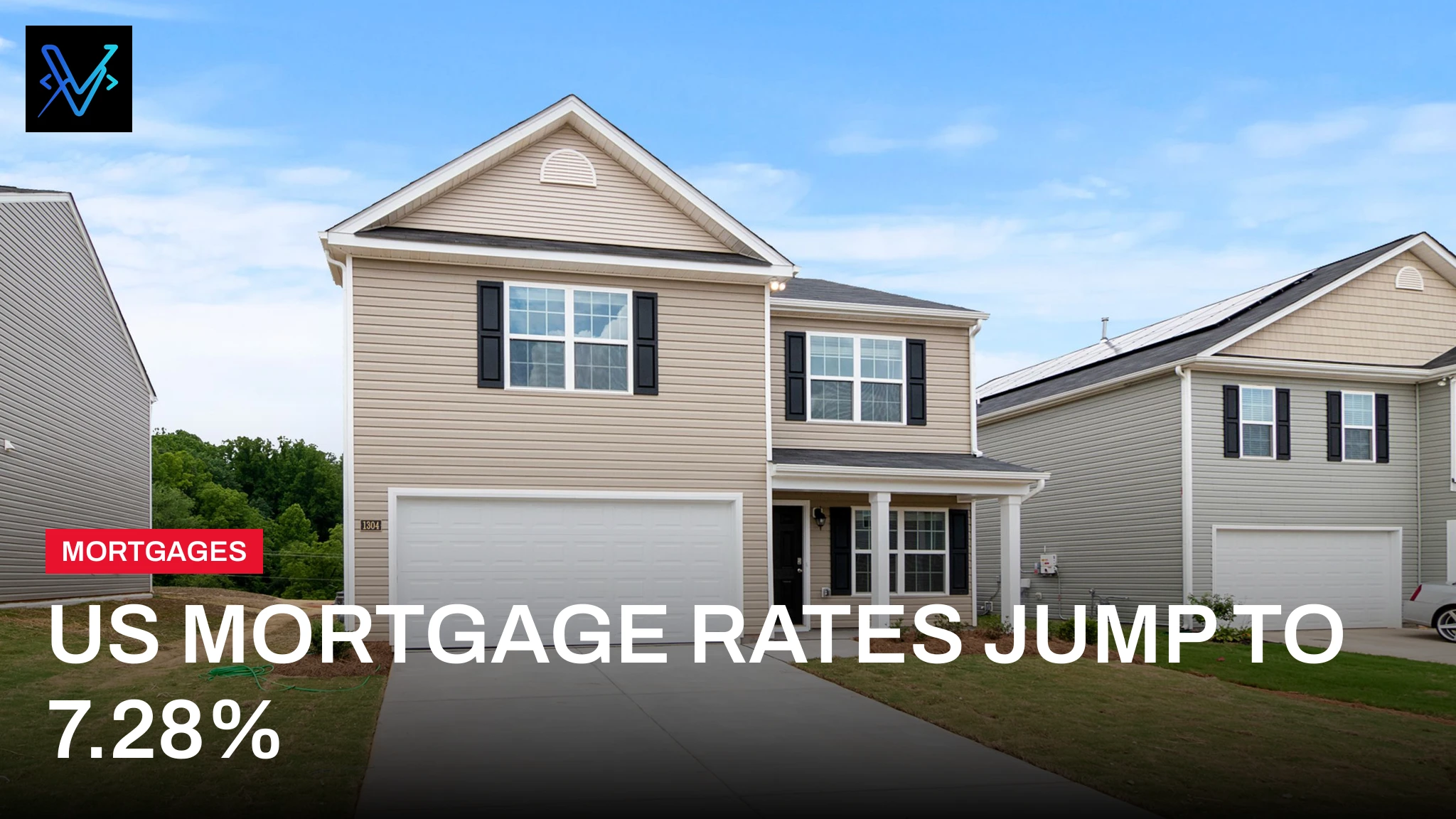
A suburban home in the US. The average 30-year mortgage rate has risen to 7.28%, its highest since late October. (Photo: Curtis Adams / Pexels)
Why Fed rate cuts didn’t cut your mortgage
Here is the paradox at the heart of this story. Since the Federal Reserve began cutting its benchmark rate in September 2024, it has lowered it by 1.45 percentage points, according to 24/7 Wall St. Over the same stretch, the average 30-year mortgage has gone up, not down — from 6.09% in the week of the first cut to 7.28% today. On a $200,000 loan, that is about $158 more a month, or roughly $56,800 in extra interest over 30 years.
The reason is simple, and it catches almost every borrower out: the Fed does not set mortgage rates. It sets the overnight rate banks charge each other. A 30-year mortgage is a long-term loan, and lenders price it off the yield on the 10-year Treasury bond — the rate the US government pays to borrow for a decade. When bond investors worry about inflation, government borrowing or the size of the deficit, they demand a higher yield, and mortgage rates climb with it, whatever the Fed does with its short-term rate.
That is exactly what has happened since 2024. The 10-year yield has risen from 3.67% in the week of the Fed’s first cut to about 5.11% now, almost exactly mirroring the Fed’s cuts in reverse. The gap between the mortgage rate and the 10-year yield has actually narrowed — from 2.42 points to 2.17 — which means lenders are not padding their margins. The bond market itself is charging more.
It is a lesson that also ran in reverse in late 2024, when the Fed cut rates by a full percentage point and mortgage rates rose by almost a full point. Borrowers who waited for Fed cuts to deliver cheaper mortgages have now waited two years and are paying more than when they started.
What the numbers look like now
| Measure | This week | Last week | A year ago |
|---|---|---|---|
| 30-year fixed (Freddie Mac) | 7.28% | 7.11% | 6.26% |
| 15-year fixed (Freddie Mac) | 6.66% | 6.45% | 5.54% |
| Monthly principal & interest on a $400,000 loan, 30 years | $2,737 | $2,691 | $2,465 |
| 10-year Treasury yield (survey-week average) | ~5.11% | ~4.89% | 4.13% |
The weekly jump alone is worth about $46 a month on a $400,000 loan. Against a year ago, the same loan costs about $271 more every month — roughly $3,250 a year — before taxes, insurance and maintenance, which have all risen too. The Mortgage Bankers Association’s separate survey told the same story, putting its 30-year contract rate at 7.35% for the week ending November 13, with purchase applications 18% lower than a year earlier.
What pushed rates up this week
Two things happened in the days Freddie Mac’s survey covers, November 12 to 18. First, the October consumer price index came in hotter than expected: headline inflation rose 0.4% in the month and core prices rose 0.3%, both a tenth of a point above forecasts. It was the third straight month of brisk inflation, and it told bond investors that price pressures are not cooling as fast as hoped.
Second, the minutes of the Fed’s October meeting, released November 18, said almost all participants judged that further rate increases would likely be appropriate. The committee held its benchmark at 3.75% to 4.00% in a 10–2 vote, but the message landed clearly: the next move is more likely to be up than down. “The debate has shifted from whether the Fed hikes in December to how aggressively it moves,” Realtor.com senior economist Anthony Smith said.
The bond market reacted immediately. The 10-year Treasury yield, which had slipped below 4.9% in early November, closed above 5.10% on November 12 and 5.15% on November 13, its biggest weekly jump since April 2025. Mortgage rates, which track that yield, followed within days. Daily rate indexes did ease slightly on Friday, November 20, as a sharp stock-market sell-off sent investors into bonds — the same market rout that then reversed into a record rally on Monday — but the 10-year was still near 4.92% at the end of the week, far above where it sat a month ago.
What it means if you’re buying
The housing market is already feeling it. Pending home sales fell to a record low in October, existing-home sales dropped to a 3.75 million annual pace — the lowest since August 2010 — and homebuilder confidence fell to a 14-year low, with building permits at their weakest since the early days of the pandemic. High rates, rising insurance premiums, maintenance costs and property taxes are all squeezing demand at once.
There is a flip side for buyers who stay in the market. The median listing price fell 2.4% from a year ago to $405,000, inventory is up 8.6% year over year, and sellers are increasingly willing to negotiate — in some metro markets, nearly two-thirds of October sales included a seller concession. Less competition means more room to bargain on price, ask for a rate buydown, or take time over a decision that felt rushed a year ago.
One piece of advice is worth more than the rest, and it comes from Freddie Mac’s chief economist, Sam Khater: shop around for the mortgage, not just the house. “While prospective borrowers often shop around for a home, they may not always think to do the same for their mortgage, as comparing multiple rate quotes can potentially save them thousands over a loan’s lifetime,” Khater said. Freddie Mac’s own research has found that borrowers who apply with several lenders can save $600 to $1,200 a year. In a market where the national average moves 17 basis points in a week, the gap between the best and worst quote on the same day can be wider than the weekly move itself.
And the money squeezed by a higher mortgage payment has to come from somewhere — which is why households are also rethinking the rest of their finances, from retirement saving, where the 401(k) contribution limit rises to $25,500 in 2027, to credit-card borrowing, where Washington is debating a 10% cap on interest rates.
What it means if you’re waiting to refinance
For homeowners hoping to refinance into something cheaper, the honest answer is that the wait is likely to be long. Zillow Research expects mortgage rates to stay above 7% through the rest of 2026 and into mid-2027. The 15-year fixed, the usual refinancing route, is also up — 6.66%, against 5.54% a year ago — so shortening the term no longer buys the saving it once did.
That changes the maths. Refinancing only helps if the new rate is meaningfully lower than the one you hold, and for the millions of homeowners locked in below 4% during the pandemic years, no refinance on offer today comes close. For buyers at today’s rates, the better question is not when rates will fall to 3% again — they almost certainly will not any time soon — but whether the price and the monthly payment work at the rate you can actually get. A half-point drop in the rate is worth about $134 a month on a $400,000 loan, so even a modest fall, if it comes, is worth having — but it is not a plan to wait on.
If you are buying now, the practical steps are unglamorous and they work: get quotes from at least three lenders, including a credit union or local bank; ask what the rate lock costs and how long it lasts; and compare the monthly payment, not just the headline rate, because points and fees can erase a lower number. The same discipline applies to the rest of your money in a choppy market — decide what you can afford, then act on it, rather than timing a market that has just proved it can move 17 basis points in a week.
What to watch next
The next data points arrive fast. Because Thanksgiving falls on Thursday, Freddie Mac will publish its next weekly survey on Wednesday, November 25, instead of Thursday — and October’s core PCE inflation reading, the Fed’s preferred gauge, lands the same day. A hot number would push yields higher still; a cool one could give rates a little relief.
Then comes the main event: the Federal Reserve’s December 8–9 meeting, where markets now price a 93% chance of a quarter-point hike, according to the CME FedWatch tool. A hike would not directly raise mortgage rates — remember, the bond market sets those — but it would confirm that the easing cycle is over and that the Fed is worried about inflation again, which is exactly the message that has already pushed the 10-year yield above 5%.
Watch the 10-year yield itself, day by day. It is the single number that matters most for mortgage rates, more than any Fed statement. If it settles back below 5%, the next Freddie Mac survey should soften. If it pushes above 5.30%, expect the 30-year average to test 7.50% — a level daily indexes already touched in mid-November.
The era of assuming that Fed cuts mean cheaper mortgages is over. The cuts happened, and mortgages got more expensive. Until inflation cools enough to bring the 10-year yield down with it, borrowers should plan around rates where they are, not where they wish they were.
This article is general information only, not personal financial advice.
Looking to grow your business online? Explore Vertex Agency at vertexagency.in for professional website development, Meta Ads and social media growth.
Sources
- Freddie Mac via GlobeNewswire — Mortgage Rates Average 7.28% (Nov 19, 2026)
- Realtor.com — Mortgage Rates Surge Again as Stubborn Inflation Ends Brief Reprieve (Nov 19, 2026)
- Cadre Trusted — Mortgage Rates Rose To 7.28%, Ending a Four-Week Slide. What Changed? (Nov 23, 2026)
- VolFlash, data from 24/7 Wall St. — Fed Cut 145bps, Yet Mortgage Rates Rose to 7.28% (Nov 24, 2026)