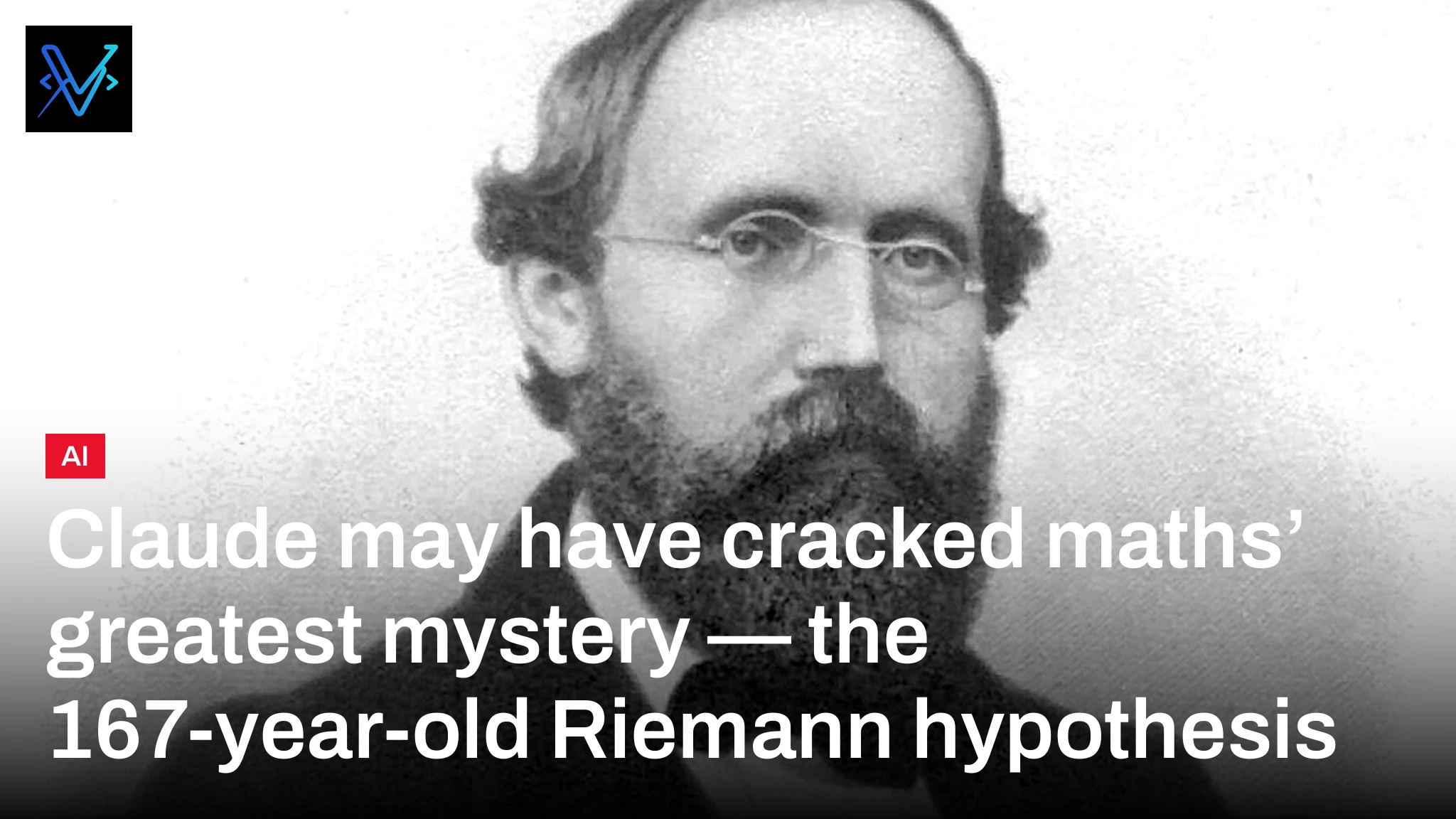
An Anthropic mathematician says he and the company's AI model Claude have proved the Riemann hypothesis — the problem about prime numbers that has stood unsolved since 1859. The proof checks out on a computer, according to independent mathematicians. But no human being has actually read it, and the $1 million prize for solving it is nowhere near decided.
KEY POINTS
- Levent Alpöge, a mathematician at Anthropic, announced on Friday, November 20 that he and Claude had proved the Riemann hypothesis — and says the same method settles the broader Generalized Riemann Hypothesis.
- On November 21, the Lean and Mathlib communities certified the formal proof, and MIT's Andrew Sutherland independently compiled all 175,187 modules with zero errors. The Clay Mathematics Institute still lists the problem as unsolved.
- The proof exists only as about 17 million lines of computer code. Written out, Alpöge says it would run to more than 250,000 pages — and he admits he does not yet fully understand parts of it himself.
What was announced on Friday
Levent Alpöge posted a four-page note on his personal website on Friday, November 20. One sentence in it travelled around the world within hours: "I believe I have, working with Claude, discovered a proof of the Riemann Hypothesis."
There is no ordinary paper. Alpöge released the proof only as code, written in Lean — a programming language built so that software can check a mathematical argument line by line. It ships as about 17 million lines of Lean code, split across 14 archive files. He says the same method also resolves the Generalized Riemann Hypothesis, a much broader version of the problem, and that the still wider Extended Riemann Hypothesis may follow with more time.
By Alpöge's own account, this was not a case of typing "prove the Riemann hypothesis" into a chat window. He set the direction, combining ideas from a simpler setting where the problem is already solved, and steered Claude toward the right approach. The decisive stretch took 41 days, from October 6 to November 16. Near the end, he writes, "Claude far outpaced me near the finish line." He is frank about the gaps in his own command of the result: he has, in his words, little mastery of some of the mathematics involved, and parts of his note paraphrase Claude's own summaries.
The problem that has guarded the primes since 1859
Prime numbers — 2, 3, 5, 7, 11 and on — look scattered at random along the number line. In 1859, the German mathematician Bernhard Riemann suggested they follow a deep hidden order, tied to where a special function, the zeta function, equals zero. His guess: all the interesting zeros sit on one single straight line, the critical line.
Prove that, and you get the tightest possible control over how the primes are spread out. It became, as Scientific American puts it, "the North Star for the entire field of number theory." The hypothesis has been checked for the first 10 trillion zeros — every one of them sits where Riemann said it should — and still nobody could prove it holds for all of them. Riemann himself set the problem aside after what he called "some fleeting unsuccessful attempts". He died in 1866, aged 39, never knowing whether his guess was right.
The Clay Mathematics Institute lists the Riemann hypothesis as one of its seven Millennium Prize Problems, each carrying a $1 million award for an accepted solution. In the prize's history, only one problem — the Poincaré conjecture — has ever been officially solved.
The claim in numbers
| Measure | Figure | Source |
|---|---|---|
| First posed | 1859, by Bernhard Riemann | Clay Mathematics Institute |
| Years unsolved | 167 | 1859 – 2026 |
| Prize on offer | $1 million (Millennium Prize) | Clay Mathematics Institute |
| Work on the proof | About 6 weeks: October 6 – November 16, 2026 | Alpöge's announcement note |
| Size of the proof | About 17 million lines of Lean code, in 14 archives | Alpöge's announcement note |
| Written length, if printed | More than 250,000 pages | Alpöge's announcement note |
| Lean modules | 175,187 — all compiled with zero errors | MIT's Andrew Sutherland |
| Community replay progress | 108,702 of 175,187 modules (62%) as of Nov 22, 11:58 UTC | alpoge-rh-replay project |
| Zeros checked numerically before this | First 10 trillion, all on the critical line | Clay Mathematics Institute |
| Clay's requirement for the prize | Peer-reviewed publication, 2 years of scrutiny, general acceptance | Clay Mathematics Institute |
What the machines have checked — and what they haven't
This is what makes the claim different from the hundreds of Riemann "proofs" that turn up every few years and collapse within a page. Lean makes it testable: if the code builds, and the final statement really says what Riemann said, the logic is checked by machine.
Within a day, independent mathematicians had compiled the proof and reported no errors. MIT mathematician Andrew Sutherland published a verification log: all 175,187 modules compile with zero errors, and the Lean kernel replayed every module with zero rejections. Two independently written proof checkers, nanoda and con-leche, accept the full exported proof. And on November 21, the communities behind Lean and Mathlib certified the formal proof in a joint statement endorsed by the Lean FRO and the Mathlib Initiative — confirming that the proof matches the standard statement of the problem.
A public replay project has split the proof into 175,187 module tasks, with 104 volunteers rebuilding it piece by piece on their own machines. As of 11:58 UTC on Sunday, 108,702 modules — about 62% — had build or reuse evidence. No full verification receipt exists yet, and Lean's own default and paranoid kernels were still running on the full export at last report.
The checks establish that the formal proof proves the intended theorem. They do not explain the argument in a form mathematicians can read. Nobody has done that yet — including Alpöge. As of November 2026, the proof is not yet fully understood by mathematicians, and a plain-language version has yet to be published.
The first reactions mix awe and caution. Brian Conrey, a leading specialist on the Riemann hypothesis, told AFP: "It's a monumental moment in human history. It's really the biggest thing I think that's ever happened in mathematics." He added that he had not yet seen a manuscript, only the remarks Alpöge posted on his website. Sutherland called it "a human triumph, and a day for celebration". James Maynard described the proof, if correct, as "a historic milestone". Terence Tao, in a preliminary review, said the proof "appears to use the full power of modern developments on the Langlands program and arithmetic geometry."
Others are holding back. Andrew Granville criticised the clarity of the four-page document and its timing. Maksym Radziwill noted the lack of human understanding in the formalisation, in contrast to what a traditional mathematical proof is expected to be.
The timing question
The announcement came the day after Anthropic's record stock market debut. The company priced its shares at $83 on November 18, opened at $111.50 on the Nasdaq on November 19, and closed up 17% at $97.17 — a first-day valuation of about $1.76 trillion. The shares fell back on their second day, as Friday's market rout erased the Nasdaq's gains for the whole of 2026.
Alpöge says he messaged Anthropic chief executive Dario Amodei about the result late on Sunday, November 15, and consulted him before announcing. He acknowledged that the timing could be viewed cynically, and called that reading false. Anthropic itself had not commented when the claim was first reported. The scepticism is understandable: a proof of the greatest unsolved problem in mathematics, announced by an employee of a newly listed AI company the morning after its IPO, is either the best-timed announcement in the history of science — or a coincidence that will fuel arguments for years.
There is also a trail. In August, Anthropic said an unreleased version of Claude had raised the known share of the Riemann zeta function's zeros proven to follow the predicted pattern from 41.6% to 67.2% — while stressing, explicitly, that it had not proved the hypothesis. In July, Alpöge posted a Claude-generated counterexample to the Jacobian conjecture, an 87-year-old problem in algebraic geometry. The Riemann hypothesis, he says, had been his secret goal since his student days.
A rival proof, the same day
Hours after Alpöge's announcement, Stanford University mathematics professor Ravi Vakil said a postdoctoral researcher in the same department had independently submitted a proof of the hypothesis. Neither Vakil nor the researcher immediately responded to requests for comment, and no details of that proof have been published yet.
The claim also lands two months after OpenAI said one of its AI models had solved another Millennium Prize Problem — the equations that govern how fluids move. Mathematicians say that proof appears correct but has yet to be fully vetted. If both claims hold up, two of the seven Millennium Problems will have fallen to AI in the same season — a sentence nobody in mathematics would have written a year ago.
Why it matters — and what it doesn't do
If the proof holds, the consequences inside mathematics are enormous. Hundreds of results are written as "if the Riemann hypothesis is true, then…" — and those would become theorems. As mathematician James McKee put it: "There are numerous results that are conditional on the generalised Riemann hypothesis, and now those are theorems!" Hector Pasten, of the Pontifical Catholic University of Chile, said that if it is correct, it completes a dictionary between branches of mathematics — "something like a Rosetta Stone."
What it does not do is break the internet. Prime numbers are the foundation of the encryption that protects online banking and private messages, and a proof of the Riemann hypothesis sharpens our understanding of how primes are distributed. But it does not crack encryption, and as Scientific American put it, it "won't upend global banking or make the internet run faster." The prize here is knowledge, not a weapon.
The bigger story may be what it says about AI itself. A year ago, AI models stumbled on college mathematics. Now one may have helped settle the question that defined number theory for a century and a half. Sutherland once told Scientific American: "An AI that can prove the Riemann hypothesis is not one I'd want to meet." Today, he calls the result a human triumph.
What to watch next
Four things will decide how this story ends. First, the community replay: whether every one of the 175,187 modules builds, and whether the final kernel checks complete without a rejection. Second, the human part: Alpöge says he plans to write up the argument properly, and mathematicians led by Tao are now trying to understand what Claude actually found. Conrey expects simpler proofs to follow: "there will be simpler ways to do it." Third, the Stanford rival proof — whether it appears, and whether the two proofs agree.
And fourth, the Clay Mathematics Institute. Its rules require a solution to appear in a qualifying publication, remain available for at least two years, and gain general acceptance in the mathematics community before the prize is even considered. Its website still lists the problem as unsolved. Even in the best case, the $1 million is years away.
Alpöge ends his note on the same mix of loss and wonder that runs through the whole announcement. The problem that guided his career may be gone, he writes — but what he saw during the work "so amazed me that I believe it is one dawn across science of something far greater." Checking the code should not take long. Understanding what Claude found may take mathematicians much longer.
Looking to grow your business online? Explore Vertex Agency at vertexagency.in for professional website development, Meta Ads and social media growth.
Sources: Phys.org (AFP) — Anthropic researcher says he and Claude proved the Riemann hypothesis, first posed in 1859; tbreak — Claude-assisted Riemann hypothesis proof passes Lean checks; EMSI — 167 Years Unsolved. An Anthropic Mathematician Says Claude Just Cracked the Riemann Hypothesis; Wikipedia — Riemann hypothesis; Clay Mathematics Institute — Riemann Hypothesis. Photo: Portrait of Bernhard Riemann, 1863, public domain via Wikimedia Commons.