Chinese stocks posted their biggest one-day gains in more than two years on Friday after Beijing promised a bigger role for its “national team” — the network of state-backed funds that buys shares when the market falls. The “national team” is not a team at all: it is a loose group of state investors, led by a fund called Central Huijin, that steps in as buyer of last resort — and on Friday, the mere promise that it would do more was enough to lift the whole market.
KEY POINTS
- The Shanghai Composite rose 3.7% and the blue-chip CSI 300 gained 4.2% on Friday — their biggest daily gains since October 2024 — while the tech-heavy STAR 50 jumped 15% and a semiconductor index soared 19%, a record single-day gain.
- The trigger was a State Council meeting chaired by Premier Li Qiang: state media said capital markets were “crucial” to the broader economy and that Central Huijin would step up as a quasi-stabilisation fund to “ensure ample liquidity”.
- The catch: the team buys shares, it does not fix the economy. Weak demand, a property slump and trade tensions remain — and analysts warn a policy-driven bounce is not the same as a durable bottom.

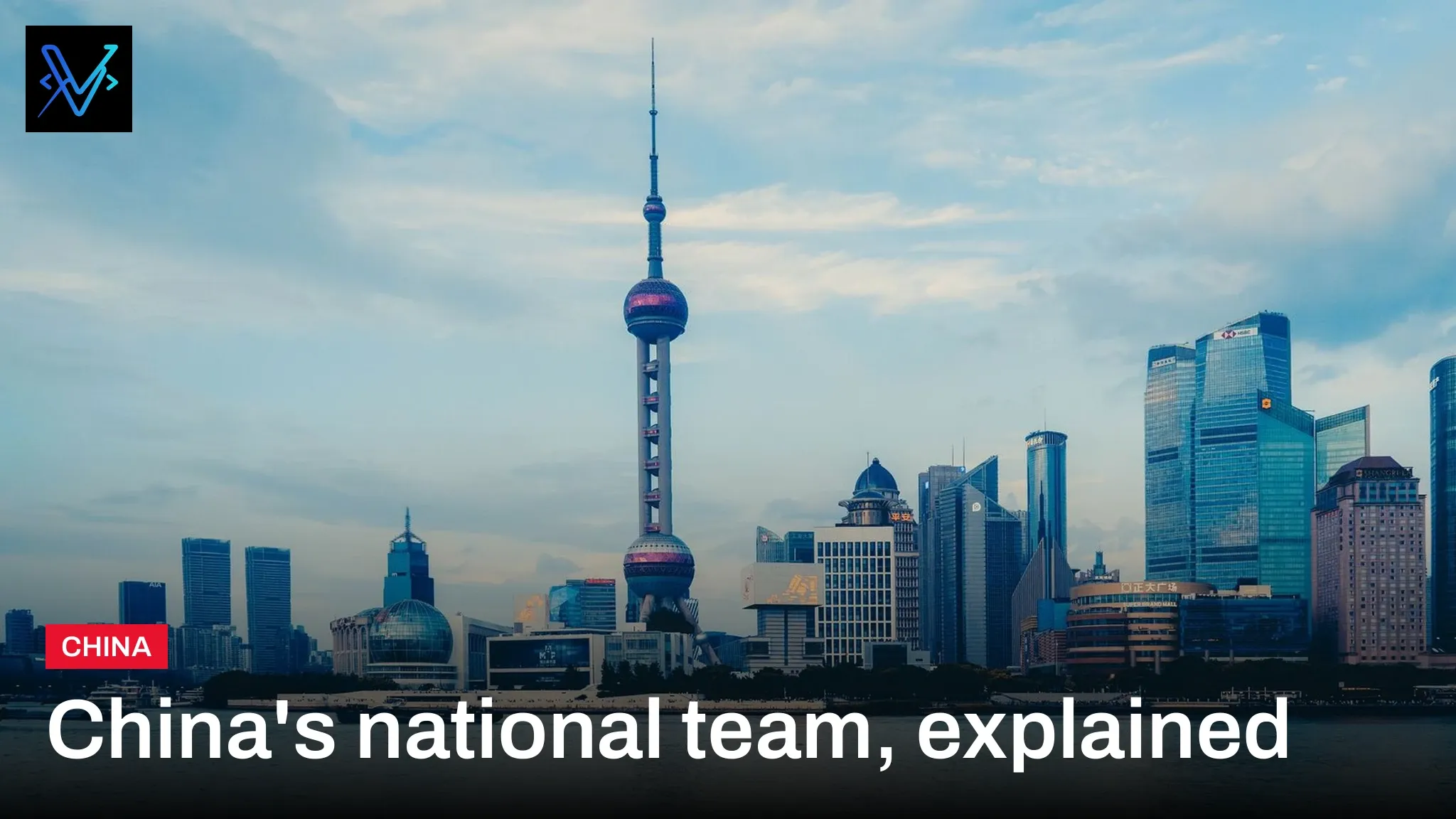
Shanghai’s Lujiazui financial district, home to the Shanghai Stock Exchange. (Photo: Blackcurrant Great / Pexels)
What is China’s “national team”?
It is the name traders have given to a loose collection of state investors who buy shares at times of stress. The principal actor is Central Huijin Investment, a subsidiary of China’s sovereign wealth fund, China Investment Corporation. Huijin controls the key intervention vehicles, including Huijin Asset Management and, since 2025, China Securities Finance, and the People’s Bank of China provides liquidity support when necessary. Other state-backed institutions join in as well.
The team’s mandate is to stabilise prices, restore investor confidence and prevent disorderly market declines. Its members are not classic profit-maximising investors; they are stabilisation agents. Beyond the immediate rescue, they aim to enforce a more controlled market trajectory — reducing volatility, preventing panicked sell-offs, but also discouraging speculative rallies.
China has one because its market is unusually jumpy. High turnover and heavy retail participation make trading sentiment-driven, and with a property downturn, deflationary pressure and subdued domestic consumption already weighing on the economy, Beijing treats a falling stock market as a threat to confidence itself — not just to investors’ portfolios.
Why did Beijing reach for it now?
Chinese stocks have been sliding relentlessly since July, on worries about weak consumer demand, the prolonged property downturn and the risk that trade tensions threaten exports — the economy’s one bright spot. The day before Friday’s rally, the CSI 300 was trading at its lowest since June 2025, down 13% for the year and on track for its worst annual performance since 2022. The tech-heavy STAR 50 and ChiNext indexes had slumped roughly 50% since July.
AI stocks have suffered the sharpest declines, first on stretched valuations and then on US chip export restrictions. This week, Donald Trump also proposed tariffs of up to 40% on goods from 14 countries, including China. State funds have been buying stocks since October, but as XTB’s morning note put it, their interventions had so far “merely managed to slow the rate of decline”.
Friday’s statement was different because of where it came from. “Giving this message from the very top level … it is an attempt to re-instill some confidence, stabilise liquidity and stabilise the trajectory of the market,” Winnie Wu, head of Asia equity strategy at BofA Global Research, told Reuters. The cabinet also called for better policies to encourage long-term funds to invest in shares, relaxed margin lending rules, and said regulators would tighten rules on share sales by controlling shareholders.
“It’s a shot in the arm for markets,” said Kenny Ng, a strategist at Everbright Securities International in Hong Kong. “Sentiment has been downbeat for so long. There hasn’t been much good news to trade on. At least now there’s something to count on: the national team will come to the rescue if things really turn south.”
Friday’s rally, in numbers
| Market | Friday’s move | Why it stood out |
|---|---|---|
| Shanghai Composite | +3.7% | Biggest daily gain since October 2024 |
| CSI 300 | +4.2% | Biggest daily gain since October 2024; at its lowest since June 2025 the day before |
| STAR 50 | +15% | Biggest one-day jump in two years |
| Semiconductor sub-index | +19% | Biggest single-day gain on record |
| Hang Seng | +2.1% | Hong Kong followed the mainland higher |
| Hang Seng Tech | +6% | Tech led the rally across the region |
| Chinese yuan | Gained | Near its firmest level against the dollar in four years |
The rally spread beyond China. South Korea’s Kospi jumped 4.3% on reports Seoul is considering expanding its own market stabilisation fund. China’s support was also one of the engines behind Friday’s global market rebound, as US futures surged and European stocks rose on the same morning.
How does the intervention actually work?
When the team intervenes, it buys shares and exchange-traded funds through institutions such as Central Huijin. It strongly prefers ETFs over individual stocks — they deliver market-wide support fast and at scale — and large caps over small caps, which offer greater liquidity and let it defend the companies that anchor the economy. UBS found that 76% of the team’s ETF purchases in early 2024 went into CSI 300 funds.
The buying is often concentrated near the close. During the 2015 crash, Reuters found most suspected state purchases occurred in the final 30 minutes of trading, and a similar surge in ETF volumes appeared in the final hour on 23 October 2023, when Central Huijin is confirmed to have traded. Late buying props up closing index levels, forces short sellers to cover and leaves investors with a better impression of the day.
Just as important is what the team does not say. The exact decision-making is not publicly explained and the amounts deployed are not always disclosed. Some trades are confirmed — usually when the aim is to restore confidence — and others never are. That uncertainty is itself a tool: if traders know the government might intervene at any moment, speculative selling becomes riskier even on days when nobody buys a share.
The scale is enormous. At the end of 2023, Central Huijin owned roughly a fifth to a quarter of each of the four largest CSI 300 ETFs. By the end of 2024, those stakes had risen to 70–82%. In the flagship Huatai-PineBridge CSI 300 ETF, Huijin’s disclosed share rose from 16.7% at the end of 2023 to about 70% a year later and 82.8% by the end of 2025.
Markets have a name for what Friday’s statement created: a “policy put”. By signalling that Huijin can add liquidity whenever prices slide, policymakers reduce what traders call left-tail risk — the fear of a sharp, disorderly drop. When that fear falls, the extra return investors demand for holding risky stocks falls with it, which is why the most volatile names — the STAR 50, the chip stocks — led Friday’s rally.
Has it worked before?
| When | The crisis | What the team did | What happened |
|---|---|---|---|
| 2008 | Global financial crisis | Huijin bought shares in ICBC, Bank of China and China Construction Bank | Bank shares steadied; the first state buying |
| 2015 | Month-long crash, fuelled by margin lending and forced liquidations | The government bought roughly 1.4 trillion yuan of shares — more than 3% of the market’s total value | Volatility fell and the market stabilised; the team still held over 1 trillion yuan of shares seven years later |
| Feb 2024 | Small-cap crash as quant funds unwound | Huijin announced bigger ETF holdings, starting with large caps and broadening to smaller ones | The rescue worked; Huijin ended the year owning 70–82% of the flagship CSI 300 ETFs |
| Sep–Oct 2024 | Confidence crisis after a long slide | A surge of ETF buying around a major stimulus package | The market’s biggest daily gains in years — a record Friday has now beaten |
| 2026 | The slide since July | Huijin trimmed a major CSI 300 ETF position in the first half of the year; other state funds stepped in during July; now the State Council pledge | Friday’s 4% jump — whether it lasts is the open question |
The record is genuinely mixed. Historically, the team’s buying points have often landed close to market bottoms, and shares have rebounded afterwards. But the 2024 episode also shows the limits: after the September surge, substantial redemptions followed in October and November, and the market slid again. Buying can put a floor under prices; it cannot by itself create a bull market.
Why it matters
China has the world’s second-largest stock market, so what Beijing does to it spills into global portfolios, pension funds and the Asia session that sets the tone for Wall Street’s open. The AI angle runs deeper: US chip curbs have been hammering Chinese AI stocks, and Beijing is now signalling it will defend the AI infrastructure buildout with state money. “There’s probably this awareness that AI is strategically, economically and financially very important, and they don’t want to see a big fallout in this space,” BofA’s Winnie Wu told Reuters. The semiconductor index’s record 19% jump on Friday is the market’s answer.
There is also a contrast with Washington worth noting. The same AI anxiety that has pushed the Nasdaq 100 to the edge of a bear market is being met in Beijing with a state backstop — while the US Federal Reserve looks set to raise rates in December. One government is putting a floor under its market; the other is tightening into a sell-off.
Why the rally may not last
The sceptics’ case starts with the fundamentals, which have not moved. “There is an increasingly clear signal that Chinese authorities are uncomfortable with the extent of the equity market selloff,” said Charu Chanana, chief investment strategist at Saxo Bank. “I would distinguish between a turning point in policy resolve and a turning point in market fundamentals… A policy-induced bounce needs to evolve into a fundamentally driven recovery before we can confidently call it a durable bottom.”
Intervention also changes how a market thinks. Research by Stanford University found that the government’s purchases during the 2015 crash weakened price informativeness: investors increasingly focused on what the government might do rather than on companies’ actual prospects. Prices stop reflecting fundamentals and start reflecting guesses about state support — which can misallocate capital.
Then there is moral hazard. If investors come to assume the government will always protect them from big losses, they take bigger risks. And the support creates dependence: the longer it goes on, the harder it becomes to withdraw without triggering the very selling it was meant to prevent. Supporting prices does not resolve the underlying problems — weak demand, the property slump, the tariff threat — it can only delay the adjustment.
What to watch next
First, Monday’s open. Investors will have the weekend to decide whether Beijing’s support changes a deep-seated wariness about Chinese equities, and the first full session will show whether Friday’s buyers were real or just relieved. Second, whether Huijin actually buys: the tell is in ETF creation data — unusually large numbers of new fund units are the fingerprint of state buying, and disclosures arrive only twice a year.
Third, whether long-term money follows. The State Council also called for more long-term funds in shares and for companies to raise dividends and buybacks — if pension and insurance money moves in, the floor gets much firmer. Fourth, the data: any sign that consumer demand or the property market is turning, and any fresh trade headlines, will matter more than the next statement. And watch the copycats: South Korea is already considering expanding its own stabilisation fund.
Friday’s jump was real, and so was the signal behind it: Beijing has put a floor under its market, at least for now. But a floor is not a recovery. The national team can buy shares; it cannot buy consumer confidence, fix a property slump or repeal a tariff. The question for Monday is whether investors believe the backstop — or whether they treat Friday as a very good day to sell into.
Looking to grow your business online? Explore Vertex Agency at vertexagency.in for professional website development, Meta Ads and social media growth.
Sources
- Reuters (via Duke FM) — China stocks surge most in two years as Beijing vows stronger market support (Nov 27, 2026)
- Finimize — China’s ‘National Team’ Stepped In, And Stocks Jumped (Nov 27, 2026)
- BSIC (Bocconi Students Investment Club) — The Presence of the Chinese National Team in Chinese Equity Markets
- XTB — Morning Wrap: Nasdaq rebounds from bear market threshold (27.11.2026)